
Local Government
Mayor, council debate rationale for lower water-sewer tap fees to developers
As noted in our lead story on the Front Royal Town Council’s Tuesday, May 26 meeting, public hearings on two ordinance amendment proposals drew some discussion prior to a vote.
The first of those two was an altered motion on water and sewer rates and lowering tap fees for new development into the Town’s central water-sewer utilities. Mayor Eugene Tewalt temporarily gave up the meeting’s presiding officer role to Vice-Mayor William Sealock so that he could add comments into the public hearing record.
The mayor then explained his understanding of development of the tap fee and water-sewer rate discussion in recent months leading up to the night’s vote.
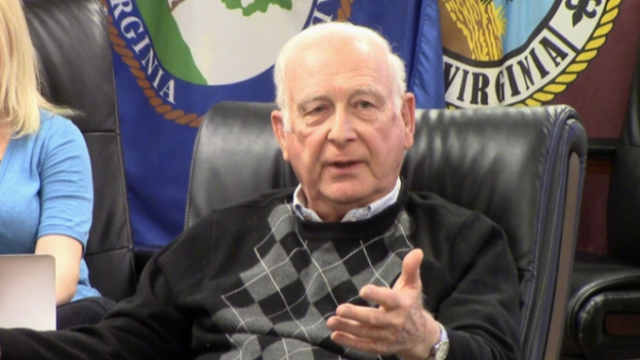
Vice-Mayor Sealock took over the meeting gavel, so Mayor Tewalt could express his concerns during the public hearing on the evolution of the recommendation on new water-sewer rates and tap fees. Royal Examiner File Photos
“Six months ago or thereabouts, we decided that the Town would install the water and sewer taps at the Town’s expense, which when we found out in talking to the person who had been doing that, it was about an $8,000 cost that the contractor or developer was paying to that individual that was doing that,” Tewalt recounted, observing, “So when we took this over, that’s $4,000 dollars for water and $4,000 for sewer to that developer,” that the Town would appear to be absorbing facing the proposed tap fee decreases on the table.
Tewalt continued to cite numbers indicating that lost revenue it appeared to him Town citizens would eventually be absorbing in higher water-sewer rates to meet an apparent revenue shortfall.
“That would equal to $12,127 that the town taxpayers are going to have to absorb somewhere … in order to cover these costs,” Tewalt told council.
A check of the 34 pages of related ordinance material in the agenda indicated large, across the board reductions to the “system development fees” (formerly known as connection or “tap” fees) ranging from $21,938 down to $12,217 to connect a sewer line to a 1-inch water meter; and from $1,464,450 down to $1,294,967 to connect a sewer line to 12-inch water meter.
Also indicated was a slight monthly increase in the base residential sewer rate for under 3,000 gallons usage per month from $16.17 to $16.74 and above 3,000 gallons usage from $13.91 to $14.40 monthly. That increase apparently holds to the water-sewer rate study consultant Stantec’s recommendation of a 3.5% sewer rate hike to cover system costs. Tewalt also noted that council had decided to defer the recommended 2% water rate increase to the next fiscal year cycle (FY-2022).
That led the mayor to predict a likely 4% increase for citizen water rates next year, or more if the “tap fee” reductions were included with the Town’s continued responsibility to make those connections for developers.
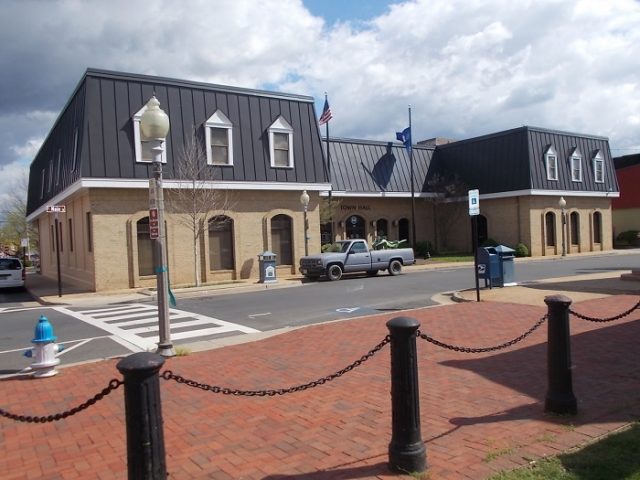
Over six months of evolving discussion of the water-sewer rate study, initially face to face in Town Hall and eventually largely by remote hook up, some confusion has developed about how recommended new water-sewer rates and connection fees were arrived upon.
“And this just doesn’t make a whole lot of sense to me at this point,” the mayor concluded of having the Town perform the connections for developers at reduced rates to be absorbed by taxpayers. However, it would take a while to determine exactly what was on the table and how it was arrived at.
As Tewalt concluded, Vice-Mayor Sealock asked Acting Council Clerk Tina Pressley if any public comments had been submitted for the public hearing. There were none, Pressley responded. So, Sealock then closed the public hearing and handed the presiding officer’s gavel back to the mayor.
Tewalt then asked for a motion. Meza responded by reading the motion originally printed for the agenda. “I move that Council affirm on its first readying an ordinance amendment to Town Code Chapter 134 pertaining to the increase of sewer service rates and the decrease of water service rates and system development charges for both sanitary sewer service and water service, as presented.” It would later be necessary to re-read the motion, deleting the reference to a reduction in “the water service rates”.
Following Chris Holloway’s second and the mayor’s call for any further discussion, Meza said, “I have a couple clarifying comments that I’d like to try to understand.” He then referenced the several months of conversation about the tap fee rates, observing that eventually, “council started moving in a rapid direction, a rapid pace to reducing those fees …”
Meza indicated it was his understanding council was moving in the direction of consultant Stantec’s recommendations.
“So Mr. Tederick, did Stantec take into account the fact that we would be doing our own installation on the tap fees?” Meza queried the interim town manager.
That led to Tederick’s introduction by remote connection of Stantec representative Andrew Burnham. In introducing Burnham to the virtually-conducted meeting conversation, Tederick noted, “I would be very delicate in how I address your question,” perhaps addressing Meza, “because it might be best to have the answer in a closed session due to potential legal matters.”
However, the conversation and Burnham’s input continued in open session.
Tederick prefaced Burnham’s entrance to the conversation with some topic history: “In 2010 when the study was last done and the rates were set … the Town was conducting the connections. Since that time the Town stopped conducting the connections but continued to keep the rate at that higher rate. The rate that is being assessed today does not include the cost of material or labor, or the fact that the developer or the builder will have the ability to go out and put the connection in himself. So, in our opinion it’s very as Stantec presented it; it was just a very fair and transparent way of conducting business.”

Did it seem to be easier for council to communicate when they were all in a room together?
Meza said he respected the mayor’s concerns, but remained confused as to how council developed varying opinions on where the new rates should be set, adding, “And now it seems there’s concerns that its actually fallen short and we won’t be able to cover (our costs) and that will fall on our taxpayers. So, I guess my question to Stantec would be did we evaluate this appropriately to take into consideration all the additional costs, so that two years out we’re not going to have to artificially inflate our rates in order to be able to sustain the program?”
Enter the consultant
“The short and the quick answer to that is, it was taken into account,” Stantec’s Burnham said to enter the conversation. He then elaborated.
“Specifically, when we went through a presentation … it was a summary of our analysis that was done using the history of accepted methodologies in allocating costs. So, we wanted to make sure that your rates or the base charges and amounts of water used would cover your ongoing costs of operations and maintenance, renewal and replacement expenses.
“And that the system development charges (formerly known as connection/tap fees) would cover the initial cost of system capacity proportionally from all new connections; and that the cost of actually making the connection, the installation and the taps – those would be done separately based on actual costs for labor, materials to make the connection.”
Following some additional input by council, Tederick told Mayor Tewalt, “The Town under the new ordinance, will not be paying for the actual labor or materials. So, the labor and materials are being passed on to the builder, or the builder could decide to go out and provide his own connections. So, in no way is the town taxpayer paying for that.”
Tewalt responded that if that was the case, “I have no problems with this,” adding he thought Stantec had “done a great job”. However, the mayor re-expressed his concern that at some point in the evolution of the ordinance amendment discussion council had agreed that Town crews would be involved in future new development connections.
“My understanding was that council said we’d be doing the installation free of charge, without any cost to the contractor. If I’m wrong, then accept my apologies,” the mayor said after nearly 15 minutes of discussion with several expressions of confusion over how what was on the table had been arrived at.
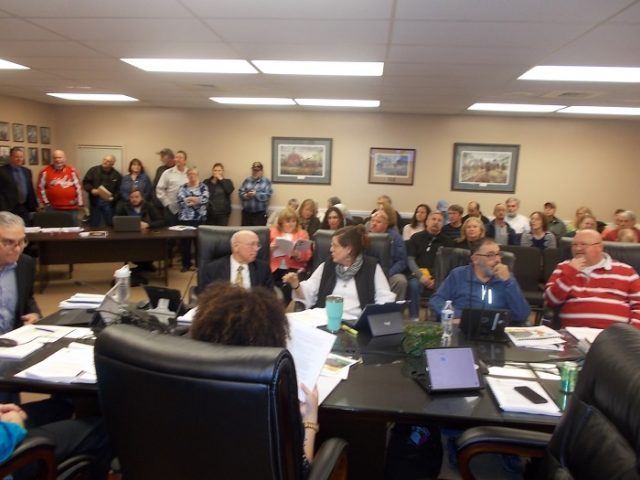
Is it just me, or were meetings and work sessions more fun prior to the pandemic restrictions on social distancing? – Perhaps again soon, to some extent.
Vice-Mayor Sealock observed that he believed that a past failure by council to adjust the utility rates as costs to provide the service increased had created ongoing issues the Town as now trying to catch up with as the tap fee discussion continued.
“The rates not being changed over an extended period of time had a definite effect on the sewer charges. So, I want to bring that up – they’ve been running in a deficit for a long period of time,” Sealock noted.
After the clerk pointed out the motion wording change regarding removal of a reference to “decreased water service rates” Meza read the corrected motion, again seconded by Holloway. The motion then passed by a unanimous roll call vote.
The second and binding reading will occur at council’s next meeting in two weeks.
Hear the whole discussion, along with council’s other business conducted, in the linked Royal Examiner recording of Tuesday’s remotely conducted meeting:


Virginia Joins Multi-State Lawsuit Challenging Trump’s Election Order

Trump Budget Seeks 43% Boost in Defense Spending, Cuts in Many Domestic Programs

Virginia Sees 33,000 ACA Enrollment Drop Since Subsidies Expired, More Likely on the Way

Annual Dental Checkups and Cleanings: Essential Appointments

4 Stimulating Activities for a Healthy Brain After 50

The First Amendment: America’s Unique Foundation of Freedom

How to Tackle Credit Card Debt

Summer Enrichment Camp Gives Teens Hands-On Learning Opportunities

VDOT: Warren County Traffic Alert for April 6 – 10, 2026

David Silek to Remain in Chairman’s Seat of WC Republican Committee Pending 6th District Appeal Decision

Sales Set to Bloom Like Daffodils This Spring

America 250: The Bookseller Who Helped Save the Revolution

Business Growth Series: Why Good Businesses Still Struggle to Grow

Brownies with Mini Chocolate Easter Eggs

Shenandoah Downs Opens 11th Season April 11 with Tribute to Roger Hammer

We Don’t Know Everything About DNA

How PAAS Came to Dominate the Easter Egg Dye Tradition

Spanberger Signs Bipartisan School-Safety, Student Support Bills Into Law

Melanie J. Pomeroy (1958 – 2026)

David Benjamin Heller (1990 – 2026)
1776 Wasn’t Just About Independence

Three-Tiered System for Urban Agriculture Based on Lot Size Takes Shape at Town Planning Commission Work Session

Child Abuse Awareness Month Brings Focus to Reporting, Prevention in Warren County

National Dental Hygienists Week: Is Your Oral Care Routine Optimal?
