
Interesting Things to Know
Two Churches: Stephens City United Methodist Church and Orrick Chapel
John Wesley was an English theologian and evangelist, who led a revival movement within the Church of England known as Methodism. The separation of the American colonies from England in 1783 led John Wesley to plan for the ordination of his own ministers. Until 1784 the Methodists were a society within the Church of England and not an independent communion. It was the American Revolution that made a separate organization unavoidable. Wesley responded to the shortage of priests in the American colonies due to the American Revolutionary War by ordaining preachers for America with the power to administer the sacraments. This was a major reason for Methodism’s final split from the Church of England after Wesley’s death in 1791.
In 1784 at the Christmas Conference in Baltimore, the “Methodist Episcopal Church in the United States” was formed and Francis Asbury was consecrated one of its two superintendents. Six months before this, Asbury had preached here in Stephens City for the first time. Following this, according to Asbury’s Journal, he had come back sixteen or more times. But on his first visit, he had been far from pleased with the “society” in Newtown (Stephens City). He wrote: “I raged and threatened the people.” But the next time he came, in August 1790, the tone was different. “Here,” he wrote, “They have built a spacious chapel.” Again, in April 1810, he wrote, “I preached at Newtown; we were crowded.” This is a flourishing little place, and we have a beautiful little chapel.”
In 1802, Market Street Methodist Church in Winchester, assigned to the Baltimore Conference, reported 280 White and 128 Black members. By 1830, there were 731 White and 225 Black members. Eventually, a small brick chapel called Cork Street Methodist Church was built around 1844 by Market Street for the [colored] people and was in good order and free from debt. Later in 1857, a larger all brick church with gas lighting was established by the African-American members of the Market Street Church on the same site. The church was called John Mann Methodist Episcopal Church, named after John Mann who was known as the founder of Methodism to African-Americans of Winchester. At this time free Blacks in Virginia and throughout the South followed local regulations which required white supervision regarding black meetings and black preaching. John Mann, who pastored his own church on South Loudoun Street, apparently took responsibility for providing the required supervision.
In Stephens City, early converts to Methodism most likely included African-Americans. When Bishop Asbury preached in Winchester in the mid-1780s, he noted the presence of both Whites and Blacks among those who came to hear his sermons. African-Americans, both male and female, began their adoption of Methodism as soon as it was made available to them and were an early and integral part of the Methodist movement. From the late 18th century through the early 19th century, it has been acknowledged that African-American Methodists in Stephens City worshiped with Whites at Stephensburg Methodist Church on the west side of Main Street between Filbert and Locust Streets. African-Americans were attracted to Methodism and they typically formed the most religiously fervent segment of any congregation. Seating arrangements in the first log church (built in 1789) are undocumented but at some point, after the brick church was built in 1827, African-American members were assigned to the “end gallery” of the church. The new sanctuary building reflected the growth of the congregation but also a change in attitudes of the nationwide Methodist Church.
By the 1820s, middle-and upper-class families began representing a greater percentage of the congregation instead of African-American and working-class whites and the church evolved from a radical sect to a more mainstream denomination. Methodists did not originally require people to have a formal education in order to preach the Gospel but soon thereafter established colleges to train ministers. The Methodist Church began assigning resident pastors to congregations instead of itinerant preachers. In 1830 the Stephens City Methodist Church was assigned its first resident pastors, Francis Macartney and William Edmond. Many Methodists began solidifying their support of slavery and the right to determine local policy. These deviations in society lessened the feeling of social equality among loyal African-American Methodists.
It can be surmised that African-American Methodists continued to share the brick church in Stephens City with White Methodists until the 1850s when pro-slavery sentiment was growing stronger just prior to the Civil War. Records reflect that by 1858 African-American Methodists had use a separate house of worship on Mulberry Street but they remained under the supervision of the local White Stephens City Methodists. In 1858, the lot on which the church resided was owned by Gustavus Adolphus and Elizabeth White. The Whites may have rented or loaned the building to the White Methodist congregation. In 1860, John W. F. Allemong purchased the lot and then quickly sold a smaller portion of the lot to four White church trustees who were clergymen and preached at Market Street Methodist Church and Stephens City Methodist Church. The deed required the trustees to maintain the building with a stipulation that it must be used as a house of worship for members of the Methodist Episcopal Church (MEC) of the Baltimore Conference.
During the Civil War, in the fall of 1864, Union Troops supposedly dismantled the church and used the lumber to build winter quarters at Camp Russell just north of town. In 1866, Stephens City Methodist Church left the MEC and joined the MEC, South and the property reverted back to the previous owner. Allemong then resold the empty lot to five trustees from an independent African-American congregation. Sometime between 1866 and 1869, a new church was built largely through the efforts and generosity of Winchester philanthropist Mr. Robert Orrick. Orrick was an ex-slave, noted minister, evangelist, prosperous businessman, and real estate investor. Orrick became a member of the Market Street Methodist Church and in 1861 the church issued him a license to preach. During the entire Civil War, the Methodist Episcopal Church in Winchester continually renewed Rev Orrick’s certification for preaching to African-American Methodists in Frederick County. After the war, in 1866, Orrick apparently transferred membership to the John Mann Methodist Episcopal Church (MEC).
Orrick recognized the church was part of an intricate social and economic support system that sustained African-Americans in Stephens City who had to endure racial discrimination and limited ability to participate in the civil and political life of the society and state. Orrick hauled construction material to the site and contributed both time and treasure for the erection of the new chapel in Stephens City on Mulberry Street. In recognition of his contributions, the church was named Orrick Chapel. The origins of the Orrick Chapel congregation in Stephens City lie with African-Americans who converted to Methodism in the late 18th and early 19th centuries and were once members of Stephen City Methodist Church. The white framed, green-roofed, Orrick Chapel still stands on Mulberry Street, just one block from the Stephens City United Methodist Church (SCUMC).
After President Lincoln issued the final Emancipation Proclamation (1863), Stephens City African-American Methodists withdrew from the white churches in order to achieve the freedom and authority they had been deprived of since the early 1800s. Yet as the 19th century drew to a close, the white leadership of the Methodist Episcopal Church increasingly sanctioned racial segregation as a form of discrimination, a process that culminated with the imposition of racial segregation on Methodist congregations in 1936.
During the 1936 General Conference, A Plan of Union emerged that would eventually segregate African-Americans into the Central Conference and place Whites in the General Conference. However, the national church continued to discuss and debate race relations within the church. In 1968 the Central Conference that administered the African-American congregations and the General Conference that administered the white congregations merged. The April 1968 merger that created The United Methodist Church not only birthed a new denomination; it abolished a painful part of Methodist history. This new Methodist denomination began to require integration throughout the United States.
Now the difficulty of assigning pastors to the small African-American churches that could not afford a full-time pastor at that time led to SCUMC and Orrick Chapel eventually being served by the same pastor in 1971. Orrick Chapel United Methodist Church became part of a charge with SCUMC, which was then led by Rev Warren L. Reeves. After 1971, Reeves was the pastor of both Orrick Chapel and SCUMC. A plaque in Orrick Chapel honors Reeves, who remained pastor until 1977.
Due to dwindling membership, Orrick Chapel merged with SCUMC on April 1, 1991. The small number of remaining members once again began worshipping with the SCUMC congregation under the leadership of Rev Waverly G. Reames. In 1993, the Orrick Chapel property was transferred to the Stone House Foundation, an organization dedicated to the preservation of historic resources in Stephens City. The Foundation was generously endowed by a good and faithful member of SCUMC, Miss Mildred Lee Grove. The 70-seat chapel is currently undergoing a historically sensitive interior renovation.
In the late 18th century, Methodists held out the promise of racial equality but rescinded that promise in the early 19th century, enacting racial segregation and limiting opportunities for Black Methodist preachers. The 1968 formation of the United Methodist Church marked the beginning of a broad movement toward an attempt to establish church unity. The merger of the Orrick Chapel with the Stephens City UMC in 1991 is an indication of this late 20th-century development.
In 2003, the SCUMC 1966 educational wing was demolished to make room for an improved, completely accessible, 19,000 square foot addition. To honor Rev Robert Orrick and the Orrick Chapel congregation, the SCUMC Church Council dedicated the new educational wing as Orrick Chapel Fellowship Hall.
SCUMC and Orrick Chapel’s history reflects the evolution of American Methodists’ attitudes towards culture and race over a period of 200 years. Records indicate that both Whites and Blacks in Frederick County, VA worshipped together in 1790 and two hundred years later, Whites and African-Americans from SCUMC and Orrick Chapel began worshipping together again. Rev Reames experienced this notable unification.
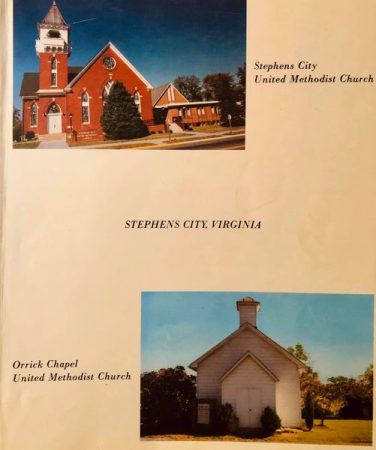
1987 Stephens City United Methodist Church Directory cover page. Contributed by Pam Barley
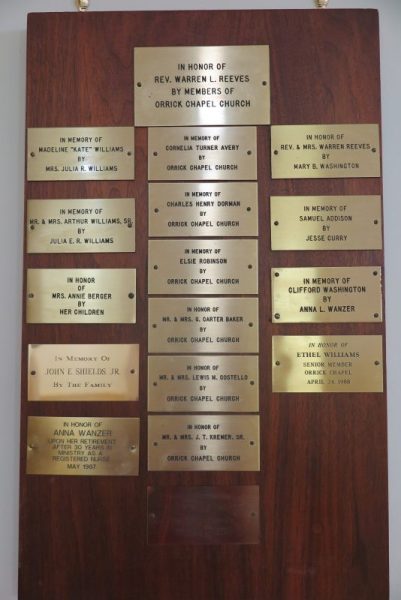
Orrick Chapel Plaques honoring Rev Warren L. Reeves and various church members. Bottom plaque reads, “In honor of Mary B. Washington by Orrick Chapel Church.” Courtesy Stone House Foundation.
Conclusion: Because Pentecost celebrates the outpouring of the Holy Spirit from heaven on human flesh, Pentecost is a season of evangelism and outreach, as Christians become empowered to proclaim the gospel of the risen Christ to all people on earth. At the Feast of Pentecost, the Holy Spirit overpowered the barriers of culture and race for now all believers in Christ Jesus were emboldened to go out into the world and become His witnesses. Many believe it was Holy Spirit intervention that held the newly formed United Methodist Church accountable in its commitment to reject the sin of racism in every aspect of the life of the church.
Note: Reference sources of information on the early years of the African-American Methodism is “The Market Street UMC: Methodism in Winchester, Virginia, 1772 to 1953, a history,” dated 1985, by Mary Katherine Kern, “History of Orrick Chapel Methodist Church in Stephens City, Virginia,” prepared by History Matters LLC, dated 2006 and “A Will to Choose, The Origins of African-American Methodism,” by J. Gordon Melton, dated 2007.

New Version of Keytruda Speeds Up Cancer Treatment, With Help From Space

Shenandoah Rail Trail Supporters Applaud CTB Move to Purchase Corridor, Launch Public Engagement

Virginia Delegate Eric Phillips Warns of Growing Strain on Power Grid, Calls for In-State Energy Expansion

Welcoming Spring Into Your Home: A Fresh Start for the Season

Government Business Shouldn’t Require a Public Display of Patriotism

March at Shenandoah River State Park: Salamanders, Wildflowers, and Nights in Nature

Blue Ridge Care Marks 45 Years, Highlights PACE Program That Helps Seniors Stay at Home
Why Trump’s Election Rhetoric Is So Dangerous

Road Rage Incident on February 20 Results in Shots Fired, Arrest

2026 Congressional Art Competition Opens for Virginia’s Sixth District Students

VDOT: Warren County Traffic Alert for February 23 – 27, 2026

Virginia State Police Recover 68 Firearms, Seize 36 Pounds of Narcotics in Weekly Operation

What Happens When We Don’t Trust Anything?

Oates Warns Against “Unconstitutional Legislation” as General Assembly Reaches Crossover

Adding a Floor Above the Garage: What You Need to Know

Trump Vows New Tariffs, Attacks Supreme Court Justices After Ruling

House Bill Gives Sex Trafficked Minors Immunity, Provides Social Services

Virginia Lawmakers Consider Civil Suits, Penalties for Masked Law Enforcement

US Supreme Court Rules Against Trump’s Tariffs in 6-3 Opinion, Dealing Blow to Trade Agenda

Ready to Unplug? Warren Coalition Challenges Community to Put Down the Phone

Other Matters of County Interest Tackled on February 17th by the Warren County Board of Supervisors

Bill to Ensure Lab Test Results Are Delivered With Maximum ‘Compassion and Humanity’ Clears House

Commentary: Halfway Through the 2026 Legislative Session, There’s Still No Consensus on Data Center Bills

Board of Zoning Appeals Sets Cap on Agricultural Pursuit in Residential Zone
