
State News
Virginia Delegate Eric Phillips Warns of Growing Strain on Power Grid, Calls for In-State Energy Expansion
Virginia Delegate Eric Phillips delivered a forceful warning on the House floor last week about what he described as a mounting strain on the Commonwealth’s electric grid, urging lawmakers to prioritize in-state, dispatchable energy generation to prevent future reliability crises.
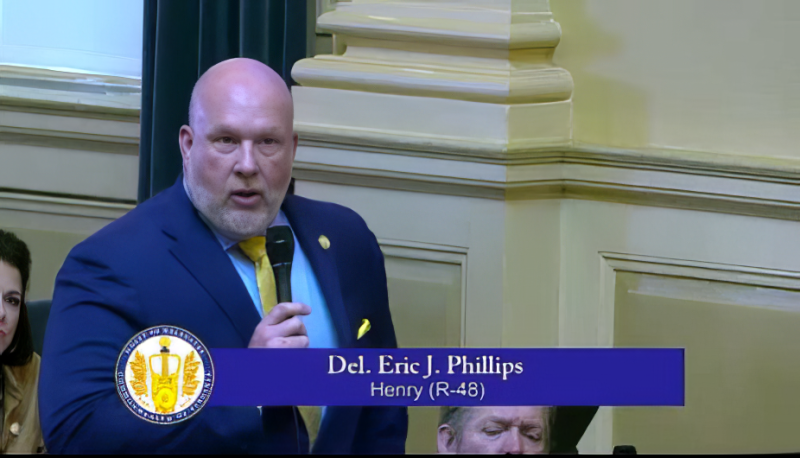
Virginia Delegate Eric Phillips
Addressing the Speaker and members of the House, Phillips said energy reliability is no longer a theoretical concern but a pressing issue affecting “every family, every business, every school, and every hospital in the Commonwealth.”
“Virginia’s electric grid is under real and growing strain,” Phillips said. “And unfortunately, we’ve made some policy decisions that are actively making it worse.”

Growing Dependence on Imported Power
Phillips pointed to Virginia’s increasing reliance on electricity generated outside its borders, particularly from West Virginia and Pennsylvania, as a growing vulnerability. Rather than generating sufficient power locally, he said, the Commonwealth is importing electricity over long transmission lines, which can lead to efficiency losses and congestion.
“That’s not energy independence, it’s energy vulnerability,” he said, noting that long-distance transmission can reduce overall efficiency and strain the grid during peak demand.
He cited recent cold-weather events as evidence of the system’s fragility, arguing that during winter storms and cold snaps, Virginia must compete with neighboring states for power.

Solar Performance During Winter Weather
Phillips criticized reliance on intermittent energy sources such as solar power, particularly during severe winter conditions.
According to PJM Interconnection data referenced in his remarks, solar generation contributed little or no power during recent winter weather events. He also noted that solar facilities in his district covered with snow and ice were offline for several days.
“Solar is intermittent. It does not perform well during winter storm mornings, cloudy days, prolonged cold spells, exactly when demand is highest,” Phillips said. “That’s not ideology. It’s physics.”

He argued that while renewable energy has a role in Virginia’s future, it cannot reliably meet peak demand on its own.
Call for Dispatchable Energy Sources
Phillips advocated for constructing modern natural gas combined-cycle power plants within Virginia. He described such facilities as among the cleanest and most efficient large-scale generation technologies available, capable of ramping up quickly to meet demand and operating in all weather conditions.
“These plants provide certainty,” he said. “They don’t depend on the sun shining. They don’t depend on the wind blowing.”

He also expressed support for expanding nuclear energy, including small modular reactor (SMR) technology, and called for bipartisan cooperation to position Virginia as a leader in advanced nuclear development.
Balancing Reliability and Clean Energy Goals
Phillips emphasized that his remarks were not an argument against clean energy but rather a call for balance.
“Reliability is not optional,” he said. “You can’t run a modern economy or protect public safety and national security on best-case assumptions.”

He warned that without sufficient in-state, dispatchable generation, Virginia could face higher costs for ratepayers, limitations on economic development, and risks to critical infrastructure, including hospitals, schools, military installations, and manufacturers.
“There’s simply not enough energy to power our burgeoning economy,” Phillips said.
A Call for Bipartisan Action
In closing, Phillips referenced Winter Storm Fern as a warning sign rather than a failure, urging lawmakers to approach energy policy with practicality and cooperation.
“The grid does not care about policy targets,” he said. “It cares about supply, demand, and physics.”
He called for respectful, fact-based dialogue on the future of baseload and dispatchable energy generation, saying action must come now, not after a crisis.
“So Virginia is not left out in the cold or in the dark,” he concluded.




The Eye Surgery Factory That Could Not Expand

Ancient Ownership of Israel

VDOT: Warren County Traffic Alert for October 5 – 9, 2026

Reaching Out Now Expands Programs and Opportunities for Warren County Youth

Dance and Arts VA Finds New Home, New Opportunities on Water Street

Ann L. Shuman (1933 – 2026)

Wendy Lee Whitacre-Stout (1966 – 2026)

Spanberger’s Energy Plan Keys in on Clean Energy to Meet Growing Demand and VCEA Goals

Jean Elizabeth Grubbs Fogle (1939 – 2026)

Feds Provide Guidance on New Federal K-12 Scholarship Tax Credit Program

Why Wait Till November? Mid-Term Election Early Voting Processes in Place Now

US Senate Leaves Nation’s Capital in Advance of Midterms With Much Still Undone

Business Growth Series: If You Don’t Control Your Day, It Controls Your Business

The End of a 20-Year Monopoly on the Credit Score
Voltron and Immigration

States OK Solar Panels for Balconies. Safety Guidelines Haven’t Caught Up

Trump TV Ads Paid for with $20M in Homeland Security Funds, Dems Find

Blue Ridge Wildlife Center Patient of the Week: Gray Treefrog

Birthday Twins: See Which Famous Face Shares Your Big Day

Meet-and-Greet Set Sunday for Republican-Endorsed Front Royal Candidates

Barbara Ann Mathews Smelser (1943 – 2026)

Kathleen Frances Elar (1956 – 2026)

Happy Creek Crossing to Hold Vendor Interest Meeting Oct. 8 in Front Royal

If the Car Name Fits, Drive It
