
State News
Virginia House Democrats Advance Four Constitutional Amendments on Opening Day of 2026 Session
Virginia House Democrats wasted little time flexing their new majority on the opening day of the 2026 General Assembly, pushing through four proposed constitutional amendments Wednesday aimed at reshaping some of the state’s most consequential political and civil rights debates — including one that would allow lawmakers to redraw Virginia’s congressional map mid-decade.
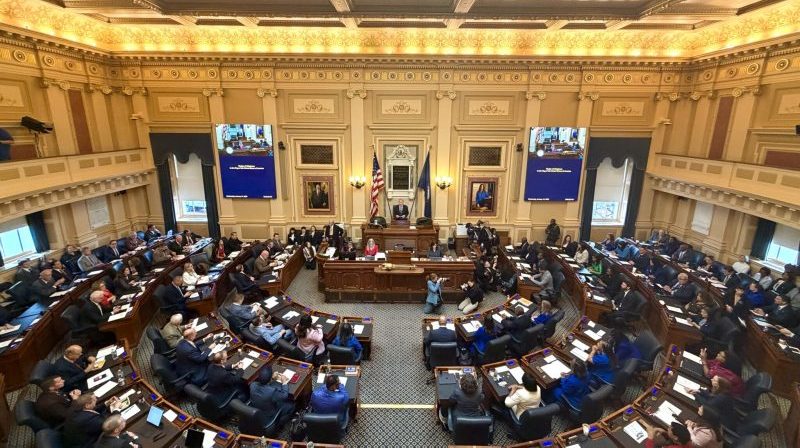
Members of the Virginia House of Delegates meet at the Capitol in Richmond on the opening day of the 2026 General Assembly session, where Democrats advanced four proposed constitutional amendments addressing abortion rights, voting rights, marriage equality and congressional redistricting. (Photo by Markus Schmidt/Virginia Mercury)
The measures, approved after clearing the House Privileges and Elections Committee earlier in the day, seek to protect abortion rights, restore voting rights for people with felony convictions, remove a defunct ban on same-sex marriage, and — most controversially — grant the General Assembly limited authority to modify congressional districts outside the traditional 10-year redistricting cycle.
All four amendments now head to the Senate, where Democrats also hold the majority.
House Democratic leaders framed the aggressive opening-day push as a response to recent national court rulings, partisan redistricting battles in other states and what they described as an urgent need to let voters — not politicians or courts — decide the future of fundamental rights.
Redistricting amendment draws fire
The most politically charged of the four measures is House Joint Resolution 4, a proposed constitutional amendment that would create a narrow, temporary exception allowing the General Assembly to redraw one or more congressional districts outside the standard decennial cycle under specific circumstances.
Under the proposal, lawmakers could act if another state redraws its congressional map mid-decade for reasons other than complying with a state or federal court order. The authority would apply only to congressional districts — not state legislative lines — and would expire in 2030.
Democrats argue the amendment is necessary to counter aggressive Republican gerrymanders elsewhere that could tilt control of Congress, while Republicans call it a blatant power grab that undermines Virginia voters’ 2020 decision to create an independent redistricting commission.
“This amendment creates a narrow, temporary exception essentially,” said Del. Rodney Willett, D-Henrico, the measure’s sponsor. He emphasized repeatedly that the proposal does not automatically redraw any lines and does not eliminate the Virginia Redistricting Commission.
“We are not expanding the authority to change the state district lines,” Willett said. “We’re just talking about congressional lines. And more importantly, it does not change any of the lines as they exist today — this just creates the process to consider doing that.”
April special election timeline
If the amendment ultimately passes the Senate this session, it would be placed on the ballot during a special statewide election in April, rather than waiting until November — a compressed timeline that Democrats say reflects the urgency of ongoing redistricting fights across the country.
“We’re going to focus on today so we’ll get that out of the House and the Senate,” said Del. Cia Price, D-Newport News, chair of the House Privileges and Elections Committee, during a news conference Wednesday morning.
“And then we are looking at a special election for a statewide referendum to have the voters have their say in potentially April. And then once that kicks in, if the voters were to give us that power, we would then be looking at a modified schedule for the primaries, and then our November elections will happen as scheduled.”
Republicans have warned that the move could open the door to dramatic changes in Virginia’s congressional delegation. Democratic leaders have openly discussed the possibility of drawing a map that would yield as many as 10 Democratic-leaning districts, leaving just one Republican-friendly seat anchored in Southwest Virginia.
House Minority Leader Terry Kilgore, R-Scott, rejected that characterization of the state.
“We’re not a 10-1 state, we’re not a 9-2 state,” Kilgore told reporters Wednesday morning. “We’re a close, 6-5 state, and some of those congressional seats are very competitive.”
Republicans have also tried — unsuccessfully — to stop the amendment in court.
A judge in Tazewell County on Tuesday rejected an emergency request from GOP lawmakers seeking to halt the General Assembly from advancing the proposal before the session began. In his ruling, the judge emphasized that courts cannot interfere with the constitutional amendment process while it is still underway.
“Plaintiffs’ motion at its core requests the Court to invade the province of the Legislature prior to the final actions of the Legislature,” the judge wrote, citing long-standing separation-of-powers principles.
The court also rejected an attempt to bypass legislative immunity by targeting legislative clerks, finding they were simply performing their official duties.
Sharp debate in committee
During Tuesday’s committee debate, Republicans warned that the amendment reverses reforms voters approved just four years ago.
“We’re using this ‘end justifies the means’ method,” said Del. Israel O’Quinn, R-Washington. He argued that the amendment was improperly introduced after the 2025 election season had already begun and pointed to social media posts showing potential maps.
“It concerns me that we’re attempting to go back to the battle days of gerrymandering,” O’Quinn said.
Democrats countered that the amendment preserves flexibility without mandating any outcome and ultimately leaves the decision to voters.
“This does not change any of the lines as they exist today; this just creates the process to consider doing that, but it does not mandate that these lines be changed,” Willett said.
Other amendments headed for November
While the redistricting proposal is expected to dominate debate this spring, the other three amendments are slated to appear on November’s ballot.
One would remove a 2006 ban on same-sex marriage from Virginia’s constitution — language that has been unenforceable since the U.S. Supreme Court’s 2015 ruling but remains on the books.
Supporters say the amendment is a safeguard should the court revisit marriage equality, something Justice Clarence Thomas suggested after the court overturned federal abortion protections.
Another amendment would automatically restore voting rights to people with felony convictions who have completed their sentences. Virginia is one of the few states where former felons permanently lose voting rights unless restored by the governor, a process critics say lacks transparency.
The third and most divisive proposal would enshrine reproductive rights in the state constitution.
It advanced last year amid emotional floor debates, shouting and a call of “out of order” in the Senate chamber, and has only moved forward because of Democratic control.
Every Republican lawmaker has opposed the abortion amendment, and GOP leaders have previously backed near-total bans or a 15-week limit without exceptions for fetal anomalies.
Since the fall of federal protections, Virginia has become the only Southern state without extensive abortion restrictions, leading to a surge in out-of-state patients seeking care.
Like the redistricting amendment, final approval of all three measures would rest with voters.
Price said the package of amendments reflects how interconnected the issues before lawmakers have become, particularly amid recent actions by President Donald Trump and Republican-controlled legislatures across the country.
“‘There is no such thing as a single issue struggle,’” she said, referencing a quote from civil rights activist Audrey Lorde. “We do not lead single-issue lives, and I feel like that is more true today, now than ever in my lifetime, because of the actions of Trump and Republican-led state legislatures.”
by Markus Schmidt and Charlotte Rene Woods, Virginia Mercury
Virginia Mercury is part of States Newsroom, a nonprofit news network supported by grants and a coalition of donors as a 501c(3) public charity. Virginia Mercury maintains editorial independence. Contact Editor Samantha Willis for questions: info@virginiamercury.com.

Brenda Jean Chrisman (1953 – 2025)

Pot o’ Gold Shamrock Hunt Returns to Downtown Front Royal for Sixth Year

General Assembly Wrap-Up: Housing Debate, Budget Battles and Pay Raise Controversy Mark Final Week

EDA, Fire & Rescue, and Building Inspections Present FY-27 Departmental Budget Requests to Board of Supervisors

Health Care Costs and Access Will Feature Prominently in 2026 Congressional Midterms

As Potomac River Advisories Lift, Public Concerns Remain After Sewage Spill

Businesses Owned By Minorities, Women Lobby to Reauthorize Federal Program

Helen Przepiorka Stuart (1921 – 2026)

How to Find a Reliable Babysitter

Amazon Pulls Back From Physical Stores — For Now

Court Accepts ‘Not Guilty by Reason of Insanity’ Plea in Godin case, Then Orders Independent Psychological Evaluations

Protect the Voice of Virginia’s Valley and Mountains

Finding Peace of Mind in Troubled Times

March Is Workplace Eye Health and Safety Month: Protecting Your Vision at Work and Beyond

Lawsuit Claims Violation of Constitutional Amendment Process, But New Law May Invalidate That Charge

‘Unprecedented Times:’ Virginia Democrats Defend Redistricting Referendum as Early Voting Begins

Petals & Pinkies Spring Tea Set for March 17 in Front Royal

Is Your Home Ready for Flooding? Simple Steps Can Help Protect Your Property

Constitution 101: The Borrowing Clause
Donald Wayne Powell (1942 – 2026)
Fairness Isn’t Just One Number

Meatballs: A Comfort Food Loved Around the World

VDOT: Warren County Traffic Alert for March 9 – 16, 2026

Spanberger Emphasizes Job Growth, Business Investment After New Jobs Report
