
Local News
Virginia Transportation Board Transfers Rail and Trail Project Amid Public Concerns
A controversial transfer of a trail project to Virginia’s passenger rail authority was pushed through by Transportation Secretary Shep Miller on Tuesday after a vote by the Commonwealth Transportation Board resulted in a 6-6 tie, drawing scrutiny of the board’s process and the project’s future.
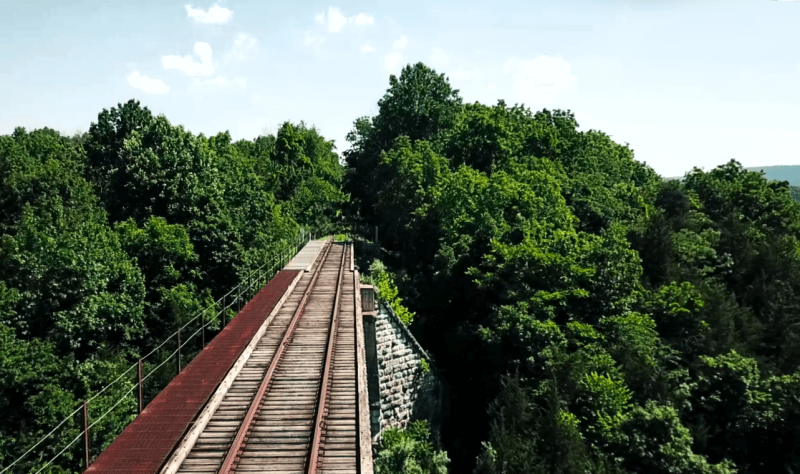
A section of abandoned freight rail is proposed to be part of a new biking and walking trail in the Shenandoah Valley. (Photo by Ben Cunningham/Allegheny-Blue Ridge Alliance)
After the board’s vote of support, the project was transferred to the Virginia Passenger Rail Authority, which will oversee $35 million in grant funding for preservation and improvements by the Shenandoah Valley Battlefield Foundation.
Events leading up to the vote drew mixed reactions from lawmakers and the public. Many questioned the cost, transparency, and feasibility of a rail-with-trail versus a trail-only project for the dilapidated, 50-mile Shenandoah rail corridor, which has been inactive for 36 years.
After the board failed to reach consensus to delay the vote, the agency’s recommended plan moved forward.
“At the end of the day, I stand by what I recommended to you, what the governor and administration recommend to you, because we think that’s in the best interest of the citizens of the commonwealth,” Miller said on Tuesday.
He said that further delay could jeopardize the project, including the planned merger between Norfolk Southern Corporation, which owns the rail line, and Union Pacific Corporation. Miller added that public input remains part of the plan.
Under the terms of the transfer, the Shenandoah Valley Battlefield Foundation would buy the rail line from Norfolk Southern. The remaining funds would be used to build the trail and meet state lawmakers’ criteria.
The agreement tasks the foundation with building the trail by certain deadlines, and gives it the authority to preserve the rail corridor for future passenger use, clarifying operational roles and risk responsibility.
For some, the vote was disappointing, as they hoped to boost the region’s economy and promote healthier lifestyles with a multi-use trail; others see more potential in restoring the Manassas Gap rail line and building a parallel trail.
During the meeting, about 17 speakers addressed the board. Some called for swift action, while others raised concerns specifically about the foundation, which is facing legal disputes over its authority to be involved in the project.
The foundation told the Mercury it will return to court in the spring to prove it did not exceed its authority in joining the rail trail project.
VDOT projections indicate a recreational trail would cost $164 million, while restoring the rail line with an adjacent trail would cost $687 million, directly influencing project feasibility and choice.
Rail supporters say those estimates are too high.
Before Miller’s decision, board member Laura Sellers had moved to delay board action until public input sessions were complete. This followed reports from board members and lawmakers that scheduled public hearings on the third and final assessment report did not occur.
“…the motion to delay and table is not to make a stand for one way or the other, is to provide time to ask these questions, to go through the study… and to allow the public comment period to take place,” Sellers said. “It’s not to choose one side or the other. It’s simply to give us more time.”
Board member Raymond Smoot Jr. supported the rail-with-trail plan and said it addresses those concerns by ensuring public input and requiring evaluation of proposals from interested groups.
“I believe that the project (can) be handled in such a way that will preserve the corridor for possible future rail use — that could be at a time that is probably unknowable today — but it would preserve that option going forward,” Smoot said. “I personally would hope that all of the groups that are interested in this project would come together and unite behind a proposal that may involve various groups, but one that will assure that this is developed as provided in the resolution.”
VPRA will be responsible for scheduling public meetings, according to the board’s resolution. No dates have been scheduled as of Wednesday morning. The agency will also be responsible for considering and evaluating any proposals submitted by “established organizations” by Feb. 15.
Proposals must include a trail alongside the rail while preserving the corridor/rail for potential future use. VPRA said it does not expect a potential rail line to be immediately developed.
CTB will vet and review the agreement and any subsequent proposals and contract terms before work begins
by Nathaniel Cline, Virginia Mercury
Virginia Mercury is part of States Newsroom, a nonprofit news network supported by grants and a coalition of donors as a 501c(3) public charity. Virginia Mercury maintains editorial independence. Contact Editor Samantha Willis for questions: info@virginiamercury.com.

Brenda Jean Chrisman (1953 – 2025)

Pot o’ Gold Shamrock Hunt Returns to Downtown Front Royal for Sixth Year

General Assembly Wrap-Up: Housing Debate, Budget Battles and Pay Raise Controversy Mark Final Week

EDA, Fire & Rescue, and Building Inspections Present FY-27 Departmental Budget Requests to Board of Supervisors

Health Care Costs and Access Will Feature Prominently in 2026 Congressional Midterms

As Potomac River Advisories Lift, Public Concerns Remain After Sewage Spill

Businesses Owned By Minorities, Women Lobby to Reauthorize Federal Program

Helen Przepiorka Stuart (1921 – 2026)

How to Find a Reliable Babysitter

Amazon Pulls Back From Physical Stores — For Now

Court Accepts ‘Not Guilty by Reason of Insanity’ Plea in Godin case, Then Orders Independent Psychological Evaluations

Protect the Voice of Virginia’s Valley and Mountains

Finding Peace of Mind in Troubled Times

March Is Workplace Eye Health and Safety Month: Protecting Your Vision at Work and Beyond

Lawsuit Claims Violation of Constitutional Amendment Process, But New Law May Invalidate That Charge

‘Unprecedented Times:’ Virginia Democrats Defend Redistricting Referendum as Early Voting Begins

Petals & Pinkies Spring Tea Set for March 17 in Front Royal

Is Your Home Ready for Flooding? Simple Steps Can Help Protect Your Property

Constitution 101: The Borrowing Clause
Donald Wayne Powell (1942 – 2026)
Fairness Isn’t Just One Number

Meatballs: A Comfort Food Loved Around the World

VDOT: Warren County Traffic Alert for March 9 – 16, 2026

Spanberger Emphasizes Job Growth, Business Investment After New Jobs Report
