
Local News
On the road again – 75 miles from Front Royal to the beaches of Dunkirk
After reporting on two epic trips to Europe (“London…city under siege”) and Alaska (“High drama on the high seas…), our contributing writer Malcolm Barr Sr. seemed disinclined to write a piece on his latest journey, a 150-mile round trip from Front Royal to Fredericksburg to report on a return to Europe – sort of.

The Barrs, Junior and Senior, in front of Big Ben on recent trip to Britain
Barr was meeting his son, Malcolm Junior, at a midway point – Fredericksburg – to see the movie “Dunkirk”. Between Barr Senior having real-life memory of the plight of British forces backed up against the sea on the Belgian-French beaches by German forces during World War II and Barr Junior’s recent retirement from military service, it seemed like a thing to do – and a human interest-historical perspective-blockbuster movie thing worth reporting on. So, into the breach this soldier, I mean reporter, went.
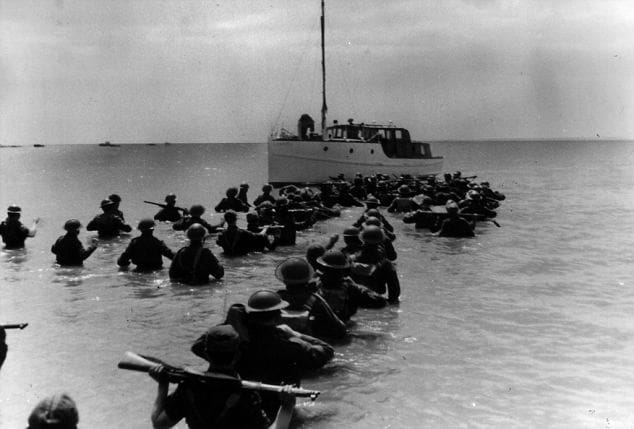
Above, a photo from the real evacuation onto one of the little ships to the rescue; below a movie promo shot of the same. Public Domain war photos & online movie promo shots

Malcolm the younger, who is now doing civilian intelligence work at Langley AFB, shares a keen interest in WW II with his dad. To illustrate, the pair met up in Normandy a couple of years ago, Barr Jr. from a U.S. Air Force base in Germany, dad from his Rockland home in northwestern Virginia. The father-son duo met on the Northern France beaches for the 70th anniversary of the D-Day invasion that spelled the beginning of the end of the western front war in Europe.

Churchill’s war room in London – Photos/the Barrs
More recently as Royal Examiner readers will recall, they visited Prime Minister Winston Churchill’s “war rooms” in London from which the British prime minister directed Great Britain’s forces in the battles for Europe. Barr Sr., at 84, has childhood memories of WW II (1939-45) in Europe along with personal memorabilia he kept from the period.
I idly asked “how was the movie” on Barr Sr.’s return. A worrisome silence – then, “As a cinematic epic, it was awesome; otherwise it didn’t, in my mind, get the story across of how hundreds of ‘little ships’ were largely responsible for evacuating many of some 300,000 allied troops trapped by Germany’s armies, thus preventing Germany from winning the war as early as 1940. And maybe that is just impossible to do given the magnitude of the Dunkirk rescue operation,” Malcolm Sr. relented somewhat of his criticism of the movie’s failure to tell its base story.
“Think of thousands of soldiers jammed together on a French beach, withstanding daily air attacks, bombing and strafing, and nowhere to go with the ocean at their backs, England about 20 miles away, their comrades behind them fighting a losing battle against the advance of German ground troops.”
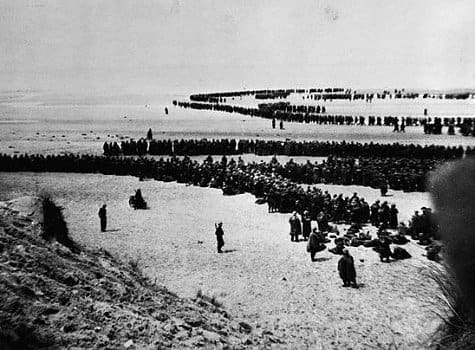
Above, thousands of soldiers with their backs against the sea; below, a small portion of the equipment left behind.


Noting that the film would soon be showing at Royal Cinemas in downtown Front Royal (it is now), and that it is already highly popular elsewhere (except, apparently, in the UK), Barr recommended that American movie goers “bone up” on this particular part of WW II history before seeing the film. “To me, and I was a kid in England when the war began, it would be hard to follow in the best of circumstances, but without prior knowledge of events that led to Dunkirk, it won’t make a lot of sense, or at best be difficult to follow.”
The “little ships” mentioned earlier that backed up the Royal Navy’s destroyers and transport ships, consisted of hundreds of weekend yachts, motor boats, and fishing vessels skippered by civilians. It was an emergency “armada” of volunteer civilians putting to sea in a national rescue operation – considering the outcome, around 300,000 soldiers being rescued from death or imprisonment not long after the war’s outset, truly the stuff of legend.

The stuff of legend – just bone up with a little background research to get the BIG picture.
“It was hard to get across in the movie, with a single example of one of these boats, how large a part the civilian volunteers played in the mass rescue of our troops; and at what cost to some of them,” Malcolm Sr. observed.
But what did the younger Malcolm, an Iraq veteran, think? I wondered. According to dad, his son agreed that the movie is a visual masterpiece, but for the average, non-military history-steeped viewer a little background research – easy enough in this age of smart phones – will help give context to what is transpiring on the screen.
And for R-MA alumni Barr the younger, whose background and interest in military history had him adequately prepped it was “a pretty good movie.”




Halloween Hazards Can Put Senior Pets at Risk, Virginia Animal Welfare Advocates Warn

Spanberger Orders Statewide Cybersecurity Plan to Address Growing Threats From Artificial Intelligence

Another Veteran’s Perspective

Warren County High School Students Help Bring Fall Fest Fun to E. Wilson Morrison Families

Rising Mortgage Rates Slow Virginia Home Sales as Housing Inventory Climbs 20 Percent

10 Tips for a Safe Halloween

Virginia Joins Governors Public Health Alliance to Strengthen Disease Prevention and Emergency Response

When Your Phone Stops Recognizing Your Fingerprint

Joan Chapman Named 2026 Valley Treasure for Bringing Women and Girls Closer to the Shenandoah River

Loss of 130,000 Trout at Virginia Hatchery Will Reduce Stocking in Warren County and 10 Other Counties

VDOT: Warren County Traffic Alert for Oct. 26 – 30, 2026

Stone Branch Offers Sugar Skull Art Workshop to Celebrate Day of the Dead

Ink & Drink Returns to Front Royal With Halloween-Inspired Printmaking Workshop

38 Years Without Answers: Family and Investigators Still Seek Justice for Tammy Thorpe

Warren County Wildcats Host Meridian Under Friday Night Lights – October 23

Community First: Jubilee Event Sees High Turnout with Public Servants in Attendance

St. John’s Drama Brings Tom Sawyer to Life in Musical Celebrating America’s 250th Birthday

Remembering the Legacy of Ditka and Da Bears

Jeffery “Jessie” David Henry (1993 – 2026)

If Passed, This Bill Would Strengthen Protections for Virginia Renters Exposed to Mold

A Dominion-NextEra Deal on Spanberger’s Terms Would Harm Ratepayers, Virginia’s Economy

Commentary: Virginia Should Do Much More To Curb PFAS Pollution In Our Waters

Virginia State Police Seize More Than $733,000 in Illegal Drugs During Weeklong Crime Suppression Operations

Business Growth Series: What Gets Measured Gets Improved
