
Local Government
Staff Seeks Alignment Between Town Code and State Code Pertaining to Derelict Structures at Town Council Work Session
On March 4, 2024, at 7 p.m. in the Front Royal Town Hall at 102 East Main Street, the Town Council met for a work session wherein their agenda items included, after coming out of closed session, a presentation about a proposed 2024-2025 budget, an ongoing discussion of an out-of-town water and septic service request, and a presentation from the planning and zoning department about derelict structures, in which staff requested a repeal of Chapter 9-303 of Town Code.

Town Council meets on Monday evening for a work session. Royal Examiner Photo Credits: Brenden McHugh.
It is better to say “derelict” than “blighted” when referring to any ongoing maintenance issues that planning and zoning want to address in Front Royal. In their address to the council, Deputy Zoning Administrator and Planner John Ware, Planning Director and Zoning Administrator Lauren Kopishke, and Property Maintenance Official Monica McClure stood together. They illustrated for the council the multiple options the town has at its disposal for rectifying issues ranging from abatement of nuisances like rodents and refuse build-up to matters of appearance like peeling paint and boarded-up windows. According to Ware, in the past, the council has made the mistake of interpreting said peeling paint, boarded-up windows, and other unsightly aspects as being descriptive of a “blighted” structure when, in keeping with the Code of Virginia, a more appropriate descriptor would be “derelict” as they do not present a safety hazard and can be addressed by the process available to the town under maintenance.
Director of Finance B.J. Wilson presents a proposed budget for the fiscal year 2024-2025 to the council.

Chapter 36-3 of the Code of Virginia defines a blighted property as well as a blighted area as presenting problems that endanger public health, safety, or welfare because they are dilapidated deteriorated or violate minimum health and safety standards. Based on this definition, Ware explained to council that they need to act quickly to repeal Chapter 9-303 of Town Code to make it align with the state code more closely. “Something that is unsightly, needs maintenance, needs painting, has windows broken out, the doors are ajar, is not blight,” Ware articulated to the council. “It has to endanger the safety and the health of the people.”
The concept of “spot blight” was discussed at length. The purpose of spot blight is to redevelop an area and provide affordable housing, which the definitions in the state code are geared to do. Meanwhile, those structures that need maintenance can be addressed by methods that do not include the process used to treat blighted structures, which might, in extreme cases, include razing the structure to the ground. “We can revisit this topic in another thirty to sixty days if you wish,” Ware said. His department currently has a reactive capacity, due to its complaint-driven process, in terms of property maintenance; a proactive capacity, from the department’s standpoint, may be desirable. “If council desires proactive enforcement,” their bullet-point reads, “additional staff will need to be provided.”

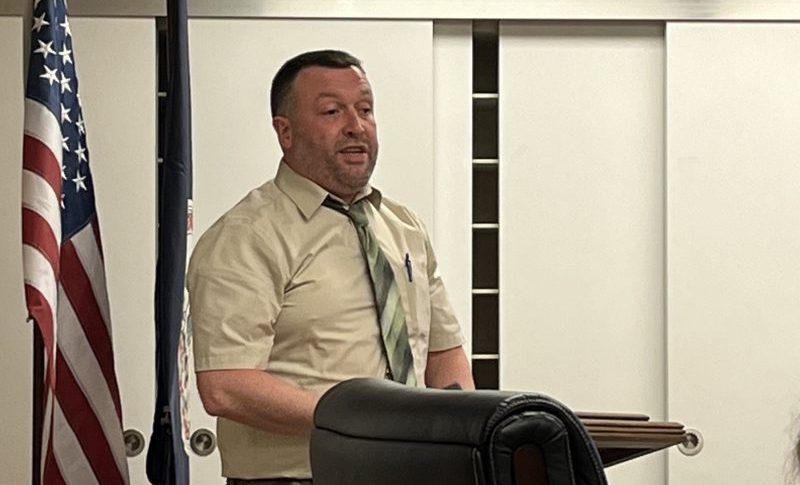
John Ware, Deputy Zoning Administrator and Planner, addresses the council about derelict structures and the need for continuity between state code and town code pertaining to those derelict structures.
“Staff has spent considerable time in the last two months to develop this process,” Town Manager Joe Waltz said. “My first objective tonight is to just educate and get everyone on the same baseline. My thought is to bring this back in about sixty days. We know the list of derelict structures that we need to address. What I would ask the council is to give us a little time to put that list together and maybe take one to three test cases here and see what it’s going to take following one of these processes to address that, and then we will really know – if we can run a test case – to see what that cost is. And it’s going to take some time to address this.”


Marisa Whitacre of Greenway Engineering supplies the council with information pertaining to a request for water and septic service outside of town limits.
After revisiting old business to discuss the request from the Catholic Diocese of Arlington and the Warren County Board of Supervisors for out-of-town water and septic service at 0 Criser Road and to discuss some of the complications surrounding council’s desire to see a sidewalk on that portion of Criser, the council adjourned at 9:45 p.m.
Click here to watch the March 4th Front Royal Town Council Work Session.




Leisa Wood (1961 – 2026)

GO VOTE: Because Complaining Alone Isn’t a Good Strategy

The Third Most Important Gift Is Laughter

Skates, Treats and Safety: Warren County Sheriff’s Office Foundation Pack October with Community Events

Celebrate Kids Day Returns Sept. 27 With Family Fun, Activities and a New Train Ride

Survey Finds That More Than Half of Virginia Families With Children Face Food Insecurity

Could Virginia’s New Law Allowing 1% Sales Tax for School Construction Need a Fix?

Now They Want to Rein It In

From Oil Field to Gas Pump: What Really Determines What We Pay?

When Fields Flood: How Farmers Protect Crops and Plan for the Future

Draw Your Circles: A Map of the People Who Matter

A Heartfelt Farewell and Thank You
Data Centers Are Necessary. That Doesn’t Mean Warren County Needs One

Diesel Prices Shoot Upward as Top Farm-State GOP Senator Begs Trump for Export Embargo

From One Barrel of Oil: What Do We Actually Get?

CNN, MS Now, Politico Sue Trump Over White House Ban

Virginia-Made Marine Mattress Nominated for 2026 Manufacturing Cup

Virginia Works Plans October Job and Resource Fairs in Front Royal, Winchester

UVA Health Prince William Medical Center Earns Third Consecutive Magnet Recognition

Virginia Hunger Study Finds 37% of Blue Ridge Households Faced Food Insecurity

WCHS Volleyball Hosts Manassas Park on Sept. 22

ORDER OF PUBLICATION: In the Circuit Court for Warren County, Virginia

The Papers You Would Grab in Ten Minutes

Spanberger’s Carbon Tax Sets New Record, Could Add $1 Billion to Electricity Costs in One Year
