
Local Government
Joint Public Schools Budget hearing Sees Critique of Schools Admin’s Detail and Past Performance Accountability
The Warren County Board of Supervisors and School Board joint budget work session of April 30th turned into a somewhat accusatory analysis of an absence of detail, a developing lack of trust, and perceived absence of accountability aimed at public schools administrators and financial staff. The most lengthy and critical comments came from North River District Supervisor Richard Jamieson, who noted that while homeschooling his own children, had himself attended public schools as a youth. He asserted that his home schooling preference for his children did not impact his current negative analysis of Warren County Public Schools.
However, following North River School Board member Melanie Salins earlier comments on being unable to have questions she has been asking about budget allocations for four vacant positions responded to in a timely manner by school system staff, Jamieson later launched a 24-minute critique of what he believes are misplaced budgetary priorities contributing to ongoing operational failures educationally and administratively at Warren County Public Schools.
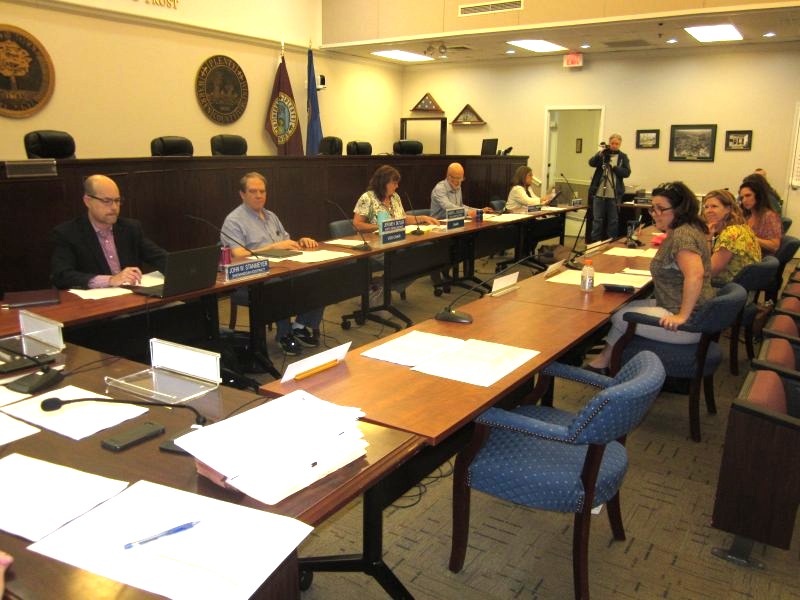
County supervisors at the far side work session table and the school board on near side try to zero in on a workable FY-2025 Public Schools Budget. At this point, a $2.4 million increase in local funding is being sought.
But more on that later. First, we’ll summarize portions of what led up to Jamieson’s negative appraisal of the county’s public school system and its evolving Fiscal Year-2025 budget proposal. It might be noted there was one elected official absence from the full boards’ joint meeting. That was Shenandoah District School Board member Tom McFadden Jr.

Schools Finance Officer Rob Ballentine opened the work session with a presentation of the evolving public schools Fiscal Year-2025 budget, explaining that the State revenue portion of the equation remains in flux, leaving a certain amount of guess work on necessary local funding involved until State officials finalize their FY-2025 budget numbers and that key portion of the anticipated revenue stream to the county’s public school system.
With some updated numbers the projected State contribution was cited at $43,514,552 of what is currently projected as a $78,790,969 total WC Public Schools FY-2025 budget-supporting revenue stream. That number includes a requested County contribution of $31,119,702, an increase of $2,469,702 over the last Fiscal Year County share of the Public Schools budget. Ballentine observed that the $2,469,702 local revenue increase was less than cited at the previous joint budget work session. Other anticipated revenue streams include Federal revenue of $3.55 million, and Miscellaneous revenue of $605,708.
Ballentine noted that the changes in submitted State revenue added about $43,000 to what had been projected previously. “The problem with that is the State sill hasn’t adopted a budget,” Ballentine said, noting a scheduled budget Special Session of the State General Assembly targeted for May 13, with a subsequent final vote on the State budget hopefully by May 15.

WC Public Schools Finance Director Rob Ballentine, left, and Superintendent of Schools Dr. Chris Ballenger prepare for their presentation of the updated FY-2025 school budget proposal, with 42 pages of small-print categories and numbers at their disposal. But where’s the detail, some still asked of certain categories.

“Once they do finalize their budget we’ll get the exact numbers that will go in that column for the State. So, those numbers probably will change, hopefully not much. And if they change, hopefully they’ll get larger — but that remains to be seen,” Ballentine observed.
The question and answer that followed began innocently enough as, first School Board member Melanie Salins asked what had propelled the reduction in the local revenue request, removal of some items or the increase in the projected State contribution. “There were things that we adjusted in the budget,” Ballentine responded, citing a $100,000 reduction from elimination of a testing program that was being deferred to FY-2026, as well as the positive impact of the projected increase in State revenue.
“Jay” Butler sought information on what was driving school budgetary changes upward, including how staffing needs were being met to fill unfilled positions. During discussion of that latter item, School Superintendent Dr. Chris Ballenger observed that it was not generally advisable to wait until the next budgetary year cycle to fill unanticipated staff vacancies because qualified available applicants would be quickly grabbed up by other school systems also looking to fill vacant positions. In response to a question, Dr. Ballenger said that of 33 current staff vacancies, 16 are teaching positions.

As John Stanmeyer studies the numbers, ‘Jay’ Butler queries Schools Admin staff on driving factors leading to a requested $2.49-million increase in local funding to $31.11 million, of a total projected budget of $78.79 million with anticipated State and Federal funding factored in.

Later, Ballenger observed that what students need educationally, as well as socially and economically, were the primary consideration in establishing annual public schools budgetary priorities. The staffing priorities discussion led County Board and joint work session Chairman Cheryl Cullers to express her hope that an Agricultural Program teaching position would be included in and approved as part of the schools FY-2025 budgetary request.
Money well spent?
Prefacing comments beginning at the 2:02:15 mark of the linked County video, Supervisor Jamieson said he felt line-item schools budget questions had been adequately covered, leading him toward another perspective he described as coming “from 40,000 feet or so”. His overview from that altitude was not complimentary:
“I’ve already made a few comments about a kind of crisis of confidence in terms of transparency and what’s visible. My primary concern as a supervisor charged with the responsibility for using taxpayer money is whether accountability is sufficient for the money being spent by the school system. And asking the question is more money being spent correlated to better educational outcomes,” Jamieson began.


Happy with the line item discussion, Supervisor Richard Jamieson decided to take an ‘overview’ of the Public Schools Budget from ‘40,000 feet’. — He didn’t like what he saw from up there. And it’s not because he’s a home schooler, he assured us.
And while admitting there were differing opinions on answers to those questions, Jamieson said he believed: “That’s not the preponderance of the evidence. That it depends on how the additional money is spent.” Jamieson asserted that he agreed that an excellent public educational system is a benefit to an entire community. However, he continued to note that recent annual statistics indicated that attendance at Warren County Public Schools had peaked, and was staying level, if not decreasing in some areas.
He did cite educational options, including home schooling and private schooling, in this community to public schools. However, he acknowledged that public schools educated the “vast majority” of students in the community. And he did not address whether shifting population and countywide age variables might impact those public school population trends. He did cite constituents he was aware of he said had withdrawn their children from the county’s public schools due to discipline or violence issues within some schools.
To make his point that public school appropriations were not being well spent, Jamieson pointed to four schools in the system that were ranked below federal standards of performance. “The elephant in the room that has been brought up, is that we do have four out of 10 schools that are not meeting federal standards. That’s 40%,” Jamieson pointed out, adding that 40% of the five-person School Board had voted against the submitted public schools budget proposal. As we understand it, that 40% was Salins and the absent Tom McFadden Jr., both of whom appear to have direct or indirect ties to the home or private schooling community here.
Jamieson said that instituting across-the-board raises in a system with a 40% failing standard of its schools, as opposed to identifying and replacing staff that could be tied to those failing standards, was a failed status quo he could not support. As to federal involvement in public education, Chairman Cullers, who was a school nurse in the public school system for years, at another point in the discussion suggested the school system should drop the federal and state implemented SOLs (Standards Of Learning) as a dysfunctional educational measurement tool. However, Jamieson noted that would amount to crossing the people with their hands on the purse strings of the educational system. — Well, at least two-thirds of those purse strings, the third being the local County appropriation he was asserting should be cut.
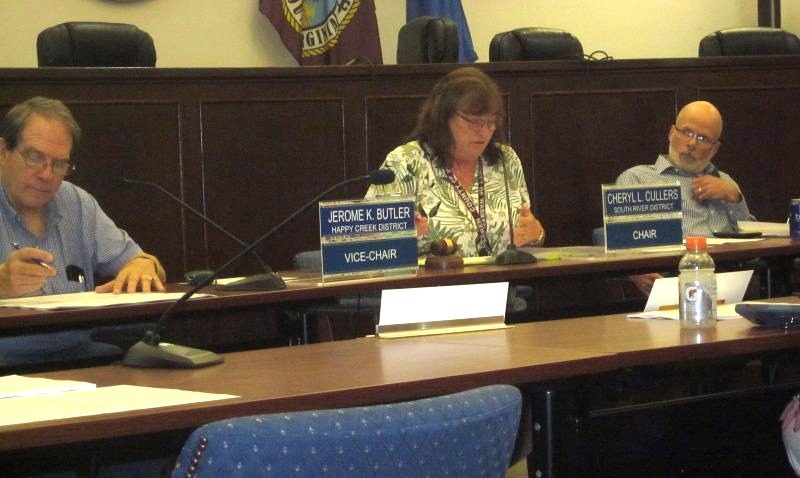
Flanked by Vice-Chair ‘Jay’ Butler and Richard Jamieson, work session and supervisors board Chair Cheryl Cullers expressed support for some schools staffing requests, as well as taking a shot at SOLs as a dysfunctional educational measurement tool, created as we recall by bureaucrats, not educators.
How may Jamieson’s negative analysis overview impact the supervisor majority’s perspective on the submitted, if not yet finalized FY-2025 Warren County Public Schools budget currently seeking $31,119,702 in local County funding, as noted above, an increase of $2,469,702 from the current Fiscal Year-2024?
Stay tuned as this crucial municipal governmental funding decision approaches a conclusion that may reverberate throughout this community for more than just the Fiscal Year to come.




Alongside Kiggans, US House Speaker Says Virginia’s 2nd District ‘Will Determine the Fate of the Country’

Virginia Secures $17 Million to Upgrade Rail Service and Improve Transportation Infrastructure

Mice May Drive Lyme Disease More Than Deer

College Football 2026: You Can Taste the Excitement!

Fall Is the Buyer’s Season — Start Now, Be Home by Christmas

AI Investment Boom Reaches Historic Scale, but Returns Remain Uncertain

Antique Tractor Preservation Day Celebrates the Machines and Families That Built Modern Agriculture

Shenandoah County School Naming Dispute Should Be Settled Through Mediation

Valley Health Unveils Mobile Mammography Unit to Expand Rural Screening Access

The Importance of Local Pride

Federal Judge Denies Hemp Entrepreneurs’ Request to Overturn Virginia’s New THC Limit

Dylan Wayne Mauck (2002 – 2026)

Hampton Leaders Cool to Limited Army Corps Flood Solutions

As Virginia Officials Weigh Data Center Pushback, Report Details Industry’s Public Service Funding

Black Lung Cases Surging Again in Southwest Virginia, Appalachia; Miners Blame Blocked Regulations

DNC Approves 2028 Presidential Nominating Cycle Starting in South Carolina, Nevada

The Shouting Comes From a Minority

Give the Credit Away

Why Reliability Often Matters More Than Brilliance at Work

Good Lions Celebrates First Anniversary with Ribbon Cutting and Renewed Commitment to Community

Data Center Misinformation is Killing the Golden Goose

Ragweed Can Make Melon Itchy
Judicial Accountability Must Apply to Everyone

Warren County Grand Jury Returns 15 Indictments, Including Equipment Theft, Child Neglect and Drug Charges
