
Crime/Court
VFW arson-embezzlement trial poised for closing arguments, jury deliberation
FRONT ROYAL – A nine-woman, four-man jury pool is poised to hear closing arguments Friday morning in the commonwealth’s two-pronged case against Leslie Rose Deavers.
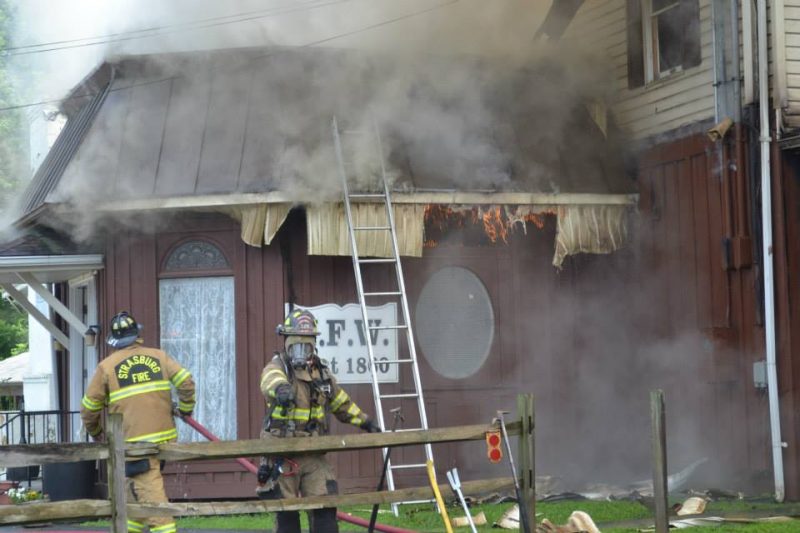
Deavers is accused of arson in the July 11, 2015, fire that gutted the Samuel R. Millar Veterans of Foreign Wars (VFW) Post 1860. The prosecution theory is that Deavers, a long-time employee and volunteer, set the fire to cover up evidence of two years of embezzlement of Post 1860 revenues tied primarily to V-Tab non-profit slot, gambling machines.

Leslie Rose Deavers outside the Warren County Courthouse Thursday March 7, 2019. / Photo Roger Bianchini
The prosecution has also attempted to tie Deavers to a break-in and robbery in which four of Post 1860’s V-Tab machines were broken into and cash boxes removed and an estimated $5,000 to $7,000 in post revenue is believed to have gone missing from a safe.

In arguing against a defense motion to dismiss the prosecution case, Assistant Commonwealth’s Attorney Brian Layton pointed to a July 10, 2015, Front Royal Police interview with Deavers with promised follow-up seeking an explanation as to why the Post 1860 alarm system and motion sensors had not activated during a July 3 break-in in which there were no signs of forced entry.
“Officers were breathing down her neck; the vets were coming in that night to be paid for some of the V-Tab winnings – will there be enough money to do it? … It has all the makings of an inside job … The only conclusion is it all ties to together,” Layton told the court in arguing against dismissal.
Prosecution rests; defense begins case in VFW arson-embezzlement case
And on Thursday afternoon Deavers took the stand to tell her side of the story. What resulted from both direct and cross-examination of Deavers and supporting testimony from both sides were contrasting portraits of the 57-year-old defendant.
From the defense perspective, you have a woman so emotionally tied to the VFW Post that consumed a large part of her daily life that after its destruction she became depressed and withdrew from normal activities, including what she and her legal team contends was a highly profitable gambling habit.

From the prosecution side you have a woman with a gambling problem; myriad financial issues and debt on the home front, who was paid little for the amount of work, much of it volunteer, and time she spent at the VFW Post.
Taking the stand as the first witness after a late lunch break ended at 2:30 p.m. Deavers recounted her work at the VFW Post, including a three-year lapse (2010-13) when she wasn’t paid anything due to financial cutbacks at the post, but continued to volunteer out of a love and commitment to the organization.
“You still stayed on – how?” her attorney Jason Ransom asked.
“Yes, I had other side jobs,” Deavers replied.

“Did you love that club?” her attorney asked.
“Yes I did,” his client replied.
“Did you love the people?”
“Yes, I did.”

“Was that club a part of your whole life?”
“Yes, it was.”
Cross-examination took a different tone.
“At the time you and Mr. Spiker had financial problems?” Layton asked of the 2014-15 time period.

“Yes, we were paying a high, high house payment,” Deavers replied launching into an explanation of the couple’s effort to get their home loan modified.
“There was a looming repossession of his Harley Davidson motorcycle,” Layton continued referencing earlier testimony from Ashby Spiker, Deavers’ live-in boyfriend of 17 years.
Deavers attempted to contradict that situation, noting that Spiker had title to the bike when he sold it to April Spiker for $5,500. Spiker’s testimony confirmed a looming repossession that he got out from under through the sale to his sister. He also testified that he sold a restored 1983 Mustang used in his Winchester Speedway racing days for $10,000. The cash sale testimony was utilized by the defense to explain some of the 98 cash deposits totaling over $104,000 made over that two-year, 2014-15 period.
Layton then questioned Deavers about turning down extra income offered by the VFW board during this period – “Yes sir,” Deavers said succinctly of that refusal.
“You gambled at two other places (than the VFW)?” Layton asked.
“Right.”
“But overall you lost more than you won.”
“No.”
“You are testifying you won more than you lost?”
“I did.”
“At Charles Town and the Middletown firehouse you won more than you lost?” Layton asked again.
“Oh yes,” Deavers assured him.
Other VFW members and friends of the defendants also testified that Deavers had a knack at the casino games, winning often. That consistent winning at the gambling tables at the VFW, Charles Town’s Casino and the Middletown Fire & Rescue headquarters, along with her boyfriend Ashby Spiker’s cash sales of vehicles, are crucial to the defense’s counter to prosecution ATF forensic financial auditor David Clemson’s discovery of 98 cash deposits totaling over $104,000 made into Deavers and Spiker’s Wood Forest joint bank account within two years prior to the VFW fire.
Deavers then assured Layton that while she had failed to file those gambling winnings initially that the IRS had caught up with her and the taxes had eventually been paid.
Deavers also minimized the role of earlier prosecution witness Laura Hutchinson, then Elder, who described an encounter with Deavers and Billy Rose the morning of the fire when she paid an unscheduled visit to the VFW property to show her mother where her wedding reception would be held at the VFW pavilion.
On Tuesday Hutchinson testified that when she entered the Post 1960 building to encounter the smell of smoke, haze, Deavers and Rose inside.

Despite valiant efforts of first-responders, the historic post could not be saved.
Hutchinson said she told the two “I think there’s a fire” to which Deavers replied, “I know” without showing much concern. Hutchinson said when Deavers and Rose failed to begin a search for the source of the fire she started looking around at which point Deavers said, “Someone must have put a cigarette out in the trash in the back.”
The trio then discovered a red glow at the base of the women’s bathroom door and discovered a fire in a trash can. “They weren’t doing anything – I asked, ‘Do you have a fire extinguisher?’” Hutchinson testified she accompanied Rose, commenting to him, “You’re going really slow” after which he located the extinguisher. Upon returning to the scene Hutchinson said she advised him to spray around the perimeter of the fire, but he ignored her, spraying directly into the fire “creating a mess”.
But with the fire out, mess or not, Hutchinson said she returned to her mother at the outdoor pavilion.
“Did you call 911?” Layton asked her.
“No, I thought she would – the fire was out but I thought she would call for professional help,” Hutchison replied.
As she drove past the headquarters exiting along North Royal Avenue she said Deavers and Rose “were outside smoking” at a side door. Deavers has described Rose as her boss at VFW. He is since deceased.
On Thursday Deavers said she didn’t believe Hutchinson was present initially and said forcefully, “Billy Rose is the one who found that fire … Miss Elder (Hutchinson’s maiden name) ran to the front, I ran to the back. I told Billy to call 911.”
“Why did you ask him?” Ransom asked his client.
“Because my phone was behind the bar, his was on his hip,” Deavers replied.
Previous testimony offered at trial appeared to indicate that 911 was not called until another man later entered the building to inform Deavers, Rose and a second unexpected visitor, Brendan Squire who was inquiring about membership, that flames were coming out of the building front entrance.
Squire was with Deavers and Rose after Hutchinson’s departure following extinguishment of the first fire. It was that second fire, believed to have originated at the utility closet housing the building’s electrical boxes, that is credited with destroying the VFW building.
Much dueling expert testimony has disputed whether an electrical short circuit could have been the accidental cause of the fire that destroyed the building.
Both sides will summarize their cases for the jury Friday morning. Then it will be up to the jury to decide if the prosecution’s admittedly circumstantial case against Deavers on both the remaining arson and embezzlement charges against Deavers is strong enough to convict.

Firefighters toiled for hours in an attempt to save the building.




Trump Administration Touts May Job Growth, New Investments in Weekly Briefing

Front Royal’s Monthly Through November ‘Vintage Market’ Event Attracts Shoppers Despite Light Rain Intrusion

Does Your Teen or College Student Need to File Taxes?

Building a Rental Property Can Offer Investors More Control and Long-Term Value

Fair Estate Planning Can Help Prevent Family Disputes

Chelsea Academy Announces Summer Sports, Academic, and Activity Camps

VA250 Mobile Museum Experience Coming to Front Royal June 18-21

Trump Touts Farm Policies, Trade, and Rural Priorities During Wisconsin Visit

US Senate Blocks Trump’s SAVE America Act, Thwarting Restrictions on Voting

The Ocean Is Fighting Back

Simple Ways to Personalize a Father’s Day Card

Careful Planning Helps Keep Livestock Safe During Transport

The People’s Power Begins with the Ballot

Front Royal Cardinals Host Woodstock River Bandits, Sunday – June 7

New Economic Development Director Shares Modus Operandi At Joint Town Council and Board of Supervisors Work Session

Topography Complicates Automobile Graveyard Application at Town Planning Commission Work Session

VDOT: Warren County Traffic Alert for June 8 – 12, 2026

Virginia State Police Report Firearms, Narcotics Seizures in Weekly Crime Suppression Operations

Warren County APS Urges Residents to Watch for Elder Abuse, Financial Scams

Business Growth Series: No Clear Goal? No Growth.

After Ashland Dam Removal, Freshwater Mussel Species Reintroduced to South Anna River

Commentary: What Virginians’ and Americans’ D-Day Sacrifices Teach Us About Our Country Now

FOIA Friday: Richmond City and Schools Face Scrutiny

Johnnie Otis Kaufman Jr. (1946 – 2026)
