
Automotive
A history of roads in Virginia: Early Paving Methods
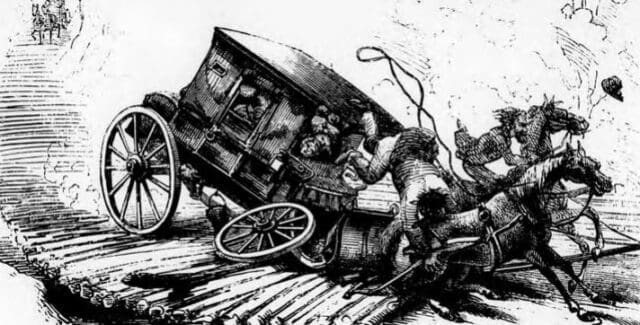
Plank roads were introduced from Canada in the 19th century, sometimes with jarring results.
While most roads remained dirt and in miserable condition, the turnpikes, relying on income from travelers for their existence, were provided in most instances with gravel, broken stone, wood, or macadam surfaces.
The old Manchester Pike near Richmond had been surfaced with gravel in 1808 and was recognized as the first “artificial” or paved road in the state. The widely used macadam surface was named after its developer, John Loudon McAdam, a Scottishborn engineer who began building roads in England in the early 19th century. McAdam is credited as the first to recognize that dry soil itself generally would support the weight of traffic and that pavement was necessary only to provide a smooth riding surface and to ensure dryness.
The macadam pavement consisted of crushed rock packed tightly into thin layers, with a top surface of sand or finely crushed stone rolled to provide a well-bound surface resistant to the penetrating damage of rain, ice and snow. McAdam generally specified a uniform thickness of seven to 10 inches for the finished road, although some ranged at least to 18 inches in thickness.

The specifications for one macadam road provided for the first layer of stone to be “cast on with a shovel to a depth of six inches, after the manner of sowing grain.” It was to be compacted with a cast-iron roller, “prepared with a box, or a cart bed, to carry two or three tons of sand” and rolled until “sufficiently solid and compact to receive the second layer.” After dressing the surface “with a rake or otherwise,” the second layer, three or four inches thick was to be “put on, rolled, and prepared in all respects as the first stratum was, until in a state of firmness and solidity, proper to admit the third or last stratum, which can then be put on, and the surface raked and dressed to such shape and form as may be required, and also rolled until satisfactorily compacted.”
Part of the Lynchburg-Salem Turnpike was the first segment of road to be macadamized in Virginia. The Valley Turnpike and the Southwestern Turnpike, between Salem and Seven Mile Fork near Marion, were others.
Wooden pavements were also used widely in the turnpike era, perhaps naturally, since standing timber was abundant over much of the state.
“Corduroy” roads were built by placing small logs side by side along a cleared path and covering them with dirt for smoothness. The “plank” road was introduced in the United States from Canada, where some 500 miles were laid between 1834 and 1850. A typical plank road had a single track about eight feet wide, with the planks placed crosswise. Later, they were inclined slightly to allow rainwater to drain.
By the mid-19th century, the railroads Crozet had favored were handling much of the long-distance movement of passengers and freight. This posed a new problem for the turnpikes, many of them already financially troubled. The railroads gained such great popularity that apathy developed toward road improvements. For the turnpikes, it meant reduced use and revenue. For other roads, it meant that many remained little more than dirt paths, impassable after heavy rains or during winter thaws and raising choking clouds of dust at other times.
With the outbreak of the Civil War in 1861, roads and railroads became immensely important to both Confederate and Union armies. The transportation arteries often governed the outcome of battles. The armies fought over them, guarded them, rebuilt them and constructed new ones. Food, clothing, medical supplies, guns, ammunition, and men moved by road and by rail.

In September 1861, Gen. Robert E. Lee, writing from a mountain encampment to Gov. John Letcher, said, “Our greatest difficulty is the roads. It has been raining in these mountains about six weeks. It is impossible to get along. It is that which has paralyzed all our efforts.”
Two years later, then commander of the Army of Northern Virginia, Lee wrote, “It has been raining a great deal… making the roads horrid and embarrassing our operations.” Some wagons simply broke down on the road from the mud and rocks. Other military commanders on both sides could tell similar stories of how road conditions often hindered their operations.
Poor to begin with, the roads and bridges were damaged and destroyed as the armies fought over them repeatedly. The company that operated the Valley Turnpike reported that its revenue collections were negligible because “of the army destroying bridges, injuring toll houses, and we are getting very little tolls.”
For most of the turnpike companies, the war was the final blow from which they could not recover, and many passed from private to county ownership. Toll collections on most of the turnpikes never had been enough to pay operating and maintenance costs or to do much toward retiring the indebtedness, and the extensive but financially weak turnpike era was nearing an end.

A few toll facilities, the Little River and Valley turnpikes among them, somehow managed to recover sufficiently from the rages of war to remain in operation into the early 20th century. But a constitutional amendment in 1874 decreed that the state government could no longer invest in turnpike company stock. The risk was too great.
After the war, the state’s board of public works turned mainly to matters other than roads, and in the counties there developed a widely varying patchwork of road development practices. Twenty-five years after the war, Virginia’s roads were far worse than when the war began.
This was true despite the fact that, in the Reconstruction period, the General Assembly enacted much road legislation. The problem was that much of it was confusing and meaningless, and sometimes humorous. One law made it illegal to drive or lead a bear on a public highway, and another set a fine of $5 for a pedestrian who crossed a bridge at a pace greater than a walk.
A series of events late in the 19th century and early in the 20th century, however, were about to revolutionize man’s mode of travel.
Next up: The Auto Age Begins
Produced by the
Virginia Department of Transportation
Office of Public Affairs
1401 E. Broad Street
Richmond, VA 23219
VirginiaDOT.org





Turning Off an Airbag Is Allowed in Limited Circumstances

A Retirement Account for a Grandchild Starts With a Summer Job

Your Photos Survive A Lost Phone, But Not A Wrong Tap

Walking Malls Don’t Solve Problems

Festival of Leaves 2026 Wraps Up a Successful Day in Downtown Front Royal

Autumn Delights: Spotlight On Pumpkins!

Lord Fairfax Health District Receives $5,000 Grant To Support Local EMS Crews

Why an AI Bubble Could Reach Your Savings

The Platypus: A Truly Amazing Animal!

A Thing of the Heart: Two-Fold Outreach to Children and Award Presentation Brings Hike Kidz to Stone Branch Arts Center

Virginia State Police Seize Drugs Valued at More Than $830,000, Recover 13 Firearms

Commentary: We Hate Technology. Please Like and Share

One Medicare Open Enrollment Decision That Can Be Hard to Undo

Constitution 101: The Postal Clause

VDOT: Warren County Traffic Alert for October 12 – 16, 2026

UVA Poison Expert Warns of Emerging Synthetic Opioids That Fentanyl Tests May Miss

Pumpkins Will Take to the Skies at Front Royal Warren County Airport Oct. 24

Front Royal Remains Under Mandatory Water Conservation As Shenandoah River Flow Drops

Front Royal Women’s Resource Center Opens 2027 Dare to Dream Grant Applications

Warner, Mizusawa Outline Competing Approaches to Disability Policy

Fable Greenhouse and Gardens Breathes New Life into Former Horton’s Nursery

Louise Virginia “Mom” Messer (1936 – 2026)

Business Growth Series: Doing Everything Yourself Is Slowing You Down

The Mystery of the Purple Seal
