
Local Government
Council work session proceeds thru credit card fee debate, Spelunkers rezoning, facilitating property cleanups & water-sewer line repairs
As the Front Royal Town Council came out of its work session-opening closed session shortly after 8 p.m. Monday night, those of us following virtually online were met by silence over what appeared to be the next three agenda items. A quick call to Town IT and Communications Director Todd Jones led to an eventual re-booting of the SWAGIT recording/streaming system, restoring sound just in time to hear discussion of agenda item “5” – the Spelunkers rezoning request to facilitate turning two lots of just under half an acre across Pine Street into staff parking and restaurant cold storage space.
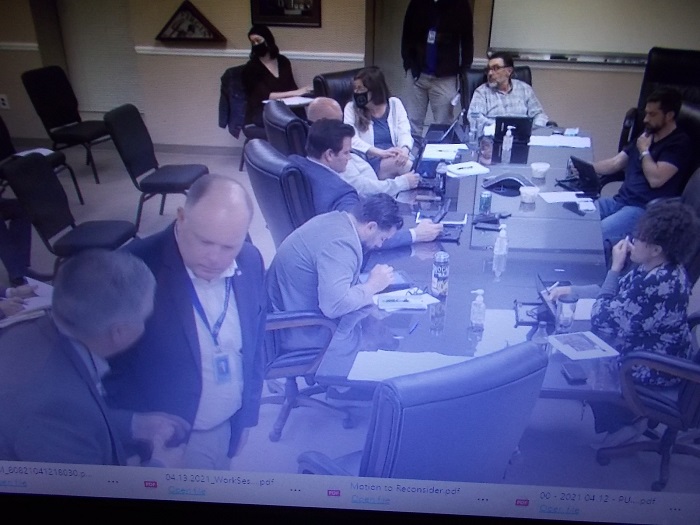
What do you mean they can’t hear us?!? – Well, that might have been what Town Manager Steven Hicks and his interim predecessor Matt Tederick were discussing in foreground before sound was restored to Monday’s work session. Royal Examiner Photos by Roger Bianchini
While there were questions about delivery trucks and lighting, the Spelunkers/116 South Street LLC representative present appeared to satisfy council concerns. William Antonelli said deliveries would be made in the existing restaurant lot and run physically across the street to cold storage and meat processing stations placed in the two involved lots. Lighting would be facilitated according to code requirements, he added. A follow-up question by Vice-Mayor Lori Cockrell on impacts on residential neighbors led to a response they would be “very minimal” – “There’s not going to be a lot of noise, not a lot of traffic,” it was asserted. The council consensus was positive, and it was agreed do move the request, which the town planning commission recommended approval of, to public hearing.
Next was Town Police Chief Kahle Magalis’s annual report on departmental functions, staffing, crime and response trends, and community relations. The latter included the chief noting an absence in recent years of neighborhood initiatives toward “Neighborhood Watch” programs, which he explained must be initiated from within neighborhoods, rather than by the police department.

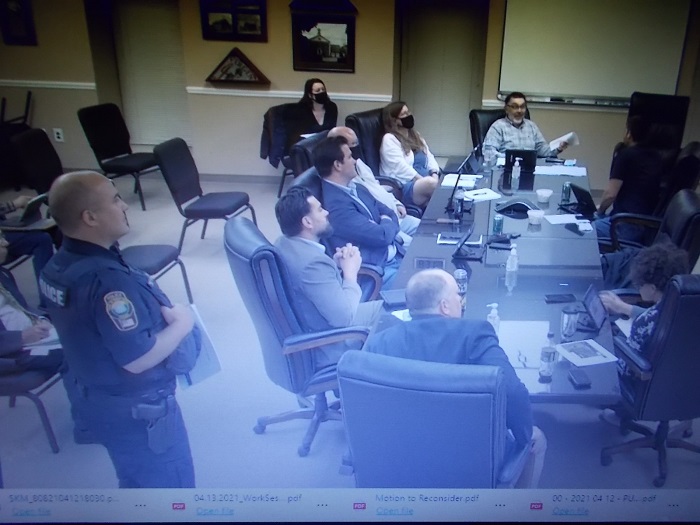
FRPD Chief Kahle Magalis checks power point projection for his Annual Report on his department’s staffing and law enforcement trends over past year.
Following the FRPD and crime update, the evening’s most debated topic was reached.
About those credit card fees
That topic was exploration of removing the fees the Town charges for processing of credit card payments on utility or other bills.

The staff summary presented by Finance Director B. J. Wilson noted that eliminating the fees would require the town government to absorb an approximate $140,000-plus annual expense on credit card payment processing in the coming Fiscal Year-2022 budget. One way put forward to accomplish that brought up in Monday’s discussion was tacking a $1.77 monthly fee on to all utility payments regardless of how they are paid, including cash and checks.
That plan did not sit well with the vice mayor. Cockrell said she would not support such a charge, forcing citizens who do not incur credit card fees to support those who do incur the fees with credit card use.
However, Letasha Thompson presented the counter-side’s argument that waiving the fees would stimulate more town citizens without the cash on hand to pay their bills to pay them on time with credit cards if the fee were waived. Other positives cited in a staff summary included facilitating the Town achieving lower “merchant services” fees; a $12,000 reduction in associate annual software expenses; making future software conversions easier and more accessible to citizens and vendors, among other tech and perception issues.
The Finance Department staff summary noted that approximately 26% of the Town’s utility payments and only 3% of tax payments are made with credit cards. Over the course of calendar year 2020 that equated to 22,349 credit card utility payments out of a total of 86,338 utility payments made, or the 26% figure.

The proposed $1.77 per monthly utility account surcharge was explained as covering projected credit card processing costs in FY-22 if the 30% increase seen last year continued in the coming year, leading to a jump in the Town’s annual processing fees from $130,000 to $180,000. At $1.77 monthly, for the year all utility customers would be paying $21.24 to cover the waived fees if council chooses to move in that direction.
Councilman Scott Lloyd observed that the 25% who use credit cards are likely to think it’s a good idea, while the 75% who don’t, won’t see it that way. “Why fix something when it’s not broken,” Lloyd asked his colleagues. But as Thompson verbalized earlier, the rationale for waiving the fees is envisioned as an incentive to encourage more citizens short of cash when their utility or other Town bills are due to utilize credit to keep those bills current and avoid penalties and interest accumulations.
“It’s under two dollars a month,” Thompson pointed out, and she could have added “under $22 a year” to try and reduce the number of delinquent utility accounts through credit card use. Of course, there was no comment indicating any research on how many citizens whose utility accounts went significantly delinquent last year, may have access to credit cards.
However, the variables of lowering vendor fees and software upgrade costs appeared a more stable projection in the staff summary. That summary also observed that the Town currently has 8,481 active utility accounts and $30,814,005 in utility sales are projected in the FY-22 Proposed Budget.

Despite the wide gap in varying council perspectives, it was agreed to move the proposal to a future agenda. Gary Gillespie drew some laughter when he observed that it would not be part of the Consent Agenda for routine business. Rather, it will move to what may be a somewhat contentious public hearing in front of a divided council on the issue.
Other business
As for those earlier agenda items we could see being discussed but not hear, with the help of Deputy Council Clerk Mary Ellen Lynn we were able to ascertain that council agreed to move forward toward facilitating a Water/Sewer Line Replacement Program that would assist property owners in replacing “old galvanized water lines” running from the Town utility system onto private property, though not internal to a structure’s plumbing, that could present a public health problem if the lines were allowed to fail and lead into the ground. Payback plans would be a part of the program designed to get needed repairs done in a timely manner in situations where the property owner could not afford the upfront costs.
Council got an update from Finance Director Wilson on moving forward with the Happy Creek Sanitary Sewer Replacement Project that has been mandated by the Virginia Department of Environmental Quality (DEQ). Project cost is estimated at $1 million. The possibility of piggy-backing that cost into an Inflow & Infiltration Abatement Loan expected to close later this year or early in 2022 is under consideration. It was noted that pending that loan closing, the Town would have to amendment its current FY-21 Budget to allow funding of the work through Sewer Reserve Funds. That is necessary because of the timeframe mandated by the DEQ Consent Order on the work. A public hearing would be required because the budget amendment would exceed one-percent of the adopted FY-21 Budget.

Council also quickly moved another item to the April 26 meeting agenda. That item was approval of a resolution initiating amendments to two code chapters, 148 and 175. According to the staff summary Chapter 148 applies to “regulations of the Town’s Subdivision and Land Development Ordinance” and Chapter 175 to the “Town Subdivision Ordinance Pertaining to the Permitting and Approval Authority of the Planning Commission”. Following an April 7 work session, the plan is to approve the resolution and send it to the town planning commission “for recommendation of Chapter 149 and Chapter 175 ordinance amendments, then returned to council for final approval. The amendments appear to relate to council’s recent request the planning commission recommend approval of an easing of some codes as they apply to apartment development in the Historic Downtown Business District.
After hearing from Deputy Zoning Administrator/Code Enforcement Officer Chris Brock, council also agreed to move to public hearing on a code amendment regarding allowing the town manager to have a “designee” authorized to move a 10-day notice process forward regarding compliance with Town Code 170-3 mandates on cleaning up “trash, garbage, refuse, litter, debris (including weeds, bushes) and other substances” from properties as a public health and safety measure. Failure to correct such situations within the prescribed timeframe upon notice can result in liens on properties and civil fines of $50 for first offenses, and $100 for subsequent offenses up to $3,000 in a 12-month period.
It would seem the Town is finally prepared to move forward on forcing property owners hands in cleaning the town up in some regards – now, about those dilapidated structures and deteriorating rental properties…
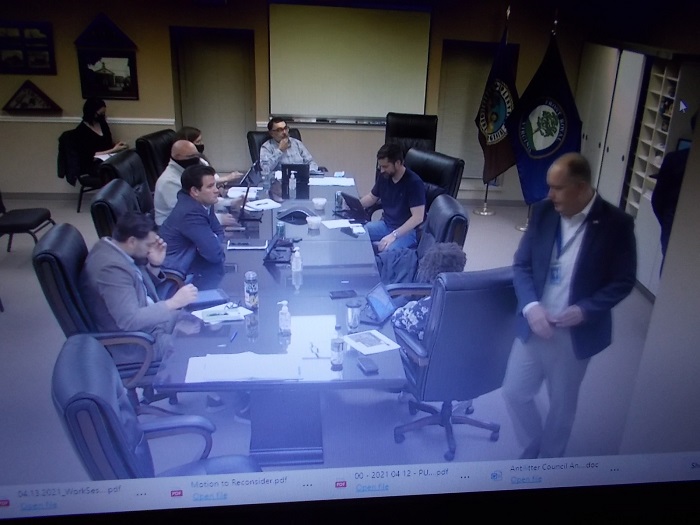
Town Manager Hicks returns to his seat after checking power point projection issues. Near the meeting’s end Hicks informed the mayor and council he would be absent from April 26 council meeting and the Town-County Liaison Committee meeting of the 29th – ‘You’re fired,’ Mayor Holloway deadpanned upon receipt of the news, drawing laughter. – Enough with those ‘The Apprentice’ impersonations, Mr. Mayor.




Hike Kidz Foundation Partners with Love in Action to Deliver Fresh Food to Families

After 12 Years of Service, Seniors First Executive Director Jimmy Roberts to Retire

Warren County Residents Speak Against Data Centers at County Planning Commission Meeting

Pirate Adventure Vacation Bible School Sets Sail July 19 at First Baptist Church

The Human Access Layer

Two Juveniles Charged After 17 Vehicle Break-Ins in Bentonville Area

Prince William Supervisors Reject Dulles Cloud South Data Center Proposal

Trump Faces Looming Deadline to Sign Popular Bipartisan Housing Package

How the Declaration and the Constitution Are Inseparable

How to Say “I Don’t Know” Gracefully

Meet the Brown Marmorated Stink Bug

Fireman’s Parade Draws Crowds Despite Summer Heat as Carnival Continues Through Saturday

Warren Memorial Hospital Achieves Another National Recognition

Warren County Tourism Debate Expands Into Broader Conversation About Governance, Accountability, and the Future of Regional Marketing

Game Postponed to July 17 – Cardinals Host New Market Rebels Thursday, July 9 at Bing Crosby Stadium

Court Battles Leave Virginia’s New Assault Weapons Ban in Legal Limbo

Virginia Ranks Among Top States for Highway Safety and Mobility Benefits, but Challenges Remain

The Supreme Court Should Be Above Politics

Commentary: Virginia’s Atlantic Coast Should Be Protected, Not Turned Into a Sacrifice Zone

Dropped Your ACA Insurance Due to Spiking Premiums? You Could Qualify for a State Subsidy This Fall

CDC Monitors Rise in Cyclosporiasis Cases as Summer Produce Season Begins

Kathryn E. “Kathy” Warren (1958 – 2026)

Virginia Expands RetirePath Retirement Program to More Small Businesses

Everyone Is Going to the Moon. Will We Fight Over It?
