
Automotive
A history of roads in Virginia: Turnpike Era
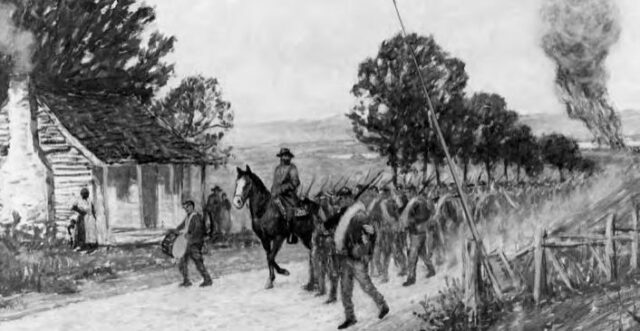
The ravages of Civil War campaigns left many of Virginia’s roads in ruins.
Road building in the latter stages of the 18th century and much of the 19th century was marked by the development of many turnpikes or toll roads. As Jefferson observed, toll financing provided a means of building highway facilities for which there was a need but which were too complex and costly to be constructed by the counties alone.
For the most part, Virginia counties were impoverished and exhausted from their contributions of men, supplies, and other resources to the Revolutionary War. The turnpike era offered a new way of meeting road needs. The turnpike got its name from its toll gate. When first designed, the gate was a turnstile consisting of two crossed bars pointed at their outer ends and turned on a vertical bar or pole.
In 1772, the Virginia legislature cleared the way for what probably was the first toll road in America, when it authorized Augusta County to build a highway over the mountain between Jenning’s Gap and Warm Springs and to establish a toll gate. The road, as outlined by the legislature, was to be financed with 300 pounds advanced by the colony and 900 pounds raised by a lottery. Revenue collected from travelers was to be spent for the upkeep of the road and “towards building… housing for the reception of the poor sick resorting to the said springs.”
In 1785, five years after Richmond had become the state’s capital, the legislature appointed a commission to erect toll gates on existing roads in the Alexandria area to increase road revenue. The Fairfax and Loudoun Turnpike Road Company was chartered in 1795 to construct an improved road between Alexandria and Little River in Fairfax County. It accomplished little, however, and was followed in 1802 by the Little River Turnpike Company which, in 1811, completed a 20-foot- wide turnpike extending west from Alexandria for about 34 miles. It operated as a toll road for nearly a century, and its completion touched off construction of many turnpikes in Virginia by the time of the Civil War.
Virginia’s population by 1800 had climbed to 880,200, with settlers in most of the major regions that make up the present state. This growth and expansion led the General Assembly in February 1816 to establish the nation’s first state board of public works and to create a fund for internal improvement. The board, with the governor serving as president, was empowered to appoint a “principal engineer” for the state, and it existed until 1902. Its formation coincided with the beginning of the nation’s canal era.
The board was responsible for chartering, finding, and supervising internal improvements. The fund, amounting to more than a million dollars, was created to transfer shares, owned by the state, in the stock of the Little River Turnpike Company, the Dismal Swamp, Appomattox, Potomac, and James River Canal companies and in two banks. Money in the fund was to be used to match private capital in financing improvements.
The office of the principal engineer provided important resources for the location, design, and construction of transportation facilities in Virginia for years to come. The first principal engineer, Laommi Baldwin Jr., held office from 1816 until 1818, when he resigned. Baldwin was succeeded by Thomas Moore, who served until his death in 1822. Moore then was followed by Claudius Crozet, an engineer who was to have deep influence on Virginia transportation.
Crozet had been a French artillery officer under Napoleon Bonaparte before coming to America. He also had been a distinguished teacher at the United States Military Academy at West Point.
In Virginia, he served two terms as principal engineer, 1823-31 and 1838-43. The break in his service reflects the continuing dilemma of those faced with the responsibility for applying the results of a rapidly changing technology to large-scale public works. One of the major efforts supported by the board of public works was the James River and Kanawha Canal, which was intended to improve communication and trade between the populous and politically powerful eastern Virginia and the comparatively isolated western regions of the state. Development of the canal had started in 1785, but it had not advanced as rapidly as its promoters had hoped.
A new and serious obstacle to its success appeared in 1829, when the Stourbridge Lion, an early locomotive, was imported to the United States from England. A year later, Crozet suggested that in view of this exciting new invention, a steam railroad would be preferable to the canal to link east and west. It was a bold idea indeed, because until then no railroad using steam locomotives had been operated in this country. Moreover, it was a controversial idea; powerful forces in the state wanted completion of the canal.
Largely as an outgrowth of the controversy, the board of public works was reorganized by the legislature in 1831 with a requirement for annual legislative approval of the principal engineer. In addition, Crozet’s salary was reduced from $3,500 to $2,500. Crozet resigned and spent the next six years in Louisiana.
Crozet returned to his former position in Virginia at the beginning of 1838, and although his position favoring railroads over canals ultimately proved correct, the controversy remained. It ended in 1843 with an act stating “that the office of chief engineer of the state be and the same is hereby abolished.”
Shortly afterwards, Crozet became principal of Richmond Academy in downtown Richmond, but in 1849 he responded to the pleas of his former opponents and returned to engineering to direct construction of a rail road through the mountains. The community of Crozet in Albemarle County is named for him.
During calmer days as state engineer, Crozet also was responsible for building highways through the mountains, as well as in other regions. One of the principal roads was the Northwestern Turnpike, which emerged in 1827 as Virginia’s bid for the profitable trade of the territory northwest of the Ohio River.
Legislation incorporating the turnpike authorized subscriptions from the townspeople of Winchester, where the road was to begin, and of the other communities along the way. But its authors chose a route to serve the most populous towns without much regard for the difficult terrain. Little progress was made.
In 1831, the legislature provided for a company, with the governor as president of its board of directors, to borrow money and construct the turnpike with a minimum width of 12 feet “from Winchester to some point on the Ohio River to be situated by the principal engineer.”
The turnpike eventually reached the Ohio River, and its gentle grades and alignment, developed largely under Crozet’s direction, made it one of the good roads of its day. The course it followed is largely that used today by U.S. Route 50.
The Valley Turnpike was another important 19th century road developed during this period. Incorporated in 1834, the Valley Turnpike Company was authorized by the legislature to improve the route between Winchester and Harrisonburg — part of the ancient Indian Warriors’ Path and the Great Wagon Road followed by the early pioneers. The improvements were financed largely with $25 shares sold to private citizens and were completed in 1840.
Next up: Early Paving Methods
Produced by the
Virginia Department of Transportation
Office of Public Affairs
1401 E. Broad Street
Richmond, VA 23219
VirginiaDOT.org

Virginia Bill to Boost Local Approvals of Solar Projects Advances

Cockroach to the Rescue?

Partial Federal Government Shutdown Begins, Amid Hopes It Won’t Last Long

Between Book Signings and Wine Tastings, I Saw Something I Can’t Explain

Spaghetti Carbonara: A Simplified Take on the Roman Classic — Rich, Creamy, and Ready in Mnutes

Data Centers in Space: Brilliant Innovation or Pie in the Sky?

6 Simple Steps to Keep Your Feet Healthy: Happy Feet = a Healthier You

League of Women Voters Marks 106 Years With Push to Empower Voters in the Valley

VDOT: Warren County Traffic Alert for February 2 – 6, 2026

DNA Modification in Oats: A Breakthrough with Widespread Benefits

Star-Studded Birthdays: Which Celebs Share Yours?

Two WCHS Juniors Aim for Virginia DECA State Office

4 Meal Types to Consider for Treating Your Wedding Guests

Virginia State Police Ongoing Crime Suppression Operations, Recovering Firearms, Narcotics, and Investigating Human Trafficking

Democrats Try to ‘Balance’ Renters’ Rights With Landlords’ Rights in Proposed Housing Bills

Virginia Delegate’s Bill Would Limit Where High-Voltage Transmission Lines Can Be Built

Freedom 250 IndyCar Race to Bring Speed and Spectacle to Nation’s Capital in August

What to Do and What Not to Do If You’re in a Car Collision

US Senate Poised to Send House Spending Deal in Race to Avert Partial Shutdown

Robert Glenn “Bob” Coverstone (1942 – 2026)

Trump Launches Great American Recovery Initiative to Address Addiction Crisis

Battery Technology Leading the Renewable Revolution

Children Activities by Samuels Public Library for the Month of February

Muley Fanatic Foundation’s 7th Annual Banquet Brings Conservation and Community Together