
Local Government
After history lessons – Ouch, that must have hurt! – supervisors scrutinize budget details
After getting a couple of history lessons, first from Richard Hoover on the breadth and depth of Warren County’s place front and center of American History from the Revolutionary War for independence from the British Empire, on through the Civil War that asserted federal authority to end states’ rights to continue the institution of slavery, to the mid-20th century-to-present-day fight for civil rights and racial equality; and then from David Downes on the 2005 Congressional declaration of April 6th as “National Tartan Day” in honor of the Scot and Scot-Irish immigrant contributions to American culture, the Warren County Board of Supervisors got down to business as a public hearing on the Fiscal Year-2022 Budget approaches.
That FY-22 Budget Public Hearing was set for Thursday, April 15, at 7 p.m. A special meeting to vote on approval of the FY-22 county budget, as promised without any tax increases, was set for Tuesday, April 27, also at 7 p.m.

Above, portrait of Gen. Joseph Warren meeting his end at the wrath of the British crown in response to his prominent role in promoting American colonial independence, as Richard Hoover, below, begins his recitation of Warren County’s place in American history with its namesake. And further below is David Downes acknowledging April 6 as National Tartan Day as declared by Congress in 2005. Royal Examiner Photos by Roger Bianchini


But one other agenda item addition also prefaced that budget process scrutiny. That was Warren County Department of Social Services Director Jon Martz introduction of his staff as part of a request the County acknowledge by proclamation April as Child Abuse Prevention Month. For it is that DSS staff that works to, among other duties, identify and stop child abuse in our community.
Referencing her work in nursing, County Board Chair Cheryl Cullers commented on the emotionally taxing job of dealing with child abuse: “I just want to thank you all, you guys have a horribly difficult job – I don’t know how you do it, to go out and see the things you see. I remember when I first got out of nursing school and was working, I had two children under the age of 12 months (abused) … It broke my heart. I don’t know anybody can harm any child, any child but especially babies. You have a horribly hard job and I appreciate every one of you … Thank you all very much,” Cullers concluded leading to applause from those present for the emotionally draining, sometimes life-and-death work they do for the community and its children.
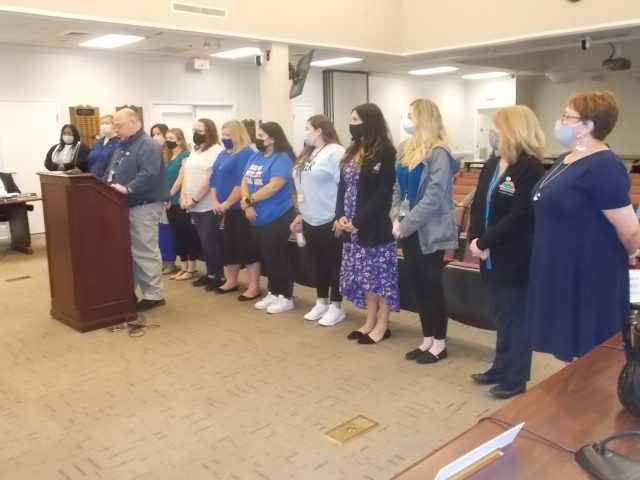
WCDSS Director Jon Martz and staff being acknowledged for their year-round work on behalf of the community’s children, as the supervisors acknowledge April as Child Abuse Prevention Month.
After other reports it was down to budget business. Among that business was authorization to advertise for Public Hearing an FY-22 Warren County budget of $124,614,829 – there must have been some late cuts to the $126,592,012 work session total presented March 20, further assuring there will be no tax increases tied to this budget. But if no tax hikes were a sure thing, not so on some departmental and school board requests.
About those Ford Explorer SUVs
First under the microscope was County Building Official David Beahm’s departmental vehicle request for a 2021 Ford Explorer through a State Purchase Contract at a price of $30,320.82. The agenda packet staff summary noted “the vehicle will be used by the office to perform daily job assignments which include site inspections, emergency calls, site investigations, meeting and other duties.”
Questioned about the type of vehicle, Beahm traced the department’s history with a pickup trucks, including extended cab models, which ultimately proved counterproductive to the type of space suited to departmental needs and protection of code books and other materials carried to jobs.
Responding to a price comparison question from Chairman Cullers, Beahm acknowledged a $2,000 cheaper price for a “Colorado” model SUV. However, Beahm pointed to 3 miles less per gallon that the Colorado gets compared to the Explorer. It had been calculated with the average annual mileage racked up by the department that equated to a loss of $500 per year in fuel expenses, which Beahm pointed out made the additional $2,000 spent to purchase the Explorer a moot point after 4 years.
While money could be saved buying used vehicles, depending on how used that would take some years off the length of service to the department. Interim County Administrator Ed Daley pointed out that the quoted price for a new model SUV of Explorer quality through the State contract was a good price. Daley also noted that various dealerships periodically offered “significant savings” incentives to switch to their models, making brand variables vary from year to year. Questioned about the dominant make of County-purchased vehicles, including the sheriff’s office, Daley said he believed it was Dodge.
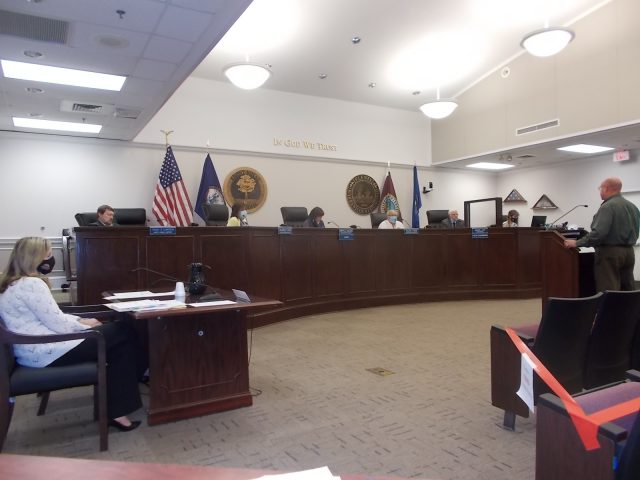
Seated at left, Deputy County Administrator/Planning Director Taryn Logan awaits her turn to present a planning department vehicle purchase request as Building Code Official David Beahm, at podium, is grilled on his department’s identical request.
After 21 minutes of grilling, on a motion by Delores Oates, seconded by Archie Fox, the purchase request was approved unanimously.
Next up was the same vehicle purchase request at the same price by the Planning Department, also through the State purchase contract. With the logistical questions around why this model at this price having been answered over the previous 21 minutes, Deputy County Administrator/Planning Director Taryn Logan saw the planning department’s request approved after a five minute Q&A.
School Surplus funding request
Also in the board’s budget cross hairs Tuesday was Warren County Public Schools Superintendent Chris Ballenger. Ballenger was present to answer questions about the schools budget, particularly the recent request that $2.38 million in FY-20 school system surplus funding be appropriated to the public schools FY-22 budget on three fronts. As the staff agenda summary noted, those fronts are the School Capital Improvement Fund ($1 million); the School Transportation Fund ($1 million); and the School Textbook Fund ($380,365).
Discussion by North River Supervisor Oates and Chairman Cullers indicated a desire to keep the surplus funding under direct control of the supervisors until specific requests for portions of it to specific uses as cited in the budget request were made by the school board. Acknowledging the board’s desire to dole out money for specific capital improvements and school bus purchases, Interim County Administrator Ed Daley expressed some confusion on the intent with the School Book Fund disbursement.
“You don’t want them to say, ‘We want to purchase this book or this book’?” Daley asked of board oversight of specific textbook purchases.
“No, we’re not getting into the selection of curriculum – we’re just making sure the funds are available when needed,” Cullers replied.
“Because they had requested the $380k to go to the School Textbook Fund directly for the textbooks, we’re kind of duplicating on that part if we set up a County Textbook Fund … if all you want to know is that it goes to textbooks because they can’t use it for anything other than textbooks,” Daley said of the process as applied to textbook purchases versus transportation or capital improvement funds that have myriad aspects to them.
“Basically what we’re doing is setting up a savings account for you – the money’s going to be there, and it’s assured to be there. I would think it’s kind of a win-win because you know you’ve got this, set off to the side and it’s not inadvertently on your side to be a temptation to pull from,” Cullers told the schools superintendent in his first year on the job here.
After another approximate 20-minute conversation on the appropriation dynamics of the surplus funding transfer, on a motion by Oates, seconded by Walt Mabe, the board unanimously approved the use of the $2.38 million by the school system as represented, without yet appropriating the money to the direct control of the school board.
Background
That there were questions about past school budget appropriations and expenditures was illustrated in one page of the budget packet containing an April 5 email from Ballenger responding to a question raised by Chairman Cullers, apparently at a joint supervisors-school board budget work session. That question revolved around a current FY-21 appropriation to hike staff salary scales for teachers, Instructional Assistants and Nurses that did not reach the “IA’s or nurses. It might be noted that Cullers is a retired school system nurse.
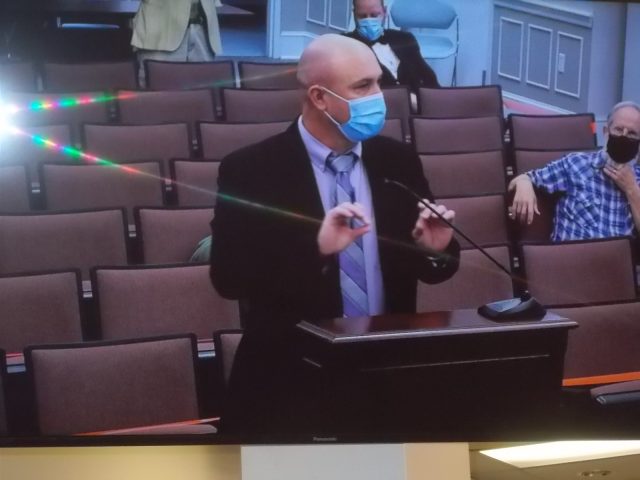
It’s WCPS Superintendent Chris Ballenger’s turn to face scrutiny on how the school board really might, or might not, spend requested surplus allotments.
After prefacing his explanation by welcoming the supervisors support and due diligence in exploring submitted budgets, Ballenger wrote, “Mrs. Cullers was correct in stating that the Board of Supervisors (BOS) gave Warren County Public Schools (WCPS) funds this year to help correct the IA and Nurse salary scales, as well as the teacher scale. The reason WCPS did not address the IA and Nurses scales this year was that WCPS was projected to receive a reduction in state funding.”
Ballenger continued to explain that after the FY-21 budget was approved the school board had received the news of “a hold back on state sales tax and to expect a reduction in overall state funding.” While not specified, that reduction was likely related to projected declines in state sales tax revenues related to the COVID-19 pandemic emergency responses limiting business activities due to social distancing parameters and executive orders in that regard.
“Since the majority of projected new revenue were state funds, we were not able to address all three salary scales,” Ballenger continued, adding, “Therefore, when going into this school year with the expectation of a revenue loss, WCPS decided to hold back the other adjustments to ensure that funding was available to make it through the school year.” Ballenger added that “In hindsight” the held salary scale funds had not been necessary to balance the budget but had been considered a necessary precaution to avoid a repeat of shortfalls experienced in 2009.
And so the Fiscal Year-2022 Warren County Budget process proceeds towards its April conclusion – without any tax increases, if with some pointed scrutiny of its own departments’ and the School Board’s shares of that $124.6 million dollar budget.

Virginia State Police Urge Sober Plans for Saint Patrick’s Day Celebrations

In a One-Party County, Internal Party Decisions Affect Us All

Virginia State Police Seize Nearly 100 Pounds of Narcotics, Recover Firearms in Weekly Crime Suppression Effort

Barton Charles “Bart” Haller (1940 – 2026)

Dawn Lee Dodson (1970 – 2026)

Mary Helen “Nanny” Spires Johnt (1954 – 2026)

Another Round of ‘Momnibus’ Bills Are Headed Towards the Governor This Year

Virginia Joins States Challenging Trump Admin Regulations That Limit Free Birth Control Access

Update: Charlotte Swanson Smith (1951 – 2025)
Why We are Challenging the Republican Mass Meeting

Bruce Norman Showman (1954 – 2026)

EDA Relaunches Small Business Loan Program to Help Warren County Entrepreneurs Access Capital

Targeted Exercises to Improve Your Putting

The Hidden Risks of House Hunting Solely Online

Choosing the Right Cleaner for Every Surface in Your Home

New Church Among Consent Items at County Planning Commission Meeting

Warren County GOP Mass Meeting Results Challenged After Allegations of Voting Irregularities

‘This Is About Equity’: In Richmond, Virginia Workers, Lawmakers Push for Inclusive Labor Rights for All

After Five Years of Attempts, Virginia On Track to Set Up a Prescription Drug Affordability Board

New Drug Take-Back Box at Warren County Sheriff’s Office Offers Safe Way to Dispose of Medications

‘Feeding Our Neighbors’ Continues Local Effort to Provide Free Meals in Front Royal

Blair David Eller (1963 – 2026)

Writing Workshop at Samuels Public Library Aims to Help Community Communicate More Clearly

Simple Steps to Reduce Wildfire Risk Around Your Home
