
Local Government
Attorney replies to Town press release on Meza appointment
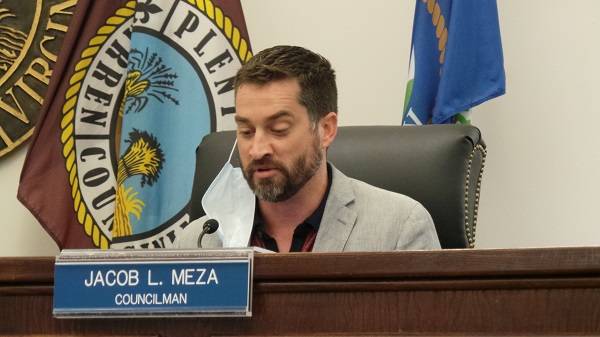
Jacob Meza first served as an appointed councilman to fill a vacancy, then was elected to retain that seat. Now he has again been appointed after deciding not to run for reelection in 2020 – but is that appointment legal by the Town Charter? Legal opinions vary. Royal Examiner File Photo/Roger Bianchini
The Town has taken a common legal phrase, “under the jurisdiction of”, out of context in an effort to manipulate and distort a common sense reading of the Town Charter. While the mental gymnastics are impressive, closer scrutiny of the Town’s analysis reveals their fallacies.
First, the Town maintains that (Charter) § 47 is not applicable to councilmen because it is referenced in “Chapter 6 Town Officers”. However, “Captions are intended as mere catchwords to indicate the contents of the subtitles”, Virginia Code § 1-244, Jones v. DCSE, 19 Va. App. 184 (1994). Moreover, the Town’s argument that the chapter only applies to “town officers” (assumes that councilmen are not “officers”) is contradicted by the specific language found within § 47 of the Charter. Specifically, it permits appointment of “one of the members of the council as town treasurer”!!! Interesting, since the Town asserts this section does not apply to members of the town council. If the Founding Fathers intended to authorize appointments to council within one year of their term, they could have added that exception as they did for town treasurer.
Second, the Town asserts that Virginia Code § 15.2-1535(A) enables appointment to Town Council of a previous Town Council member. This is a correct, but incomplete, statement of law. The Virginia General Assembly permits “a member of a governing body may be named a member of such other boards, commissions, and bodies as may be permitted by general law”. Where the Town Charter precludes appointment for one year after serving as councilman, the Virginia Code would NOT permit appointment by general law. Consequently, the Town’s assertion that the Code allows appointment “without any time restrictions” is contradicted by the statute which the Town relies upon.
Third, the Town interprets the legal phrase, “under the jurisdiction of” to argue that the office of councilman is not “under the jurisdiction of” the town but of the Commonwealth. This is a fascinating position. If the Town is sincere in this belief, then the Commonwealth, not the Town Council, should be appointing councilmen for vacant seats. Of course, that would render the Town Council appointment of Mr. Meza unlawful, not to mention, contradict the preceding paragraph where the Town argues that the Town has the authority to appoint councilmen. The Town’s assertion that the “Town Council is not under the jurisdiction of itself” ignores the context that the legal phrase is modifying. This phrase in § 47 modifies “any office” which is under the jurisdiction of the council. If the Town Council has the authority to appoint councilmen (previously agreed to by the Town), then appointment is under the jurisdiction of the Town.
Fourth, the Town Attorney is interpreting this statute to “not allow ‘double dipping’ or ‘conflict of interest’ where a Town Council member is also an employee of the local government which he serves.” However, this interpretation is inconsistent with § 47 as a whole because the section makes councilmen ineligible to hold office “for one year thereafter”. Consequently, they would not be both a town employee and councilman at the same time. The purpose of this statute was to minimize nepotism and appearances of impropriety by precluding town council to appoint their former colleagues for one year. The Town’s novel interpretation contradicts the clear intent of the Town Charter.
Unlike the Town’s analysis, this analysis is in harmony with the State Code.
David Downes
Front Royal/Warren County

Virginia State Police Seize Nearly 100 Pounds of Narcotics, Recover Firearms in Weekly Crime Suppression Effort

Barton Charles “Bart” Haller (1940 – 2026)

Dawn Lee Dodson (1970 – 2026)

Mary Helen “Nanny” Spires Johnt (1954 – 2026)

Another Round of ‘Momnibus’ Bills Are Headed Towards the Governor This Year

Virginia Joins States Challenging Trump Admin Regulations That Limit Free Birth Control Access

Update: Charlotte Swanson Smith (1951 – 2025)

Why We are Challenging the Republican Mass Meeting

Bruce Norman Showman (1954 – 2026)

EDA Relaunches Small Business Loan Program to Help Warren County Entrepreneurs Access Capital

Targeted Exercises to Improve Your Putting

The Hidden Risks of House Hunting Solely Online

Choosing the Right Cleaner for Every Surface in Your Home

New Church Among Consent Items at County Planning Commission Meeting

Warren County GOP Mass Meeting Results Challenged After Allegations of Voting Irregularities

‘This Is About Equity’: In Richmond, Virginia Workers, Lawmakers Push for Inclusive Labor Rights for All

After Five Years of Attempts, Virginia On Track to Set Up a Prescription Drug Affordability Board

New Drug Take-Back Box at Warren County Sheriff’s Office Offers Safe Way to Dispose of Medications

‘Feeding Our Neighbors’ Continues Local Effort to Provide Free Meals in Front Royal

Blair David Eller (1963 – 2026)

Writing Workshop at Samuels Public Library Aims to Help Community Communicate More Clearly

Simple Steps to Reduce Wildfire Risk Around Your Home

Lyme Disease Cases Continue to Rise as Tick Season Returns

County Receives 5 More FY-27 Budget Overviews Prior to Closed Meeting on Administrator Search & Business Expansion
