
Local Government
Auxiliary Dwelling Units Revisited at Town Planning Commission Work Session
ADUs have been the subject of an ongoing exchange between the Town Planning Commission and the Town Council, with the former recommending an ordinance for ADUs that has at times raised concerns among council members about being too restrictive and, from at least one member, not being restrictive enough. Vice Chairman Allen Neel of the commission stated at a Thursday, December 18 work session that the council had not provided clear direction when it sent the item back to the commission for further review. Neel presented to the commission a recommendation package intended to provide the council with the critical information it may need to respond to the commission’s recommendation that the proposed ordinance be adopted as is.
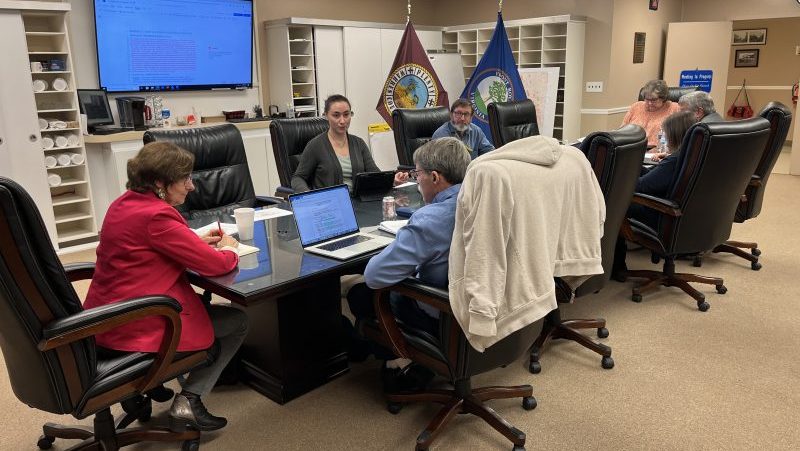
The Town Planning Commission will hold an uncharacteristically short regular meeting, followed by a work session, on Thursday, December 18. Royal Examiner Photo Credits: Brenden McHugh.
It is important to remember that the zoning ordinance currently allows accessory dwelling use by right in the R-1 residential district, though not potentially at the density this proposed ordinance would allow. One might ask: Is such a move towards greater density for this zone in keeping with R-1 character? At least, Councilman Bruce Rappaport is asking that question.
The statement of intent for R-1 from section 175-11 of the code reads as follows: “The R-1 District is composed of quiet, low-density residential areas, plus undeveloped areas where similar residential construction appears likely to occur. The standards set forth for this district are designed to stabilize and protect the essential character of the areas so delineated, to promote and encourage a suitable environment for family life where there are children, to provide areas for suitable expansion of the Town as facilities are provided, and to prohibit all commercial activities. Development is therefore limited to relatively low concentrations, and permitted uses are limited to single-unit dwellings and selected additional uses, such as schools, parks, churches, and certain public facilities that serve district residents. Mobile homes or rooming houses are prohibited.”
Should ADUs also be prohibited for R-1? In higher-density zones like R-2 and R-3, they might not be as obtrusive, whereas in R-1, they could be perceived as an existential threat. It is also important to balance this concern with the benefits ADUs provide in terms of affordable housing for young and older adults living with family. The commission’s findings addressed many concerns, such as the impact on parking, and reached the bottom line that if ADUs are prohibited in the R-1 residential district, ADU policy becomes meaningless in practice. This argument is supported by statistical findings on how ADUs are used nationally and the high percentage of parcels zoned R-1 in Front Royal.
Much of the conversation at the work session focused on the scope of the proposed ordinance, including, but not limited to, owner-occupied property. One might ask: how would this be enforced? The commission explored the implications of confirming owner occupancy at the time the building permit is conveyed. It was assumed the owner would not want to be caught subsequently violating the occupancy rule by renting out both the primary and accessory dwellings, as it could leave the owner with an unusable ADU structure on the property.
After separately reviewing the draft ordinance for the mixed campus development district and the industrial zones, the commission adjourned.
Click here to watch the Front Royal Planning Commission Meeting of December 18, 2025.

French Earl Tolliver, Jr. (1960 – 2026)

5 Tips to Prevent Sports Injuries

Standardbred Owners Ainspan, McDonald Each Score Thoroughbred Wins at Colonial Downs’ Virginia Derby Meet

Most Dangerous Cycling Scenarios Involving Cars

VDOT: Warren County Traffic Alert for March 23 – 27, 2026

Virginia State Police Seize $22.4 Million in Drugs, Recover Firearms in Weeklong Operation

Virginia Home Sales Rise in February as Inventory Grows, Spring Outlook Uncertain

Bing Crosby Stadium Hosts Warren County–Skyline Baseball Battle Tonight

Warren Supervisors Address Audit Contract, Permits, and Property Sale at March 17 Meeting

Here’s How Virginia Lawmakers Suggest the Next State Budget Handle Federal Health Care Funding Fallout

Spring Essentials Checklist: Prepare Your Home for Summer

Virginia Joins National Push for Refunds After US Supreme Court Voids Trump Tariffs

Four Reasons to Consider Hiring a Professional Cleaning Company

Ask the Expert : We Are Applying for a Mortgage Soon. What Kind of Documents Will We Need?

Charles Michael “Rusty” “Chuck” Fischbein (1944 – 2026)

Jerrold E. “Jerry” Groves (1931 – 2026)

Town Planning Commission Moves Forward with Industrial Zoning, Holds Preliminary Discussion of Urban Agriculture

Schools Push for Budget Flexibility, Consistent Funding as Needs Grow

Skyline High Teams, Athletes Successful Seasons and Performances Acknowledged – Oh, and Those Roosters

School Board Seeks to Restore Meals Tax Funding for School Facilities

Wasting Drinking Water: 3 Habits to Eliminate From Your Daily Routine

Medicare Launches TEAM Program to Improve Recovery After Surgery

Izaak Walton League Promotes Conservation and Outdoor Programs at Community Forum

POLICE: 7 Day FRPD Arrest Report 3/16/2026
