
Interesting Things to Know
Church cemetery wrought iron fence history recently revealed
No one knew the date the wrought iron fence was installed on the east side of the Stephens City United Methodist Church (SCUMC) cemetery grounds. It is believed the iron gate served the third church as the entrance to the SCUMC cemetery. Eighty feet of the iron fence remains today and church elders wanted to ascertain when it was manufactured. We do know that an American wire fence bordered most of the cemetery in the 1930s through the 60s and still exists on the north side.
On this site, construction of a log meeting house began in 1788 and was completed in 1789. The cemetery was established in 1790 and the oldest tombstone dates to 1809 and the newest to 1906. The log meeting house served until 1827 when it was torn down and replaced with a brick one on the same site. During the Civil War, the church suffered considerable damage as the sanctuary was used as a hospital to treat both federal and confederate wounded soldiers. The 1827 church sanctuary was repaired after the war, but eventually the church was considered “unsafe” and “uncomfortable” for worship. In 1882, the congregation replaced the 1827 building with a more spacious facility on the same site. It was noted at the time that the foundation of the old log church could be seen when the 1827 building was demolished.
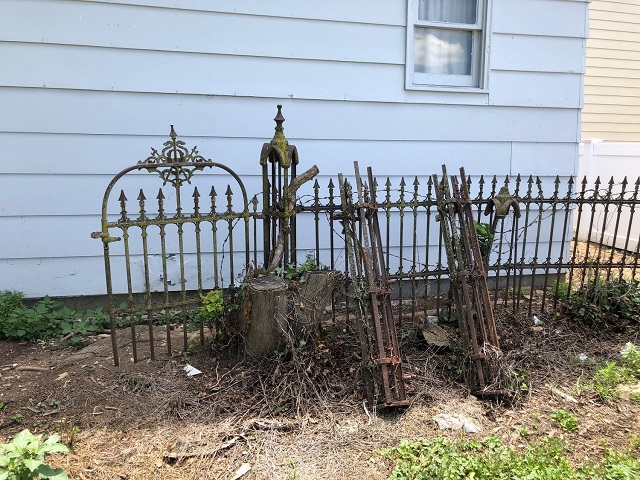
Recent investigation discovered the wrought iron cemetery fence was installed after completion of the third SCUMC in 1882. The church served the congregation until 1915, when a new church was constructed a short distance south on the corner of Main and Locust Streets. The commercial building in the background, replaced the old church and was built for the telephone company, (now All Nation Hobby and Model Supply) in 1946. Courtesy Mark Gunderman.
I discovered two ornate old wrought iron corner fence posts (in the photo above) buried near the 120-year-old elm tree that was cut down in February 2020 to make way for an expanded children’s play area. Fences around cemeteries, especially wrought iron fences, served both practical and otherworldly purposes. In terms of practicality, wrought iron fences were placed around a cemetery to prevent wild animals from entering the grounds and digging up recently buried human remains. Our Colonial ancestors wanted to be assured that the remains of their loved ones would be well intact for their resurrection on Judgment Day, so they erected sturdy and gated wrought iron fences with spear tipped bars.
Wrought iron fences were also placed around cemeteries to protect the living from the spirits of the dead. People believed that the ghosts of their dead loved ones could follow them from the cemetery if preventative measures were not made. Iron was believed to ward off both benign and evil spirits. Just as it was believed that spirits could not cross water, so it was believed that they could not move through or past iron. If you have ever seen an iron fence that has the upper portion of its bars pointed in towards the cemetery — rather than away from the grounds — you can be assured it was constructed that way to ward off spirits.
Wrought iron (sometimes called puddled or charcoal iron) is the traditional material of the blacksmith. It is a mixture of nearly pure iron and can resist corrosion, is not brittle and seldom breaks. It is soft, relatively malleable and easily worked. As a result, it is often found as delicate artwork.
According to Sandra Bosley, executive director of Preservation of Historic Winchester, the gate decoration appeared to be similar to the 1880 “Buckeye” wrought iron fence. Bosley virtually visited the remnants of the wrought iron fence for some historical investigation. The eighty feet of fence fortunately retained the gate, which is one of the most likely places to find a manufacturer’s mark or other distinguishing maker characteristics. This gate was by far the most distinctive Bosley had the pleasure of examining, with an elaborate crest on the top with crossed halberds, heraldic sea snakes, and scroll-like decorative flourishes around the central finial. Although the label where the maker’s mark should be was long worn away by time, the gate design alone was unique enough that Bosley could say with relative certainty it was a “Buckeye” wrought iron fence from the 1880s.
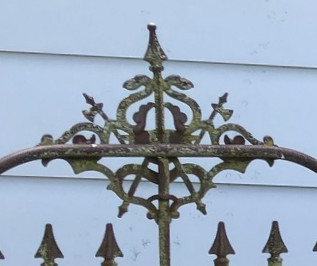
Detail of the fence with a distinctive gate ornamentation that provided the key to the manufacturer and thus its age. Courtesy Mark Gunderman.

The catalogue image of the Buckeye gate ornamentation – exactly as advertised. Courtesy Sandra Bosley.
Naturally, having found such a distinctive architectural piece but never having heard of it before, it seemed like a good time for Bosley to do a little more investigation into the parent company. Buckeye fences were just one of the products produced by Mast, Foos & Company. Although founding dates have been contradictory, Bosley was inclined to believe the company was founded in 1876 by Phineas P. Mast and John Foos in Springfield, Ohio, after Mast had undertaken earlier ventures in buggy and farm implements. In addition to the Buckeye fence, the company also produced wind engines, force pumps, lawn mowers, and lawn sprinklers. The company existed for almost 100 years after various acquisitions and remains well-known in Springfield, Ohio, particularly as Phineas P. Mast helped to found the local historical society.
The late historian Mildred Lee Grove’s grandfather, Milton Boyd Steele was a Stephens City resident and a devout Methodist and Sunday School teacher. I am speculating that Mr. Steele, who was in the mercantile trade, had a long-time business relationship with Mast & Foos and recommended that the Methodist church purchase their fence from that company in 1882.

Virginia’s Newest Troopers Include Descendant of WWII Hero Desmond Doss

Virginia State Police Ongoing Crime Suppression Operations, Recovering Firearms, Narcotics, and Investigating Human Trafficking

Democrats Try to ‘Balance’ Renters’ Rights With Landlords’ Rights in Proposed Housing Bills

Virginia Delegate’s Bill Would Limit Where High-Voltage Transmission Lines Can Be Built

Freedom 250 IndyCar Race to Bring Speed and Spectacle to Nation’s Capital in August

What to Do and What Not to Do If You’re in a Car Collision

US Senate Poised to Send House Spending Deal in Race to Avert Partial Shutdown

Robert Glenn “Bob” Coverstone (1942 – 2026)

Trump Launches Great American Recovery Initiative to Address Addiction Crisis

Battery Technology Leading the Renewable Revolution

Children Activities by Samuels Public Library for the Month of February

Muley Fanatic Foundation’s 7th Annual Banquet Brings Conservation and Community Together
Jane Duble Riddleberger
Sean G. “Bubba” Collins (1989 – 2026)

William “Bill” Hamilton Rhodes I (1941 – 2026)

POLICE: 7 Day FRPD Arrest Report 1/26/2026

Blue Ridge Wildlife Center Patient of the Week: Red-tailed Hawk

Lawmakers, Virginia Native Tribes Pitch Education, Sovereignty Reforms to Address Historic Injustices

Warren County Government Acknowledges Employee Milestones

White House Marks McKinley’s 183rd Birthday with Tribute During America 250

Recently Hired County Administrator Bradley Gotshall’s Resignation Accepted After Largely Closed Special Meeting

Grandma’s Maple-Apple Upside-Down Cake

Virginia Lawmakers Try Again on Paid Sick Leave and Family Medical Leave Bills

New ‘Heart Percentile’ Tool Estimates Long-Term Risk of Heart Disease
