
Local Government
Council approves tax decrease, ponders COVID-19 revenue shortfalls
Following a remote, virtual world hook up work session discussion and adjournment to a virtually conducted Special Meeting Monday night, April 20, the Front Royal Town Council rolled ahead with its planned half-cent Real Estate Tax reduction despite myriad revenue shortfall scenarios flowing into the next fiscal year from the COVID-19 Coronavirus pandemic economic impacts.
By a 5-1 vote, Letasha Thompson dissenting, on a motion by Jacob Meza, seconded by Vice-Mayor Bill Sealock, council voted to reduce the Town Real Estate Tax Rate from 13.5 cents to 13 cents per $100 of assessed value and to keep the personal property tax rate flat at 64 cents per $100 of assessed value. Also included were decreases to the personal property tax relief rate – from 56% to 53% on the first $20,000 of the assessed value of qualifying vehicles, and a 100% relief on qualifying vehicles assessed at under $1,000.
Numbers included in the agenda staff summary of the tax rate proposal indicated $129,257 of tax revenue for every penny of real estate tax collected by the Town. So, while it appears to be only $64,628 of lost revenue at issue, it comes at a time the Town is pondering potential revenue shortfalls in the millions of dollars, as well as an emerging need to provide emergency financial assistance to citizens impacted by COVID-19 business closings and layoffs.
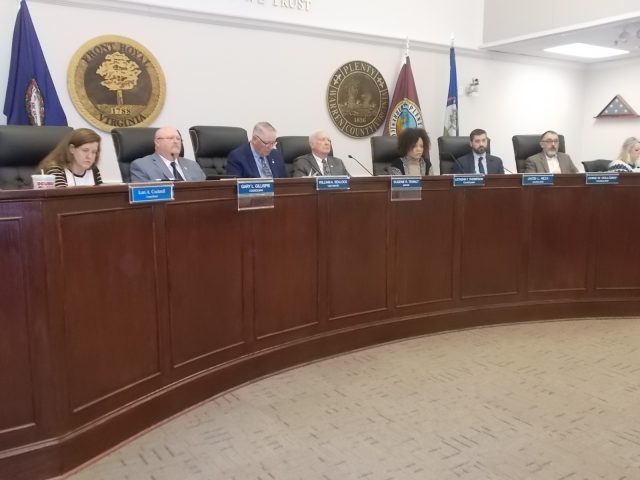
Remember the good, old days when municipal meetings were up close and personal, and there were no new viruses lurking about to take a shot at taking some of us out of here? We thought you might need a reminder, or two, from late January and early February. Royal Examiner File Photos/Roger Bianchini
Administrative staff and council continue to look at additional work sessions as they approach budget deadlines for the coming Fiscal Year 2021 in an uncertain financial landscape. One Monday night work session suggestion from Interim Town Manager Matt Tederick was to approve a contingency budget by the June deadline – the fiscal year begins July 1 – and review and tweak that budget on a monthly basis as the financial landscape evolves moving forward into the next fiscal year.
Following a power point presentation on “Options for Local Economic Recovery” Tederick presented work session numbers forecasting as much as $3,137,361 in potential revenue shortfalls, including General Fund ($1.37 million) and Utility/Enterprise Fund revenue shortfalls ranging from $720,845 (Electric Fund), $415,210 (Water), $391,530 (Sewer), and $35,028 (Refuse/Trash).
However, those numbers were dramatically reduced by cuts labeled “Contingency Transfers” slashing projects, planned merit and compensation study pay increases, insurance coverage, training, staffing, overtime and service cuts. Those cuts actually reduced that projected system-wide $3.137-million revenue shortfall to $261,636.
Tederick has been the architect of the Fiscal Year-2021 and end of Fiscal Year-2020 town government departmental and staff downsizing plan he has labeled “right-sizing” to facilitate reductions in Town budgets, present, and future. As the budget process has progressed from the first late January staff terminations that included the Planning Department and Community Development directors, among others, as well as recommended Tourism Department cuts, it has become apparent Tederick has the blessing of his fellow county Republican Committee members’ five-seat council majority.
And it appears if the pandemic-fueled revenue shortfall scenario takes a worst-case turn as the new fiscal year progresses, it will be with further departmental and staff cuts that council will meet those additional shortfalls.
On April 20, the council debated whether Town administrative and departmental staff should hear about the potential of additional staffing cuts as part of the budget process by public meeting broadcast or internal meetings.
Thompson, who as noted above cast the only dissenting vote against the tax rate proposal, worried that town staff would learn of the possibility of additional cuts to their numbers from the broadcast of the April 20th work session discussion. Had there been any preparatory briefing within departments to brace staff for the evening’s public discussion of the potential of additional staffing cuts to balance the town budget, Thompson wondered.
And while the answer was “no” other than with department heads in evaluating the most expendable staff with town administration, Tederick said he believed the bulk of personnel cuts, if it came to that, could be achieved by not hiring replacements for staff who were planning to or have already left the town government.
Earlier in the budget process, Tederick was referred to by county Republican Committee Treasurer Amber Poe Morris as “Front Royal’s Trump” for the amount of public criticism he was receiving over personnel and budget matters. Perhaps mirroring the Trump Administration policy over three-plus years of leaving cabinet and other federal positions unfilled or manned by lengthy interim appointments, on Monday Tederick estimated the town government currently was carrying “18 to 19 unfilled positions”.
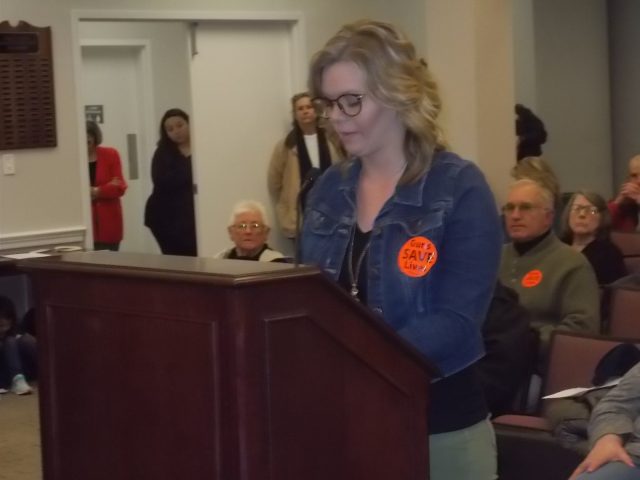
At Feb. 10 council meeting, Amber Poe Morris let everyone know she is pro-gun, pro-Trump and pro-Matt as the interim town manager came under public fire for sudden, not-publicly-discussed staff terminations at the top of several Town Hall-based departments.
“We met with department heads and identified the critical hires. So, I think we can possibly get by – we’ll have that data for you more specifically as we go through this budget process – … I think we can go from 177 employees on our work chart for FY-19 to,” here Tederick struggled to pull up numbers he was searching for, continuing to estimate an 8 to 10 personnel cut “just by not rehiring people for vacated positions”. Contacted later, Tederick verified he was referencing numbers from the current Fiscal Year 2019-2020 budget.
He also told the council that during the current hiring freeze, discussion with department heads appeared to indicate an ability to reach the desired reduced expenditure levels without further personnel cuts or furloughs.
Of Thompson’s stated concern about employees learning of potential departmental personnel cuts through the council’s public discussion, rather than face-to-face discussion with supervisors, Councilman Meza observed, “We’ve also tried that route of talking to them before public meetings and that blew up in our faces. So, I’m going to be more candid about it now and say (while we haven’t talked to employees) I think generally speaking we need to understand that we have to look at the whole picture, which could include some furlough options, or temporary staff layoffs or something along those lines.
“As ugly as that sounds, I feel like if we have it stated here tonight in our budget discussions, then this isn’t some secret meeting … or some sort of hidden message that’s getting out there to the public …”
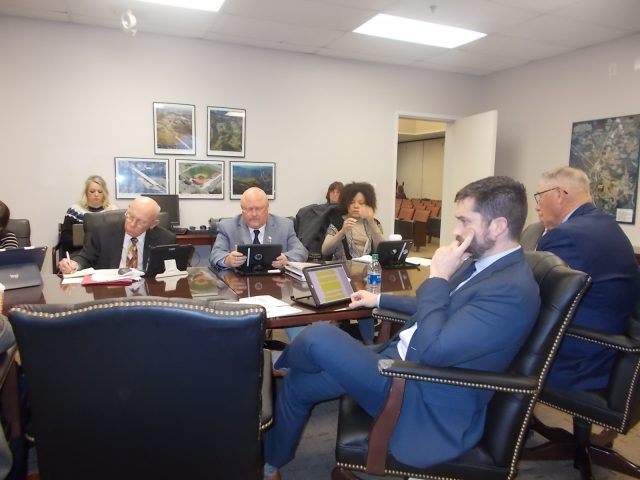
Municipal work sessions used to be up close and personal too – according to its JPG history this one is from Jan. 27, just prior to at least one council clerk, among other, terminations.
Referencing a 5% to 6% revenue shortfall estimate some municipalities are working with as a reference point for coming shortfalls, numbers based on the 2008 “Great Recession” experience which Meza observed he thought might be an underestimate of the consequences of the current financial situation, the councilman added, “If it comes in at 6% we’re still going to have a hard time hitting that. And if it goes past that, what’s the alternative?
“And our largest line item that we have is staff salaries and benefits,” Meza observed, adding, “I know I’m going to get a bunch of hate mail for saying that, but that is the cold, hard reality.” Another cold, hard reality, left unstated by an absent public, might be council’s unwillingness to back off a somewhat symbolic tax revenue reduction in the face of what several, including Meza, observed may be a revenue crisis of unprecedented proportions.
With that economic shadow hanging over its FY 2021 budget process, Councilwoman Lori Cockrell suggested future agenda information to help streamline discussion.
“As a general thought about the deficit, when we do come together and discuss these budget things, I was thinking even if we have, I won’t say a ‘hit list’, but like a list of priorities in each section, like if it’s only 4% (shortfall) these are the things we put back in; if it’s 8% then it’s these things, putting them in a priority list from like 1 to 10 … then we don’t each time have to go through re-saying this is important, this isn’t important,” Cockrell observed as budget deadlines loom.
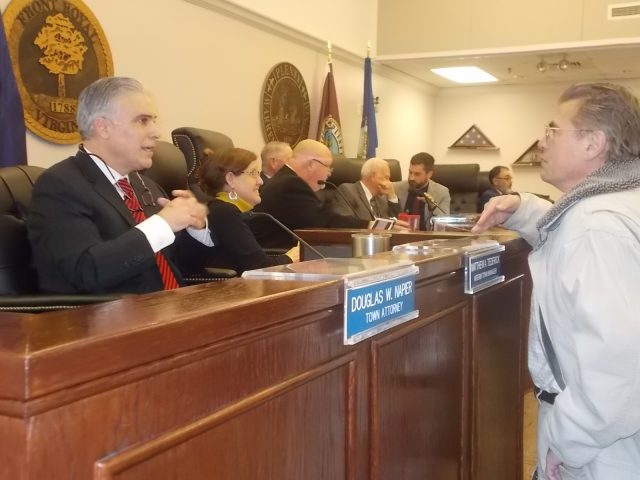
No social distancing here on Feb. 10 prior to the convening of Front Royal Town Council meeting.
As for the existing unfilled Town staff positions, Vice-Mayor Sealock wondered at those vacancies. “Well, let’s look at reality – and Matt, follow what I’m saying very carefully – the personnel, we have four critical positions in this staffing right now that we’re understaffed; that’s got to go forward,” Sealock suggested of filling department head and other top-level positions on a permanent basis.
“There are probably 18 positions that’s been requested but 10 of them will not be filled at this time,” the vice mayor observed, calling on the interim town manager for comment.
“That’s a good point, Mr. Sealock, and that is accurate. We looked at unfilled positions currently – I don’t have the spreadsheet in front of me – I believe we’re carrying about 18, 19 unfilled positions. Of the unfilled positions, we met with department heads and identified the critical hires. So, I think we can possibly get by – and we’ll have this data for you more specifically as we go through this budget process – but Mr. Sealock is not far off,” Tederick reiterated before visiting the above-referenced numbers of existing and potential reductions to the Town’s staff of 177 in the current fiscal year.
“We’re trying to go through this, first by a hiring freeze, which we’ve done. You have to realize also that we’ve taken $3-point-some million from this year’s budget and we’ve presented a budget with $3.1 million in next year’s; so within only a few months we’ve reduced the size of government by $6 million dollars,” Tederick told the town’s elected officials.
General Fund reserve for ‘Relief’
As he closed his “Recommended Options for Local Economic Recovery” work session presentation, Tederick told the council, “Our recommendation at this point is to keep the tax rate as advertised and let us offer the incentives to businesses and individuals through our Unrestricted Fund Balance. Again, in trying to calculate the relief, first of all, this relief would go to all citizens and all businesses, which in normal circumstances I think that’s a great thing; in this circumstance, if the goal of reducing the tax rate was to target businesses that are in need and target citizens who are in need, we feel that we can do that better by a program through the General Fund Balance, as opposed to lowering the tax rate.”
At the end of his “Local Economic Recovery” PowerPoint presentation Tederick noted that as of June 30, 2019, the final day of FY-2019, other than “OPEB Liability” the Town’s Unrestricted General Fund Balance was $2.02 million above the recommended 3-month reserve level. His recommendation was to utilize “up to $1.5 million” of those reserves “to be distributed to local citizens & businesses for relief”.
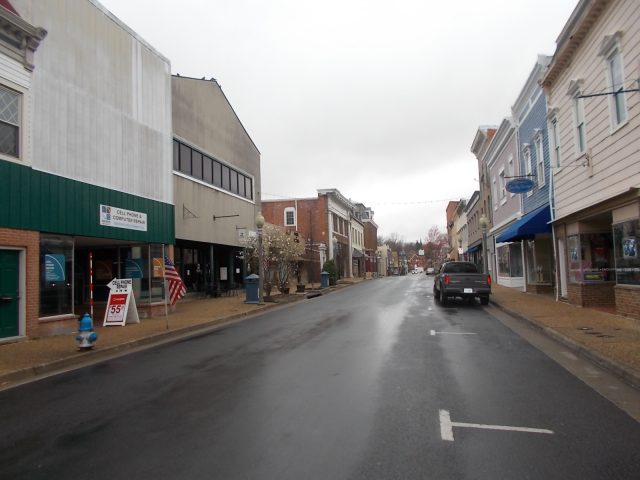
That empty downtown commercial district street, above; and town shopping center parking lot, below, are definite indicators of a coming Town commercial tax revenue shortfall.

Contacted Tuesday, Town Finance Director B. J. Wilson explained OPED Liability as a State-required estimate of future employee retirement benefits known as Other Post Employment Benefits that do not directly impact a fund balance in any given budget year.
Responding to more questions, Wilson also cited the recommended three-month General Fund Balance Reserve at $3.61 million; with the total Unrestricted General Fund Balance at $9,042,845; with Enterprise Fund Balances added the number rose to $11.9 million.
So, if our calculating on these numbers is correct, the interim town manager’s recommended “Relief” package reserve expenditure of $1.5 million would leave the General Fund Balance total reserves at $4.1 million, about $500,000 above that recommended three-month minimum reserve amount that helps municipalities maintain a good credit rating. But in this uncharted economic territory who knows how long that number might last.

But we don’t want to be apart anymore! – Of course, we do want to be and have those we love, uncontaminated by a disease that has now killed 40,000-plus of over 700,000 Americans known to have been contaminated by COVID-19 since the first case was reported here on Feb. 22, just two months ago.
Listen to the far-ranging work session discussion and presentations, and the special meeting vote and other agenda items in this virtual recording:


James Christopher “Chris” Sain (1948 – 2026)
Alice “Maybelle” Henson (1938 – 2026)

How Sleep and Stress Affect Cancer Risk

Spanberger Signs Sweeping Public Safety and Gun Violence Bills

Horses, Fans Return as Shenandoah Downs Season Begins

Skill Games Halted Again as Spanberger Issues Veto

VDOT: Warren County Traffic Alert for April 13 – 17, 2026

The Cat Who Outlasted Six Prime Ministers

Front Royal, Virginia. Vacation Destination?

Virginia State Police Report Major Drug Seizures in Weekly Crime Suppression Effort

Virginia Secures Birth Control Access as Other Southern States Eye Abortion Pill Manufacturers

SCC Approves Loudoun Transmission Line, Nixes Undergrounding; Final Route to be Determined

Slate of New Virginia Laws Address Health Care and Housing Affordability
James J. Coverston Sr. (1942 – 2026)

Business Growth Series: Your Biggest Problem Isn’t Competition — It’s Being Overlooked

Why Many Experts Say a Concussion Should Be Called a Brain Injury

Missouri Man Arrested in Undercover Operation Targeting Online Crimes Against Children

Trump Tax Plan Credited With Higher Refunds, Lower Taxes

Spanberger Vetoes Fairfax Casino Bill, Citing Local Opposition

Blue Ridge Point-to-Point Races Return Saturday at Woodley Farm

Legislative Effort to Buy Monroe’s Loudoun Estate on Pause, Budget Effort Underway

US House Democrats Call for Congress to Come Back Into Session for Iran War Debate

Virginia to Raise Minimum Wage to $15 by 2028 Under New Law

Spanberger Signs Bills to Aid Low-Income Utility Customers, Manage Power Demand
