
Local Government
Council majority moves to lock in half-cent real estate tax decrease
Perhaps the most telling moment in the Front Royal Town Council’s multi-faceted Wednesday evening did not occur at a Special Joint Meeting with its Planning Commission called to facilitate permitting to allow the installation of modular classrooms to allow A.S. Rhodes renovation work to proceed on schedule, nor during a dizzying council work session discussion of financial variables that threaten to jeopardize a $700,000 matching State/Federal funded Community Development Block Grant (CDBG) committed to physical redevelopment of downtown business frontages and the Village Commons and Gazebo area.

With Lori Cockrell abstaining due to her career in public education, the full Front Royal Town Council (right) and Planning Commission (left) minus one absence agreed after some debate on safety issues, to permit classroom modules during A.S. Rhodes Elementary School renovations in the coming year. Photos by Roger Bianchini. Video by Mark Williams, Royal Examiner.
While those two discussions dominated much of the council’s attention, it was a third discussion near the work session’s end related to the funding of the coming Fiscal Year 2021 budget that was an eye-opener on the council’s thought process for the coming budget cycle.
Despite ongoing uncertainty among some on council about the plan to privatize and outsource the Town’s Tourism marketing function in the wake of scathing public and impacted business owner criticism of that plan; and the seemingly unavoidable presence of $29 million in physical capital improvements in the coming budget year, a 5-1 council majority committed to advertising a Real Estate Tax Rate of 13 cents per $100 of assessed value in the coming year.
That rate will maintain Interim Town Manager Matt Tederick and the council majority’s desire to implement a half-cent Real Estate Tax rate cut in next year’s budget. Tederick has commented that implementation of a tax cut despite the coming capital improvement needs will be a sign of the Town’s economic strength despite the $15 million in lost assets it has thus far claimed in the Economic Development Authority (EDA) financial scandal.
Only Vice-Mayor Bill Sealock asked that council at least keep the option of maintaining the existing 13.5-cent Real Estate Tax Rate and Town governmental revenue stream where it is. Sealock explained he had serious concerns about the plan to outsource the Town Tourism function and suggested the $64,000-plus of revenue that half-cent of Real Estate Tax would provide could help fund Visitors Center operations in the next budget year.

To left, Mayor Tewalt and Vice-Mayor Sealock found themselves outnumbered 5-2 on keeping a flat real-estate tax revenue option at least available to the council.
As Mayor Gene Tewalt noted in also expressing a desire to keep the flat tax rate option open, once advertised a tax rate can be adjusted down, but not up. Following the work session, Town Finance Director B. J. Wilson told Royal Examiner that one option available should it become apparent that the Town will need to keep its current revenue stream to fund coming fiscal year capital improvements and operations, would be to re-advertise a tax rate higher than the 13-cent one currently poised to be put forward.
However, several council comments seemed to indicate that as an unlikely option.
Newly-appointed Councilwoman Lori Athey Cockrell said she was in favor of “keeping taxes as low as they can (be)” in voicing support for the half-cent real estate tax decrease being committed to this early in the budget process.
Then Jacob Meza pointed a path forward for council should it do an about-face on the Tourism Department – that path cuts to other town governmental functions to allow the half-cent Real Estate Tax reduction to stand.
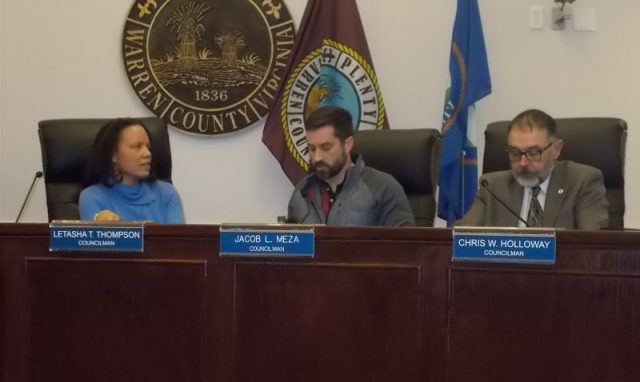
At center between Letasha Thompson and Chris Holloway, Jacob Meza may have spoken for the council majority when he said, if not tourism then another town department should be earmarked for outsourcing or cuts to its budget to facilitate a half-cent decrease to a real estate tax rate already 3.5 cents below the median level for Virginia towns.
“If the council wants to change something, I’d rather instead of keeping tax rates high or increasing taxes, figure out what other areas of the budget need to go … I want the council to find the areas that we’re willing to do without or willing to change. So again, if Tourism is the hot-topic button right now if that’s the direction the council wants to go, fine. Let’s figure out what other reductions we can have in the budget … because I can support some of the changes that we’ve made whereas the justifications were reducing some of our tax bases, not find other reasons to spend the money and increase it again,” Meza said.
Following Meza’s call to reduce the town governmental function in some, even as-yet-undetermined way, rather than keep tax revenue at existing levels, Mayor Tewalt polled council on its preference on a rate to advertise. And as noted above, only Sealock expressed support of keeping the option of a flat Real Estate Tax open to the council as a means of funding the Visitors Center function.
Beginning with Cockrell’s call to keep tax rates as low as possible in support of the 13-cent rate advertisement, Gary Gillespie, Letasha Thompson, Meza, and Chris Holloway all concurred to advertise the 13-cent rate, cementing in the $64,629 of lost Town revenue in the coming budget year.
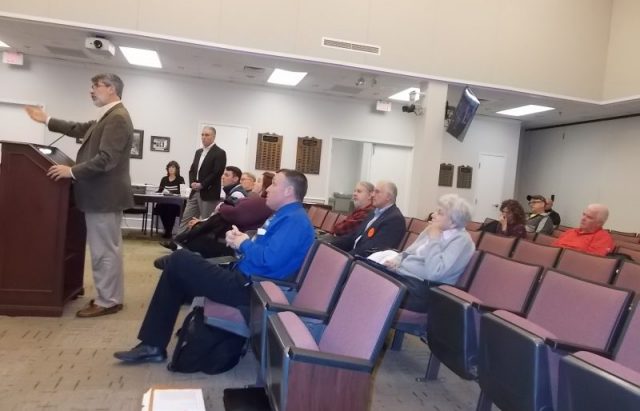
Town Finance Director B. J. Wilson, seated blue shirt, and other Town and County staff, citizens and downtown business owners listen to consultant Craig Wilson traverse the complex and expensive bidding ground of Community Development Block Grant programs and processes. Stay tuned as the interim town manager was instructed to keep council posted on developments as a mid-September deadline approaches and a ‘materials only’ option on façade and other improvements are considered to reduce an exorbitant bid price.
The following day we called Town Finance Director Wilson to see where the Town of Front Royal ranks statewide with its municipal real estate tax rate. While he did not have specific rankings, Wilson noted that the Median Real Estate Tax Rate for Virginia towns is 17 cents per $100 of assessed value. So, the Town’s existing 13.5-cent rate was 3.5 cents below the Virginia town median; the proposed cut will take that to 4 cents below the median level.
According to staff numbers included in the work session agenda packet, the revenue produced at the 13.5-cent real estate tax rate in FY 2020 was $1,744,970. The proposed FY 2021, 13-cent rate will provide $1,680,341, or as observed above, a $64,629 reduction.
Council decided to keep the Personal Property Tax rate flat at 64 cents per $100 of assessed value. That rate provided $597,872 of tax revenue to the Town last year.
See the full Town Council-Planning Commission Special Meeting and council work session in linked Royal Examiner videos:


Virginia State Police Urge Sober Plans for Saint Patrick’s Day Celebrations

In a One-Party County, Internal Party Decisions Affect Us All

Virginia State Police Seize Nearly 100 Pounds of Narcotics, Recover Firearms in Weekly Crime Suppression Effort

Barton Charles “Bart” Haller (1940 – 2026)

Dawn Lee Dodson (1970 – 2026)

Mary Helen “Nanny” Spires Johnt (1954 – 2026)

Another Round of ‘Momnibus’ Bills Are Headed Towards the Governor This Year

Virginia Joins States Challenging Trump Admin Regulations That Limit Free Birth Control Access

Update: Charlotte Swanson Smith (1951 – 2025)
Why We are Challenging the Republican Mass Meeting

Bruce Norman Showman (1954 – 2026)

EDA Relaunches Small Business Loan Program to Help Warren County Entrepreneurs Access Capital

Targeted Exercises to Improve Your Putting

The Hidden Risks of House Hunting Solely Online

Choosing the Right Cleaner for Every Surface in Your Home

New Church Among Consent Items at County Planning Commission Meeting

Warren County GOP Mass Meeting Results Challenged After Allegations of Voting Irregularities

‘This Is About Equity’: In Richmond, Virginia Workers, Lawmakers Push for Inclusive Labor Rights for All

After Five Years of Attempts, Virginia On Track to Set Up a Prescription Drug Affordability Board

New Drug Take-Back Box at Warren County Sheriff’s Office Offers Safe Way to Dispose of Medications

‘Feeding Our Neighbors’ Continues Local Effort to Provide Free Meals in Front Royal

Blair David Eller (1963 – 2026)

Writing Workshop at Samuels Public Library Aims to Help Community Communicate More Clearly

Simple Steps to Reduce Wildfire Risk Around Your Home
