
Local Government
Council will advertise flat tax rates for FY-22; forwards pedestrian crossing signal on North Shenandoah Avenue
After observing that the Fiscal Year 2022 Town Budget proposal was constructed on the premise of no tax increases being necessary to support it, Front Royal Director of Finance B. J. Wilson asked the town’s elected officials for additional feedback at the February 16 work session before making his recommendation on advertising real estate and personal property tax rates for the coming fiscal year. The existing Real Estate Tax Rate is 13 cents per $100 of assessed value, the Personal Property Tax Rate is 64 cents per $100 of assessed value.
With council’s two new members, Lloyd and McFadden, facing their first municipal budget process, Wilson reminded council and the mayor that they can approve a lower tax rate than advertised without delays to the budget approval process. However, were it discovered that additional tax-generated revenue was necessary to balance a final budget, the necessity of re-advertisement of higher-than-originally-proposed tax rates would delay the approval process by a week or more.
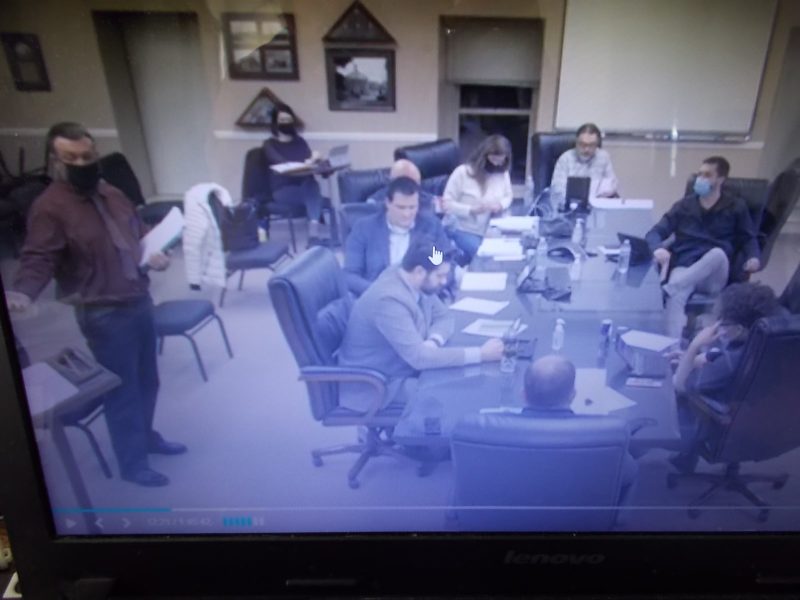
Town Finance Director B. J. Wilson, standing left, explains the FY-22 revenue-neutral budget proposal being developed. Royal Examiner Photos by Roger Bianchini
Councilman Meza asked the finance director when a final Town budget needed to be approved. Wilson cited a target of approval at some point in April, likely to give department heads time to make any changes to their budgets if necessary. But he added that a drop-dead date was June 30, the final day of the current fiscal year. However, municipalities that don’t have earlier deadlines due to State funding variables surrounding public education or other State-assisted revenues, rarely push their budget envelopes that far.
Cockrell then asked Wilson if he was sure, with pandemic economic variables still in play, a late downturn in projected Town tax revenues wouldn’t require a late adjustment upward in the tax rates to support even a revenue-neutral budget. The finance director replied that he felt “pretty good” that no major downward spike would occur, though he added that the generally tight economic times could lead to a downward turn in personal property tax revenues due to a trend in the purchase of used vehicles as opposed to new ones with a higher value and subsequent higher personal property tax assessment.
“I want to go ahead and advertise it the way it is in this COVID situation,” Councilman Gillespie injected, adding, “I mean we’re not going to raise taxes anyway with all the troubles that people are going through.”
Asked for a consensus by the mayor, Councilman Meza asked how long the tax rates had “been in the ballpark” of where they now stand, including the half-cent Real Estate Tax deduction the previous council had implemented last year. Wilson concurred with Meza’s estimate of five years as a “ballpark” on the real estate rate, adding after checking his notes that the Town Personal Property Tax Rate had not been raised since 2010. Then with an assist from Town Manager Steven Hicks, Wilson pinned the Real Estate Tax Rate in the 13-cent “ballpark” since 2014.
Meza suggested in advertising a flat rate, council include that information to trumpet its record of maintaining consistently flat, comparatively low tax rates. “I think that would be great to put in there because that would be the easiest thing for us to raise, and we haven’t,” he said.
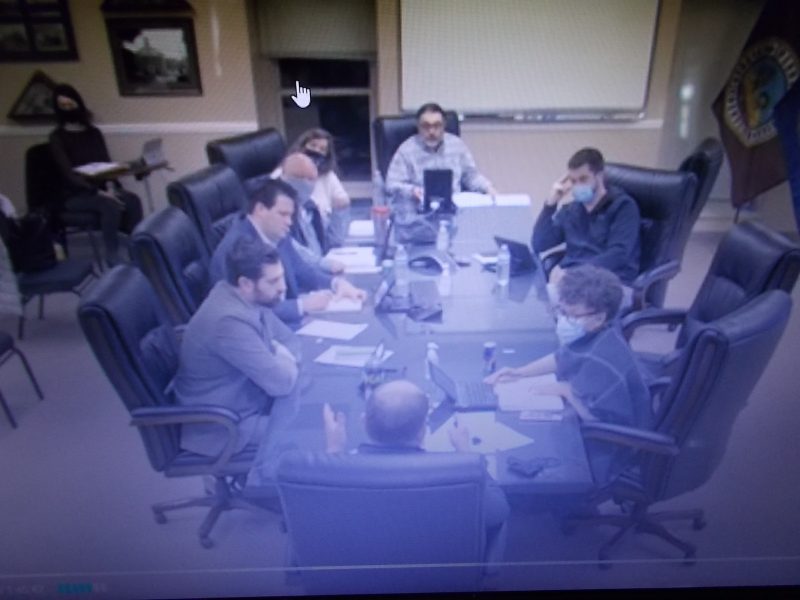
A flat tax rate advertisement decided, Town Manager Steven Hicks, near end of table hands extended, asks how council wishes to proceed with recommended water-sewer utility rate hikes to cover upgrades.
Council having reached a consensus to not even put the possibility of a tax hike on the table, Town Manager Hicks inquired if they wanted to discuss planned hikes to the water-sewer rates to cover costs of required upgrades. The consensus appeared to be to follow consultant-established phased-in rate hikes as necessary to cover utility maintenance expenses.
Additional pedestrian safety at WMH
After input from Town Director of Energy Services David Jenkins and Police Chief Kahle Magalis on public safety challenges along North Shenandoah Avenue at the current Warren Memorial Hospital site, council agreed to move forward with Valley Health’s request for the installation of a pedestrian-activated crosswalk flashing signal.
“I mean they’re paying for it,” Councilwoman Thompson pointed out as the request was introduced to council. Valley Health has offered to pay the $4,753.26 cost of the traffic signal, which town crews would install. Visual issues, particularly approaching the hospital southbound on North Shenandoah up a hill that levels approaching West 10th Street near Family Pharmacy were noted at the requested location.
When the variable of how long the hospital would still be operational at the site with the new one currently under construction off Leach Run Parkway, a June target date for the new hospital’s opening was cited.
Councilman McFadden wondered with a projected June departure of hospital staff and turnaround time on purchase and installation, why Valley Health was making the request at this point as it prepares to move from the current WMH location. Town Energy Services Director Jenkins told council he had, had that conversation with Valley Health officials. He said that while they were unsure of future use of the existing hospital building, they noted that the Lynn Care Center on the hospital’s northeast side off of West 11th Street would remain at the site, with an estimated 50 residents and associated staff.
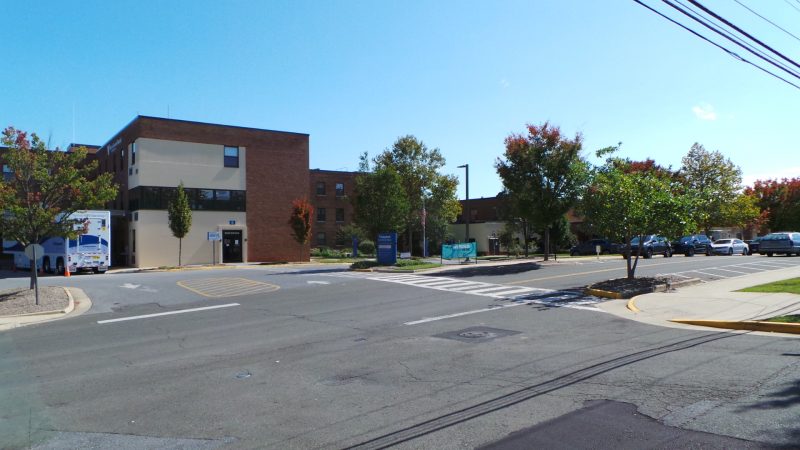
The intersection in question for installation of a pedestrian-activated, person-crossing warning signal approaching W. 10th St. on N. Shenandoah Ave.
When Jenkins noted a hospital employee had been struck “about a month ago” in the area, Valley Health employee Meza, added, “There was a nurse who was hit and put in critical condition” leading to an “Oh my gosh” reaction from Thompson. Noting a several decades time-lapse, Cockrell observed that a boy and girl she went to school with’s mother had been killed along that stretch of road.
Jenkins described the planned flashing light warning of a person crossing ahead that activates immediately upon pedestrian-activation, unlike some signals at larger intersections where there is lag time to activation. And after additional positive input on installation from FRPD Chief Magalis, who observed there was another recent traffic accident involving a bicyclist in the area, council seemed satisfied that even with some unanswered questions about the future use of the building, with Valley Health’s willingness to pick up the cost, installation of the signal could do no harm, and might increase public safety.
In fact, Jenkins observed it could help counteract some added danger from a past attempt to slow traffic thereby narrowing the street with concrete outcroppings. Trees planted in those outcroppings, he observed were now creating a visual problem near intersections. There are also road width problems there that now force vehicles turning right onto North Shenandoah to cross the center line potentially into oncoming traffic.
Other business
A consensus was also reached to take the Jefferson Avenue/Hillcrest Drive R-3 rezoning proposal by Rockledge Development Company to a public hearing. It was noted that the developer’s plan was to build and sell the proposed duplex units for occupant ownership, rather than use them as rental properties. And a voluntary proffer was offered to eliminate the potential of development of multi-unit apartments on the site, which is a normal by-right use on R-3 zoned land. That restriction would continue were the developer to sell the property, rather than build on it, it was noted.
Council also agreed to move the proposed Liaison Committee procedural and non-alphabetical assignment changes forward as part of a coming Consent Agenda; and to make FRPD Captain Jason Ryman’s Joint Tow Board appointment permanent, rather than continue as an indefinite replacement for the retired member, Sgt. Bryan Courtney.

Virginia State Police Urge Sober Plans for Saint Patrick’s Day Celebrations

In a One-Party County, Internal Party Decisions Affect Us All

Virginia State Police Seize Nearly 100 Pounds of Narcotics, Recover Firearms in Weekly Crime Suppression Effort

Barton Charles “Bart” Haller (1940 – 2026)

Dawn Lee Dodson (1970 – 2026)

Mary Helen “Nanny” Spires Johnt (1954 – 2026)

Another Round of ‘Momnibus’ Bills Are Headed Towards the Governor This Year

Virginia Joins States Challenging Trump Admin Regulations That Limit Free Birth Control Access

Update: Charlotte Swanson Smith (1951 – 2025)
Why We are Challenging the Republican Mass Meeting

Bruce Norman Showman (1954 – 2026)

EDA Relaunches Small Business Loan Program to Help Warren County Entrepreneurs Access Capital

Targeted Exercises to Improve Your Putting

The Hidden Risks of House Hunting Solely Online

Choosing the Right Cleaner for Every Surface in Your Home

New Church Among Consent Items at County Planning Commission Meeting

Warren County GOP Mass Meeting Results Challenged After Allegations of Voting Irregularities

‘This Is About Equity’: In Richmond, Virginia Workers, Lawmakers Push for Inclusive Labor Rights for All

After Five Years of Attempts, Virginia On Track to Set Up a Prescription Drug Affordability Board

New Drug Take-Back Box at Warren County Sheriff’s Office Offers Safe Way to Dispose of Medications

‘Feeding Our Neighbors’ Continues Local Effort to Provide Free Meals in Front Royal

Blair David Eller (1963 – 2026)

Writing Workshop at Samuels Public Library Aims to Help Community Communicate More Clearly

Simple Steps to Reduce Wildfire Risk Around Your Home
