
Local Government
County OKs chickens ‘in the backyard’ in R-1 neighborhoods
Staff explains subdivision; POA covenants override County Zoning changes
Warren County has followed the Town of Front Royal into Code changes allowing a degree of “urban agriculture” – in this case chickens, specifically female hens, to be kept in its highest density residential neighborhoods.
The County Code change approved by a 4-1 vote (Fork District’s Archie Fox dissenting) on November 15 differs from the Town Code approved by a 4-2 margin (Tewalt, Tharpe dissenting) a year earlier. While the Town Code approved in November 2015 allows a maximum of “up to 6 hens, rabbits or honeybee hives” regardless of the size of the Residential-One (R-1) yard; the County Code creates a sliding scale on the number of chickens allowed by acreage. The County Code allows only hens, and permits up to 24 of them to be kept on R-1 lots over 2 acres in size.
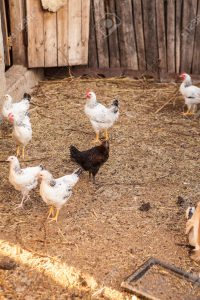
Warren County will now allow chickens ‘in the backyard’ in R-1 neighborhoods – IF POA and Sanitary District regulations ALSO allow them.
The entire sliding scale is:
- Half-acre lots, “no more than six chickens”;
- Half-acre to 2-acre lots, “no more than 12 chickens”;
- Over 2 acres, “no more than 24 chickens”.
Responding to a question from the Board, Planning Director Taryn Logan noted that Subdivision Property Owners Associations and Sanitary District restrictions on such uses DO supersede County Zoning Codes. So, while the County may now enable chickens in the backyard; if your neighborhood POA does not, you may NOT raise chickens.
And if it seems a tad counterintuitive that it is a County following one of its Town’s leads in enabling “urban agriculture”, to our knowledge there were no supervisors directly impacted by the previously existing prohibition on raising hens in a more tightly-clustered, R-1 neighborhood.
Government overreach?
The lone Public Hearing speaker was Brian Connolly of Linden. Connolly asked the Board to remove two conditions from the proposed code he felt were indicative of “too much government” overreach into the lives of its citizens. Those conditions were the necessity of submitting a Management Plan prior to County approval of requests to raise chickens on R-1 properties; and an annually-reviewed Zoning Permit to see that the Management Plan reflecting County guidelines continued to be adhered to.
County Planning Director Logan told the Board that “a lot” of citizens expressed either serious reservations or outright opposition to allowing chickens in their R-1 neighborhoods during the Planning Commission process and Public Hearing. During the Board’s own discussion, Fork District Supervisor Archie Fox continued to express concern the Code change WAS going to create too much of a potential nuisance and pollution factor to neighbors, particularly on the smaller lots the Code enables.
Consequently, a Board majority sided with the interests of a majority of citizens potentially impacted by the Code change, voting to keep all the Code conditions as recommended by their Planning Commission.
Required in a Management Plan to be submitted to the County Planning Department prior to legally placing “chickens in the backyard” are:
- a sketch indicating coop setback requirements from neighboring properties are being met;
- there is a waste disposal and odor control plan, along with other “biosecurity” measures, including coop and pen cleaning and maintenance;
- feed storage and location.
The annual Zoning Permit renewal assures these standards, along with the number guidelines, are being maintained year to year.
‘Back in the 1700s’
Following Connolly’s Public Hearing remarks, Shenandoah District Supervisor Tom Sayre attempted to amend Tony Carter’s original motion to approve the Code as presented, to incorporate Connolly’s suggested deletions. Pointing to people who may already be raising chickens in R-1 areas in violation of the existing Code, Sayre, an attorney professionally, argued that a Management Plan was irrelevant if the County was unaware chickens were there, and no neighbors complained about them.
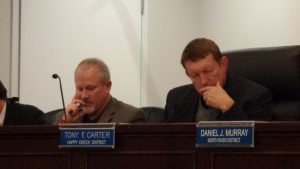
County Administrator Doug Stanley, left, and Supervisor Carter ponder all of ‘God’s creatures’ and life in the 1700s as writ by colleague Sayre regarding chickens in R-1 neighborhoods in the year of our Lord 2016.
During the discussion, Sayre further elaborated that he loved “all of God’s creatures”, which in the 1700s and 1800s, he observed, were likely to be found in every neighborhood without permit or management plan.
As Carter predicted it would and despite the history lesson, Sayre’s amended motion deleting the Management Plan and Zoning Permit requirement failed by a 4-1 vote.
Carter’s original motion then passed by the same margin, with only Fox dissenting. Other approved Code conditions include:
- restricts chickens to containment in a coop or enclosed pen;
- does not allow commercial transactions or sales;
- requires a 25-foot setback from adjacent properties;
- a 30-foot setback from wells, springs, streams and stormwater drains.
- Renters must gain written approval from property owners or management companies before applying to keep hens.

Virginia State Police Urge Sober Plans for Saint Patrick’s Day Celebrations

In a One-Party County, Internal Party Decisions Affect Us All

Virginia State Police Seize Nearly 100 Pounds of Narcotics, Recover Firearms in Weekly Crime Suppression Effort

Barton Charles “Bart” Haller (1940 – 2026)

Dawn Lee Dodson (1970 – 2026)

Mary Helen “Nanny” Spires Johnt (1954 – 2026)

Another Round of ‘Momnibus’ Bills Are Headed Towards the Governor This Year

Virginia Joins States Challenging Trump Admin Regulations That Limit Free Birth Control Access

Update: Charlotte Swanson Smith (1951 – 2025)
Why We are Challenging the Republican Mass Meeting

Bruce Norman Showman (1954 – 2026)

EDA Relaunches Small Business Loan Program to Help Warren County Entrepreneurs Access Capital

Targeted Exercises to Improve Your Putting

The Hidden Risks of House Hunting Solely Online

Choosing the Right Cleaner for Every Surface in Your Home

New Church Among Consent Items at County Planning Commission Meeting

Warren County GOP Mass Meeting Results Challenged After Allegations of Voting Irregularities

‘This Is About Equity’: In Richmond, Virginia Workers, Lawmakers Push for Inclusive Labor Rights for All

After Five Years of Attempts, Virginia On Track to Set Up a Prescription Drug Affordability Board

New Drug Take-Back Box at Warren County Sheriff’s Office Offers Safe Way to Dispose of Medications

‘Feeding Our Neighbors’ Continues Local Effort to Provide Free Meals in Front Royal

Blair David Eller (1963 – 2026)

Writing Workshop at Samuels Public Library Aims to Help Community Communicate More Clearly

Simple Steps to Reduce Wildfire Risk Around Your Home
