
EDA in Focus
County supervisors review draft of EDA bylaw changes

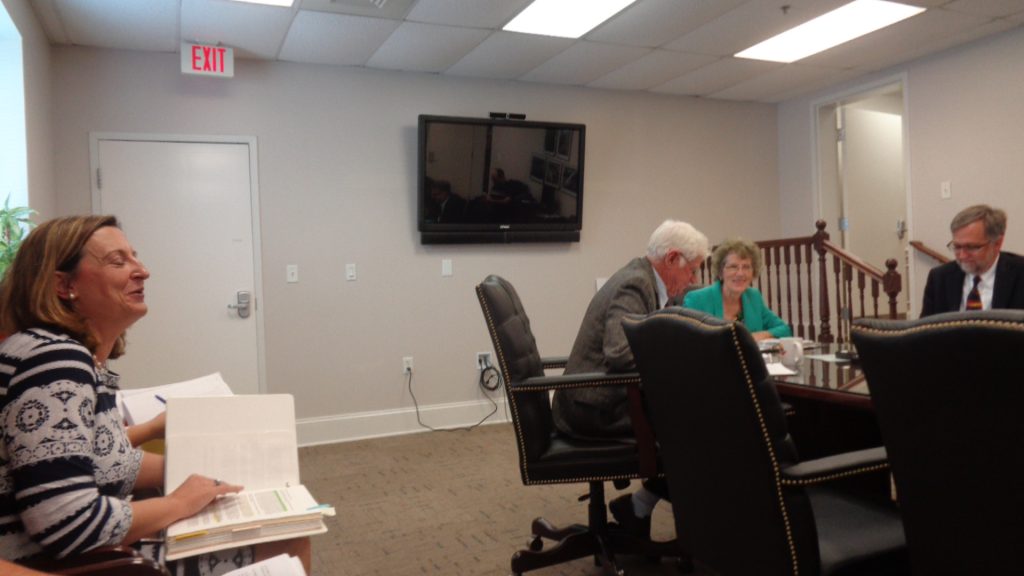
From left, a patch of Supervisor Archie Fox, County Board Chair Linda Glavis, EDA Board Chairman Greg Drescher, Supervisor Tom Sayre and County “sit-down comic” Tony Carter were among those reviewing suggested changes to EDA bylaws at Sept. 5 work session. Photos/Roger Bianchini
Draft changes to the bylaws of Front Royal-Warren County Economic Development Authority were discussed at a September 5 work session of the Warren County Board of Supervisors. EDA Board Chairman Greg Drescher prefaced presentation of the draft by telling the supervisors the EDA was seeking feedback on a bylaw review process he said was done every several years.
County Administrator Doug Stanley explained to his board that the EDA controlled its bylaws, while the State dictated parameters of membership on an EDA board. County Board Chair Linda Glavis asked if it was her board’s responsibility to approve the EDA bylaws. The answer was no, but as Drescher explained his board was seeking input and feedback from the municipal board directly responsible for a portion of the EDA’s annual operational funding. The County took over the Town’s former operational contribution to the EDA several years ago as part of the ongoing negotiation on the Route 522 North Corridor Agreement. According to an established fair funding formula, both the County and Town still contribute to the EDA’s annual debt service accumulated in economic development efforts on behalf of both.
Included in the draft bylaw changes were the addition of a reason for the potential removal of a board member, and authorization for board members to participate in meetings from a remote location by electronic means.
EDA Board member Jim Eastham, who is battling health issues, listened in to a closed session of the August 25 EDA meeting but was not allowed to participate. The draft change on remote participation limits the number of meetings allowed to be participated in electronically to two per calendar year. Other requirements include advance notice of the member’s inability to physically attend for personal, emergency or health reasons; a record in the meeting minutes of the reason the member was not physically present; the member participating remotely must be audible to all in attendance at the meeting; and a board quorum must be physically present for the meeting to be held.
The reason added for a vote on potential dismissal of a board member is “Failure to file a financial disclosure form as required by Virginia Code Section 2.2-3115 (A).”
It came to light in recent months that two board members had failed to file the required financial disclosure forms this year. One was new member Brendon Arbuckle, who was appointed to replace William Sealock after he was elected to the Front Royal Town Council; the other long-time member Ron Llewellyn. Both consequently filed the disclosures. Arbuckle recently resigned for unrelated reasons after taking a new job that was relocating him out of state.
Existing reasons for potential dismissal of a member by an EDA board majority include “Failure to abide by lawful decisions or policies which have been established by the Board by a majority vote” and “Failure to keep confidential any of the following:”
- Any information concerning a prospective business or industry or expansion of an existing business or industry where no previous announcement has been made of the business or industry’s interest in the locating or expanding its facilities in the community;
- Confidential information discussed in closed session as authorized by State Codes;
- Any information not required to be disclosed by the provisions of the Virginia Freedom of Information Act … and not voted to be disclosed by a majority vote of the Board.
One change suggested by the supervisors was that rather than the EDA board vote on the dismissal of a member, the matter be brought to the board of supervisors for a vote. Happy Creek Supervisor Tony Carter observed such a vote might be more difficult for the EDA board disciplining one of its own members. County and EDA Attorney Dan Whitten was instructed to prepare a new draft of the EDA bylaw changes with the vote of dismissal being made by the county supervisors, rather than the EDA board.
Whitten himself was the subject of a closed session vote by the supervisors on September 5. The board unanimously approved a salary hike for the county attorney to $100,962.50 from $98,500. Human Resources Director Jodi Saffelle explained the raise equated to the 2.5-percent hike authorized for other county employees in the current fiscal year.
Carter inquired about the existing residency requirement for EDA board members, noting they were required to work in the county, but not reside here. EDA Executive Director Jennifer McDonald, who accompanied Drescher to the work session, quoted the State Code which states that EDA board members must “reside in, or in an adjoining locality.” Shenandoah District Supervisor Tom Sayre asked Drescher what he thought about a residency requirement.
“I don’t think it’s critical,” Drescher replied.
As the discussion wound down, Carter brought attention to another suggested change – the wording/spelling of pro and con votes on any matter involving the “appropriation of expenditure of funds”. Some astute EDA staffer or board member had noticed the votes being recorded in the bylaws as “years” or “nays”. The suggested spelling change was to “yays”.
Working on his standup, or in this case sit-down routine, the Happy Creek supervisor wondered if a YAY vote might entail pompoms and cheerleaders. Opting out of that possible scenario at coming meetings, the EDA reps settled on the more refined, alternate spelling of “aye” for future positive votes on expenditures.
EDA Executive Director Jennifer McDonald opts out of Carter’s suggestion of pom-poms and cheerleaders for future EDA appropriations votes of ‘YAY’.

VDOT: Warren County Traffic Alert for February 2 – 6, 2026

DNA Modification in Oats: A Breakthrough with Widespread Benefits

Star-Studded Birthdays: Which Celebs Share Yours?

Two WCHS Juniors Aim for Virginia DECA State Office

4 Meal Types to Consider for Treating Your Wedding Guests

Virginia’s Newest Troopers Include Descendant of WWII Hero Desmond Doss

Virginia State Police Ongoing Crime Suppression Operations, Recovering Firearms, Narcotics, and Investigating Human Trafficking

Democrats Try to ‘Balance’ Renters’ Rights With Landlords’ Rights in Proposed Housing Bills

Virginia Delegate’s Bill Would Limit Where High-Voltage Transmission Lines Can Be Built

Freedom 250 IndyCar Race to Bring Speed and Spectacle to Nation’s Capital in August

What to Do and What Not to Do If You’re in a Car Collision

US Senate Poised to Send House Spending Deal in Race to Avert Partial Shutdown

Robert Glenn “Bob” Coverstone (1942 – 2026)

Trump Launches Great American Recovery Initiative to Address Addiction Crisis

Battery Technology Leading the Renewable Revolution

Children Activities by Samuels Public Library for the Month of February

Muley Fanatic Foundation’s 7th Annual Banquet Brings Conservation and Community Together
Jane Duble Riddleberger
Sean G. “Bubba” Collins (1989 – 2026)

William “Bill” Hamilton Rhodes I (1941 – 2026)

POLICE: 7 Day FRPD Arrest Report 1/26/2026

Blue Ridge Wildlife Center Patient of the Week: Red-tailed Hawk

Lawmakers, Virginia Native Tribes Pitch Education, Sovereignty Reforms to Address Historic Injustices

Warren County Government Acknowledges Employee Milestones
