
EDA in Focus
Criminal and non-criminal dereliction of public duty: Where might they apply in the EDA financial scandal?

The FBI and State Police searched and seized records and equipment during an April 16 search of EDA Headquarters seeking evidence related to the EDA financial fraud investigation. Royal Examiner File Photos/Roger Bianchini
In coming stories Royal Examiner will explore how the “catastrophic failure” of processes and oversight leading to the EDA financial fraud investigation and its resultant civil and criminal cases developed. Newly-named EDA Board Vice-Chairman Jeff Browne introduced the “catastrophic failure” term in an opening statement on behalf of the EDA to open the August 27 Town-County-EDA discussion of a path forward.
The 16 specific transactions and projects tied to the EDA fraud allegations occurred over the course of years under the supposedly watchful eye of a total of 12 elected officials on two municipal boards – six councilmen and one mayor of the Town of Front Royal and five Warren County Supervisors; not to mention seven more appointed members of the Front Royal-Warren County Economic Development Authority Board of Directors. It is that municipally-appointed EDA board that forms the first line of oversight of EDA business transactions and land investments.
Perhaps reconsideration of EDA board membership as an unpaid, volunteer position should be on the table for change as a potential means of bringing a more conscientious and professional outlook to the job in the future. But let me add that the recent volunteer appointments made to fill vacancies, as well as some sticking it out from year or so tenures, appear to be committed to learning from past board mistakes, even ones they were involved in, and implementing change to prevent a recurrence.
Elected municipal officials, particularly on the Town side, are now asking pointed questions and expressing righteous indignation at past offenses alleged in the conduct of economic development in this community. But one is left to wonder where those questions, or at least attention to them when they were asked by colleagues or the media, were over the past five-plus years.
Those were years that saw myriad projects, proposals and promises generated out of EDA-Town-County discussion of coming economic revitalization and financing for municipal capital improvement projects.

Work on the initial stage of the West Main St. connector road is 98% complete but at a halt due to the failure of ITFederal to install a water drainage piping system across its property housing a lone, unoccupied 10,000 s.f. building.
Many of those projects had fundamental factual assertions that should have elicited basic questions seeking verification or explanation before agreeing to:
– A one month $10-million Town bridge loan that was twice-extended with only one month of fee payments equaling lost monthly interest on the investment account withdrawal over the three-month period paid to the Town. That short-term municipal loan enabled the EDA to convince a perhaps skeptical bank to finance the ITFederal project with $10 million issued to ITFederal through the EDA. QUESTION – Where is evidence of a $140-million federal government contract with ITFederal upon which Sixth District Congressman Robert Goodlatte and EDA Executive Director Jennifer McDonald based the promised $40-million ITFederal investment and 600 high-dollar tech jobs here on?;
– a $445,000 “moral obligation” EDA purchase of a property initially presented as a $10 gift from McDonald relatives, followed by the $10 giveaway of that property now written off as a $640,000 EDA loss. QUESTION – What tax credit deal and deadline is that gift to the EDA based on? And why am I being asked to sign and send a deed of sale to Winchester with no price on it, allowing a sales price $444,990 less than our purchase price to be filled in by the buyer?;
– and what might best be described as a collective Front Royal Town Council majority pipe dream that a new $11-million town police station could be financed virtually interest free through a New Market Tax Credit (NMTC) program that a brief phone call would have revealed the project did NOT qualify for.
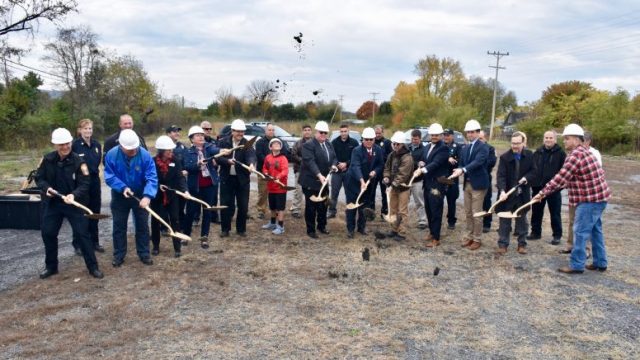
Town government and police officials toss dirt breaking ground for the new FRPD headquarters. Financing costs and the interest rate on the $11-million project remain an issue between the Town and EDA.
Some town councilmen now trumpet loudly that they were “misled” by Jennifer McDonald over the availability of the NMTC program for police station or other capital improvement project financing.
But how, one might ask, did not only those seven elected Town officials, but also five elected County officials impacted on other pending capital improvement projects fail to make or initiate staff to make that one phone call? It was a call that would have revealed, as subsequent EDA/municipal discussion has indicated, that the NMTC low-interest loans were available for projects defined as job-creating, economic development stimulating projects.
While a magnificent and long-overdue facility, FRPD’s new headquarters created no new permanent jobs, just housed existing ones in a more professional environment with room for long-term departmental growth.
Perhaps the mayor and town council should have paid more attentions when both their Town Manager and Finance Director, along with the People Inc. regional administrator of the NMTC low-interest loan program, Brian Phipps, told them in December 2017 and January 2018, respectively, that if you’ve got a promised 2.65% interest rate locked in for 30 years through a bank, you MIGHT want to take a serious look at accepting that deal on the loan to construct your new $11 million dollar (non-job creating) police station.
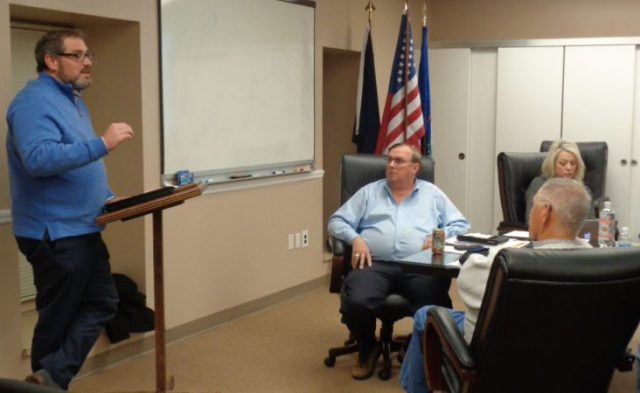
In January 2018 Bryan Phipps of People Inc., regional administrator of the NMTC program, confirmed what town staff had recently told council – that a bank-offered 2.65% fixed, 30-year interest rate on its new police headquarters might be the best financial path forward.
Council ponders financing gamble on FRPD and Happy Creek Road projects
Welcome to 2018 – Town Council continues pondering the future & its costs
The collective failure to ask, listen or verify by a great majority of public officials and employees when it mattered over the course of years leads us to an exploration of terms used to legally describe failings of people in public office. There are three such terms describing various degrees of abuse or failures of public officials – malfeasance, misfeasance and nonfeasance. They are terms now increasingly heard in the public conversation in Front Royal and Warren County.
While some examples of failures in public office may be a consequence of ignorance of some statute or regulation or even intellectual laziness, other acts may be intentionally carried out for personal gain.
Malfeasance
Malfeasance is defined as intentional conduct that is wrongful or unlawful, especially by officials or public employees. Malfeasance is at a higher level of wrongdoing than nonfeasance (failure to act where there was a duty to act) or misfeasance (conduct that is lawful but inappropriate).
Public malfeasance can be prosecuted as a crime in Virginia, though the act of malfeasance itself is a misdemeanor offense. However criminal acts tied to such malfeasance could result in more serious criminal charges.
Malfeasance is usually used to refer to deliberate misuses of power or violations of trust for gain. Any criminal act by public officials would be considered malfeasance, as could other actions that are reckless but not actually illegal.
That latter category could include inappropriately high-risk investing of managed funds leading to lost public resources; the use of business expense accounts for non-business purchases; and even nepotism in using one’s public office to enrich relatives by means outside the normal conduct of public business; as the enrichment of one’s self in a similar manner would be.
An act defined as malfeasance must be found to be contrary to the public good; must have been performed in the individual’s official capacity; and interfere with the individual’s performance of his official duties or with the official duties of another public official.
In committing an act of malfeasance the official may have either committed an affirmative act or an act of omission. In the latter case it would be a purposeful decision not to act in order to further an unethical or criminal end.
Misfeasance
Misfeasance is the wrongful execution of an appropriate act or carrying out a proper act in a wrongful, harmful or improper way. In other words, misfeasance is a harmful act that is legal but improperly performed.
Misfeasance includes irresponsibility in performing tasks or failing to act with diligence that is due and appropriate for the situation.
Misfeasance is accidental rather than intentional, but still blameworthy as falling short of fulfilling an official responsibility.
Nonfeasance
Nonfeasance is the omission of an act that should be done; it is the neglect or refusal to perform an act that is a legal duty to perform. Nonfeasance is the failure to act according to one’s responsibility; it is when operational procedures of an organization are circumvented for a direct or an implied assurance of personal profit.
An example of nonfeasance: an administrator willing to hide transgressions – his own or others’ – for fear of retaliation and/or public outcry.
So now readers are armed with defined parameters for their future discussion of perceived liability of public officials in the development of what is alleged to have happened within the financial world of economic development in this community – and we are confident you will use them appropriately.

Virginia State Police Urge Sober Plans for Saint Patrick’s Day Celebrations

In a One-Party County, Internal Party Decisions Affect Us All

Virginia State Police Seize Nearly 100 Pounds of Narcotics, Recover Firearms in Weekly Crime Suppression Effort

Barton Charles “Bart” Haller (1940 – 2026)

Dawn Lee Dodson (1970 – 2026)

Mary Helen “Nanny” Spires Johnt (1954 – 2026)

Another Round of ‘Momnibus’ Bills Are Headed Towards the Governor This Year

Virginia Joins States Challenging Trump Admin Regulations That Limit Free Birth Control Access

Update: Charlotte Swanson Smith (1951 – 2025)
Why We are Challenging the Republican Mass Meeting

Bruce Norman Showman (1954 – 2026)

EDA Relaunches Small Business Loan Program to Help Warren County Entrepreneurs Access Capital

Targeted Exercises to Improve Your Putting

The Hidden Risks of House Hunting Solely Online

Choosing the Right Cleaner for Every Surface in Your Home

New Church Among Consent Items at County Planning Commission Meeting

Warren County GOP Mass Meeting Results Challenged After Allegations of Voting Irregularities

‘This Is About Equity’: In Richmond, Virginia Workers, Lawmakers Push for Inclusive Labor Rights for All

After Five Years of Attempts, Virginia On Track to Set Up a Prescription Drug Affordability Board

New Drug Take-Back Box at Warren County Sheriff’s Office Offers Safe Way to Dispose of Medications

‘Feeding Our Neighbors’ Continues Local Effort to Provide Free Meals in Front Royal

Blair David Eller (1963 – 2026)

Writing Workshop at Samuels Public Library Aims to Help Community Communicate More Clearly

Simple Steps to Reduce Wildfire Risk Around Your Home
