
Local Government
EDA’s future and regional water opportunities highlight first Liaison Committee meeting in 8 months
The overriding theme of the first Front Royal-Warren County Liaison Committee meeting since January, on Thursday evening, September 16, was improved communications and working together to achieve the best for the community as a whole. As reported following the Warren County Board of Supervisors Work Session two days earlier in the same Warren County Government Center main meeting room, prominent among that coexistence theme was how to approach the future of economic development in the community. And the answer appeared to be to proceed toward two separate Economic Development Authority Board of Directors but without two separate, upper pay range EDA executive directors. Rather, the idea broached by County Administrator Ed Daley at the September 14 supervisors’ work session, a single “Director of Economic Development” who works for the involved municipality, in this case, municipalities, appeared to gain traction.
However, some concern was expressed on the County side that the reorganizational conversation was taking place without input from the existing EDA Board of Directors. The Town is still in its interview stage of potential FREDA board members, with no appointments made. Shenandoah District Supervisor Walt Mabe also wondered if two separate EDA boards would be necessary if there was a centrally functioning staff working to the benefit of both municipalities.
In a post-meeting discussion with Royal Examiner, Daley called such economic development organization “very, very common”, not only across Virginia but nationally. Regionally, the former 21-year Winchester City Manager pointed to Fauquier, where departing WC EDA Executive Director Doug Parsons is headed October 1, as well as Shenandoah County and Winchester among others in his experience in Virginia, West Virginia, and Kansas over his professional career.
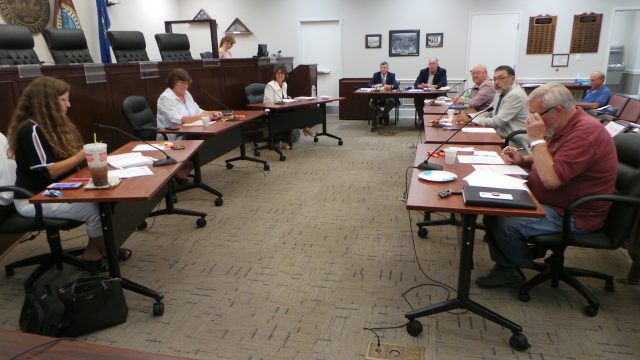
After an eight-month hiatus, not just staff, but elected officials of the County and Town sat down for official discussion of matters of mutual interest. ‘Why did we stop doing this?’ some may have wondered after some crucial information was exchanged that would appear to be of potential benefit to both municipalities. Royal Examiner Photos by Roger Bianchini
But it wasn’t only economic development where municipal cooperation, rather than competition, was a key element of discussion. Other Liaison Committee topics where that factored in were:
1 – continued work on a Joint Town-County Tourism Committee structure;
2 – a potential property sale of the jointly held McKay Springs parcels;
3 – work on both municipal Comprehensive Plans and the related notion of establishing a long-term future vision for the community on both sides of the town-county boundary;
4 – improving the low-cost Town Trolley-County Corridor Connector municipal transport service;
5 – work to develop more widespread Youth Programs;
6 – development of a “Drug Court” system aimed at rehabilitation more than punishment;
7 – the continued move toward increased Short-Term Tourist Rentals on both sides of the Town-County line;
8 – and the future of water distribution and purchase on the county’s north side.
Water, whose water?!?
It was that latter matter, based on the county supervisors exploration of entering into a regional water authority in which Frederick County would supply water to Warren County on the western side of Route 340/522, north of Fairgrounds Road, that seemed to draw the most tension and disagreement in principle between the three liaison representatives of the county board and town council. Those representatives, up one person per side from past liaison meetings in which the board chair and mayor have been joined by one board and council member at the liaison table, were board and liaison meeting chair Cheryl Cullers, Delores Oates, and Walt Mabe on the county side, and Mayor Chris Holloway, with Vice-Mayor Lori Cockrell, and Gary Gillespie for the town. A number of staffers from both sides were also present.
It was Gillespie who first expressed concern from the Town side that the County would consider purchasing water from another municipality while the Town’s central water system based on access to the Shenandoah River, has the potential capacity to provide water for considerable commercial and residential growth into the future. It was noted that while the Town is currently permitted to draw up to 4 million gallons of water per day from the river by the State Department of Environmental Quality (DEQ), it currently only draws about 2 million gallons, and has the capacity to draw as much as 12 million gallons, town officials indicated. We later confirmed updated numbers from Assistant Town Manager Kathleen Leidich. She reported the DEQ currently permits the Town to take 5.94 million gallons per day from the South Fork of the Shenandoah, with a current average Town daily outtake of 3.5 million gallons per day.
Culler took the lead in explaining the County perspective that having an alternate water source of a regional nature not wholly dependent on the Shenandoah River, could be an advantage for both the County and Town in the future as drought-impacted water levels and water quality concerns become increasing issues.
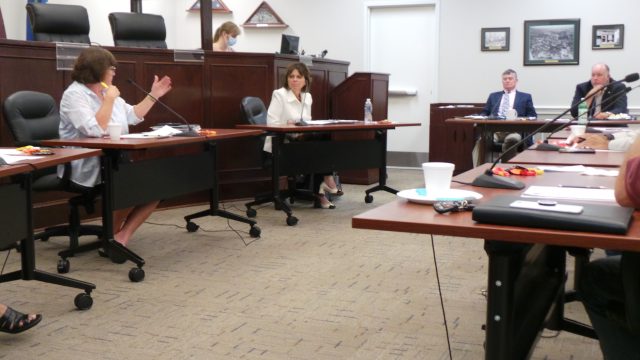
Liaison Committee Chair Cheryl Cullers, left, of the hosting county government, explains the advantage of joining a Regional Water Authority with more than one water source in case of future issues with the Town’s one source, the Shenandoah River. Town Manager Steven Hicks, far right, was an attentive listener.
However, the Town contingent noted it was in the process of finalizing a commitment to spend a cited $12 million dollars on a backup water line into the North Corridor per an agreement dating to Dominion Power’s decision to build its north side power plant feeding the eastern corridor here. That agreement carried the promise the Town would build a backup line to assure the Dominion Power Plant would continue to receive the water it needs to operate were the existing line to fail. At the time about a decade ago, Dominion committed $3.5 million to the project, which would have covered a much larger portion of the total cost than it currently does. – “That’s what happens when you kick the can down the road,” Gillespie observed the Town’s past reluctance to initiate the redundant water line project due to its covering the balance of the cost of expanding its central water utility infrastructure into the County’s North Commercial-Industrial Corridor.
Town officials have long pointed out that their agreement to expand the Town’s central water service beyond the town limits into the County’s Route 340/522 North Corridor, which began decades ago to allow DuPont to locate out there, facilitated the eventual commercial development explosion of two major shopping centers and other industry on county land. And on Thursday, September 16, 2021, current town officials seemed to be asking “for a little love” in return for the county’s expanded commercial tax base, a base created with the expansion of Front Royal’s central water utility. So, why go outside for water when we’ve got the capacity to provide more, DEQ permitting allowing.
But with supporting info from the county administrator, Cullers pointed out that while the Town’s central water supply is totally dependent on the status of the Shenandoah River, Frederick County has other water sources that can keep its supply flowing if the river’s supply was halted or impacted negatively by future environmental concerns.

County Administrator Ed Daley, charting at left, suggested town officials attend an Oct. 12 County work session presentation by Frederick Co. officials on creation of a Regional Water Authority. Town Manager Hicks, right, was sure to pinpoint the date of that presentation.
County Administrator Daley pointed out that the board of supervisors would be getting a presentation from Frederick County officials regarding a multi-jurisdictional Regional Water Authority initiative at an October 12 work session. Daley suggested that would be an opportunity for town officials, including council and the mayor, to attend and be briefed on the advantages of moving toward a regional water partnership.
Vice-Mayor Cockrell wondered if, with this turn toward potential regional authority participation by the County and perhaps the Town, council should reconsider the $12-million-dollar redundant water line project. However, Daley said he believed the Town was legally bound to the project by legal commitments made by council’s predecessors to Dominion Power. North River Supervisor Oates wondered if the regional authority option might present an alternative way to meet that legal obligation, at perhaps less cost to the Town. At this point, Town Manager Steven Hicks confirmed the date of the County work session regional authority presentation by Frederick County officials. Maybe the Town should put in for some reserved seating for that supervisors’ work session.
Short-term tourist rentals
During discussion of an increase in requests for short-term tourist rental Conditional Use Permits (CUPs), Assistant County Administrator Taryn Logan noted that despite sometimes passionately vocal public hearing opposition, the County has heard little in the way of neighbor complaints following board permitting approvals. She said the County had approved about 30 short-term tourist rental CUPs since requests took an upturn, with about 10 such uses having been grandfathered in for a total of 40 now permitted in the county. Where things like noise or garbage disposal have been issues, Logan said that once neighbors contact the renters, they have been cooperative in complying with neighborhood rules and common courtesies they may not have considered or been informed of in advance by owners or property managers.
However, the assistant county administrator and long-time planning director did observe that the use “was not for everywhere – there are some places where they don’t fit”. Establishing an objective, legal or code-based criteria for determining such locations in the permitting process is crucial to a successful resolution of those applications, Logan suggested.
As the meeting was adjourned at 8:54 p.m., just under three hours past its 6 p.m. starting time, there appeared to be a mood that things were changing for the better in Town-County relations. Reinitiating official face-to-face elected official communications on matters of mutual economic, social and legal interest would certainly seem a step in that direction.
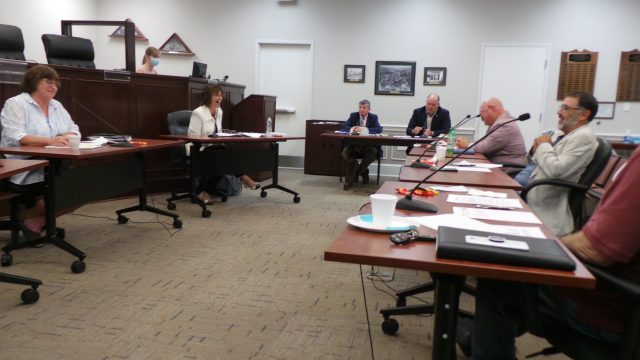
If they’re laughing it must be a good sign – ‘This is fun (and informative), we should keep doing it’ seemed to be the consensus. A quarterly meeting was tentatively scheduled for December.

Virginia State Police Urge Sober Plans for Saint Patrick’s Day Celebrations

In a One-Party County, Internal Party Decisions Affect Us All

Virginia State Police Seize Nearly 100 Pounds of Narcotics, Recover Firearms in Weekly Crime Suppression Effort

Barton Charles “Bart” Haller (1940 – 2026)

Dawn Lee Dodson (1970 – 2026)

Mary Helen “Nanny” Spires Johnt (1954 – 2026)

Another Round of ‘Momnibus’ Bills Are Headed Towards the Governor This Year

Virginia Joins States Challenging Trump Admin Regulations That Limit Free Birth Control Access

Update: Charlotte Swanson Smith (1951 – 2025)
Why We are Challenging the Republican Mass Meeting

Bruce Norman Showman (1954 – 2026)

EDA Relaunches Small Business Loan Program to Help Warren County Entrepreneurs Access Capital

Targeted Exercises to Improve Your Putting

The Hidden Risks of House Hunting Solely Online

Choosing the Right Cleaner for Every Surface in Your Home

New Church Among Consent Items at County Planning Commission Meeting

Warren County GOP Mass Meeting Results Challenged After Allegations of Voting Irregularities

‘This Is About Equity’: In Richmond, Virginia Workers, Lawmakers Push for Inclusive Labor Rights for All

After Five Years of Attempts, Virginia On Track to Set Up a Prescription Drug Affordability Board

New Drug Take-Back Box at Warren County Sheriff’s Office Offers Safe Way to Dispose of Medications

‘Feeding Our Neighbors’ Continues Local Effort to Provide Free Meals in Front Royal

Blair David Eller (1963 – 2026)

Writing Workshop at Samuels Public Library Aims to Help Community Communicate More Clearly

Simple Steps to Reduce Wildfire Risk Around Your Home
