
Local News
Higher Blue Ridge Tech class fees, VSBA membership, SMS schedule change top work items
The Warren County School Board, during its Wednesday, June 21 work session, received details on several items, including a proposal to increase fees for certain classes at the Blue Ridge Technical Center (BRTC), whether to retain membership in the Virginia School Boards Association (VSBA) and a schedule change at Skyline Middle School.
School Board Chair Kristen Pence and board members Antoinette Funk, Andrea Lo, and Melanie Salins were present, while Board Vice Chair Ralph Rinaldi was absent.

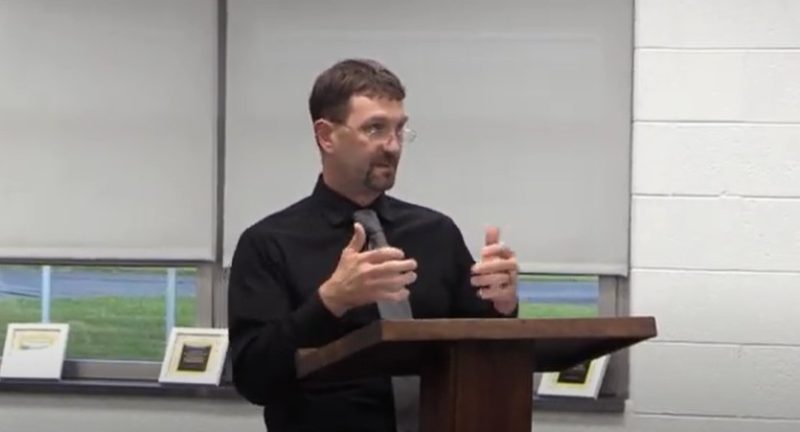
Vincent Gregg, principal, and director of Career and Technical Education at BRTC (above), discussed the 2023-2024 school year fee change proposal for BRTC classes.
The cost of consumable supplies has risen significantly, especially in the trades and industry area, with costs for building supplies and metals tripling in many cases, Gregg said, noting that an increase in student fees will be requested specifically for the advanced classes, where 60 percent to 70 percent of the time is spent with hands-on activities using consumable supplies.
“The increase is requested for our advanced classes,” which offer more practice of skills, are longer in duration, and use a much greater amount of supplies, Gregg said. “The costs have risen, particularly in these areas.”
For example, Gregg said that welding rods have increased from an average of $50 to $200 for the same box of rods.
Similar increases have been observed across all trades and industry classes, he said, and the proposed fee increase, while not negligible, aims to offset some of these rising costs in order to continue to provide students with first-hand experience in their classes.
“The goal is to put more materials in the hands of our students so that they can get that first-hand experience when they sign up for our classes,” Gregg told the School Board, adding that the BRTC has never turned away a student for his or her inability to pay the class fees. The main goal is not to create a financial barrier but to manage the escalating costs that the school has been facing, he said.
Gregg’s proposal includes a $10 increase for the Automotive II class fee to $25; a $10 increase for the Carpentry II & III class fees to $25 each; a $10 increase for the Electricity II & III fees to $25 each; a $10 increase for the Welding II class fee to $35; a $5 increase for the Welding I class fee to $25; and a $5 increase for the Culinary I class fee to $25.
The fee change proposal will be part of the agenda for the July 12 School Board meeting.
To stay or not to stay?
The School Board again discussed whether to renew its VSBA membership for the 2023-2024 school year.
Board member Salins, who is against being a VSBA member and who also is the board’s delegate to the VSBA, questioned the value proposition that the VSBA offers, particularly around the services that she says could be sourced through different organizations. The School Board has already switched its policy services to the school division’s attorney, Bruce Anderson, in lieu of the services provided by the VSBA.
For instance, Salins cited the School Board Member Alliance of Virginia (SBMA), a 501(c)(3), non-partisan association.
“I’d love for you guys to join. It’s an individual membership,” Salins told her board colleagues about SBMA. “It’s a lot cheaper, and they are very proactive encouraging boards for what they can do instead of constantly reminding boards, ‘Oh, be scared, don’t say that, be scared, don’t say that, hide this, hide that.’ It’s a very different perspective that things are done through.”
Other board members see the potential in remaining a member of the VSBA, particularly because of its lobbying power, in addition to the many other benefits provided by VSBA, such as board leadership development, professional services, training, networking, and collaboration, among others.
“All things considered, it may be a benefit to Warren County to have our voice heard in that group because it would be stronger than just us saying something,” said Lo, referring to the VSBA’s lobbying arm.
With a final decision on membership pending, the School Board plans to watch how things develop in the coming months at VSBA, particularly around its proposed changes to the VSBA’s lobbying positions, which Salins will provide to VSBA in July.
In other discussions, the School Board heard from Warren County Public Schools (WCPS) Superintendent Christopher Ballenger, who presented an item on a school division logo redesign that’s an effort to enhance the visual identity of WCPS and better represent the spirit of the community.
Ballenger said that the logo redesign project has sparked conversations and creative discussions among stakeholders, who have shared their opinions and suggestions for further improvements. With a diverse range of perspectives, the logo redesign process has become an engaging and collaborative endeavor, he said.
For example, a recently conducted survey for three different designs received 1,248 votes, said Ballenger.
Board members made several suggestions, as well, to the top-proposed logo, and Ballenger will take them back to the group working on a final design for board approval at a later date.
Skyline Middle School Principal Bobby Johnston
In the last work session item, WCPS Assistant Superintendent of Instruction Heather Bragg and Skyline Middle School Principal Bobby Johnston shared information regarding Skyline Middle School (SMS) changing its schedule to a seven-period class day beginning in the upcoming academic year.
Bragg said that the change is recommended to allow for a more student-centered schedule that supports both student, academic, and behavioral needs. And the schedule change also allows SMS to hire a reading specialist and two instructional coaches to help support teachers.
She also said it would be a mitigated cost of about $3,000 for the instructional coaches who work an additional five days beyond the 200-day teacher contract. “But other than that, it’s a one-for-one swap. So we’re not asking for additional positions,” said Bragg.
Johnston said that through a partnership with the American Institutes of Research (AIR) forged last year, SMS received valuable input and recommendations. The goal was to address the academic needs of students, provide additional support for special education students, and enhance teaching practices. Based on these recommendations, a transition to a seven-period day was identified as an effective solution, he said.
Specifically, SMS will move from four 75-minute blocks to seven 48-minute periods, Johnston said. Under the new schedule, students attend four core classes each day, including English, Math, Science, and Social Studies. Physical Education also is offered daily, compared to the previous alternating day schedule. Eighth-grade students have the opportunity to engage in Spanish 1, PE, and band concurrently — an arrangement not previously available. Additionally, the revised schedule allows for increased instructional time in history and science.
The class sizes will remain an average of 20 to 25 students per grade and approximately 200 students per grade level. The transition to the new schedule is expected to result in two core teachers for each grade level to ensure smooth continuity of instruction, said Johnston, and the change doesn’t require additional teaching positions.
The key objectives of the schedule change include providing extension periods for students requiring additional support in math, English, and special education. These periods would allow for targeted instruction and individualized attention. Gifted and talented (GATE) students also will benefit from advanced classes that delve deeper into specific subjects.
Teachers will have dedicated planning and meeting periods, safeguarding their planning time and allowing them to focus on student needs.
Behavioral support for students will be provided during seminar periods, which align with the extension periods. Students requiring executive functioning support or other behavioral assistance will receive targeted interventions during this time.
The addition of reading specialists and instructional coaches also aims to enhance professional development opportunities for teachers and ensure continuous growth in teaching practices.
“Will there be growing pains? Absolutely,” said Bragg. “Do we need to do it for more than one year to see the result? Yes. But just trying to make some true changes that when we look at the data, we can see if something is starting to build.”
Watch the exclusive Royal Examiner video in its entirety at: https://www.youtube.com/watch?v=m2EUk6MV3dg.

What Factors Are Most Likely to Affect the Cost of a Funeral?

Learn to Spot Scams: Free Workshop Set for June 2

Smart Ways to Use Your Tax Refund This Year

Supervisors Revisit Cross-County Chester Gap F&R Service, See Member-Staff Confrontation After Numbers Apology Offered

Get Your Equipment Ready Before the Start of Fishing Season

Landscaping Careers Offer Outdoor Work and Creative Opportunities

Blue Ridge Wildlife Center Patient of the Week: Virginia Opossum

From Crime Scenes to K9 Units: Citizens Academy Opens in May

Weekly Yard Waste Pickup Begins April 8 in Front Royal

Town Council Reviews Goals at Retreat in Advance of Work Session

New Virginia Laws Target School Construction and Classroom Cellphone Use

Clear Horizons Brings Fresh Approach to Mental Health

Funding Cuts, State Error Strain Virginia’s HIV Care System

Virginia Hospitals Filed More Than 1 Million Medical Debt Lawsuits Since 2010, a New Report Finds

POLICE: 7 Day FRPD Arrest Report 4/6/2026

Spanberger Signs Bipartisan Bills Tied to Billions in Business Investment Across Virginia

Birthright Case Forces US Supreme Court to Confront Prospect of Americans Losing Citizenship

Caleb Benton McKinstry (2010 – 2026)

Ideas for Nurturing — or Rediscovering — Your Inner Child

Protein Takes Center Stage in Updated U.S. Dietary Guidelines

Blue Ridge Wildlife Center Acknowledges a Quarter of a Century of Work in Wildlife Preservation & Human Education

What Does A ‘Fair Share’ Really Mean?

South Warren Ruritan Club Hosts 20th Annual Spaghetti Dinner Fuels Scholarships for Local Teens

Trees Take Root as Virginia’s Frontline Defense Against Urban Heat
