
Local Government
Joint Town Planning – Council Meeting kicks off Comprehensive Plan rewrite push
The Front Royal Planning Commission did not consider any new permit proposals this month, and instead met October 20 with the Town Council in a Leadership Forum to hear from the consultant team that will help the Town with a major rewrite of its Comprehensive Plan. The current plan dates from 1998. In that version of the Comprehensive Plan, the Town sought to address the problem of an increasing number of community residents who had to commute to the Washington DC metropolitan area leaving a bedroom community without a strong economic base or community character. The plan also identified the loss of the rural character of the area by residential developments in rural areas or mountain development as slowly robbing town residents of the public values contributed by surrounding farms and natural areas. Many of the themes and emphasis areas in the old plan are even more relevant in 2021.
Summit Design and Engineering, the firm that the town has tapped to provide expertise and staff to conduct the rewrite, provided an overview of the schedule and areas of concentration for the joint session, as they had in a one-on-one meeting with council the previous day. Ann Darby, the Summit Design representative, explained that the Comprehensive Plan is a guiding document that envisions what the future of a community looks like and outlines steps it takes to get there. A particularly important point is that although the plan itself does not have the force of law, it should lead to changes in the official zoning map and the Zoning and Subdivision ordinances that bring legal weight to the adopted guidelines.
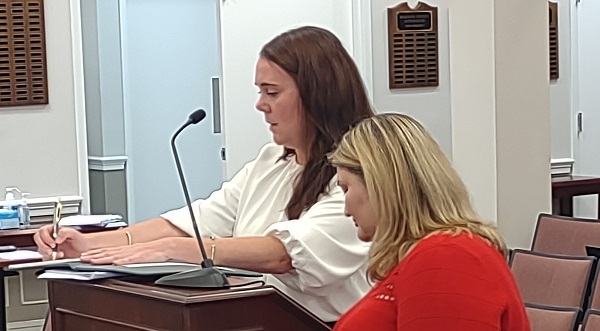
Summit Design and Engineering representative Ann Darby, left, and Town Planning Director Lauren Kopishke address the Joint Leadership Forum of the Town Council and Planning Commission under questioning from Commission members.
Town Planning Director Lauren Kopishke outlined the results of a Town Council session held on October 19 where council members identified their vision for the town. That vision included:
- An abundance of retail options
- A walkable community
- Riverfront Development and Access
- Preserve and enhance Downtown
- Natural Resources
- Small town charm and architecture
- Community Appearance
- Lodging Options
- Public Transit options
- Small area planning for key areas.
During the October 19 meeting, Council also identified areas that the members felt should be revisited during the Comprehensive Plan rewrite:
- A Road Diet, described as a review of the roadways in the town and how they can be made appropriate to the traffic levels
- Expansion of the entrance corridors
- Minimization of trip time for basic necessities
- Location of Industrial Zoning
- Desirable vs. undesirable uses
- Traffic Concerns
- Congestion
- Bike/Pedestrian safety
- Public Transport expansion
The vision and goals identified during the process of rewriting the Comprehensive Plan are really only the beginning of the process. A useful Comprehensive Plan is the product of, not only the team assembled by the Town with participation of a consultant, council itself, and the Planning Commission, but the largest and most challenging part – public participation.
The traditional permit process used for individual projects or permit requests includes advertisements in the neighborhoods affected by the granting of a use permit, public hearings, and council approval, but it was noted the Comprehensive Plan needs much more. To properly address the small-town character, economic, environmental, and housing sustainability, tourism, mobility and accessibility, public health and safety, responsive and accountable governance, and public services, the plan needs input from citizens, businesses, and even visitors, in addition to the planning experts and government staff. The Town Planning Department will be reaching out to the public with a variety of tools to gather public input. The team will use public input sessions, an interactive website, online and paper surveys, comment sessions for draft documents, and vision statements to reach the widest population of those citizens, business owners, and visitors who will be impacted by the decisions made in the review and rewrite.
Because the plan must be grounded in current reality, the team intends to spend the initial months of the process gathering information on existing conditions. It must take account of what is working, and not working, Darby said. The plan will be ultimately organized around 11 general areas:
- Community Appearance
- Transportation
- Land Use
- Economic Development
- Capital Improvements
- Tourism
- Housing
- Parks & Open Space, Development Areas
- Goals, Vision, and Future
The benefits of both the Comprehensive Plan and the ensuing Subdivision and Zoning Ordinances are for both citizens and businesses – Companies want to locate in places where their employees would want to live, and citizens want an active local economy for employment and supply for their everyday needs. A good plan builds realistic expectations, better transparency, and a healthier community. Work is expected to continue on the Comprehensive Plan into February of 2023.

VDOT: Warren County Traffic Alert for February 2 – 6, 2026

DNA Modification in Oats: A Breakthrough with Widespread Benefits

Star-Studded Birthdays: Which Celebs Share Yours?

Two WCHS Juniors Aim for Virginia DECA State Office

4 Meal Types to Consider for Treating Your Wedding Guests

Virginia’s Newest Troopers Include Descendant of WWII Hero Desmond Doss

Virginia State Police Ongoing Crime Suppression Operations, Recovering Firearms, Narcotics, and Investigating Human Trafficking

Democrats Try to ‘Balance’ Renters’ Rights With Landlords’ Rights in Proposed Housing Bills

Virginia Delegate’s Bill Would Limit Where High-Voltage Transmission Lines Can Be Built

Freedom 250 IndyCar Race to Bring Speed and Spectacle to Nation’s Capital in August

What to Do and What Not to Do If You’re in a Car Collision

US Senate Poised to Send House Spending Deal in Race to Avert Partial Shutdown

Robert Glenn “Bob” Coverstone (1942 – 2026)

Trump Launches Great American Recovery Initiative to Address Addiction Crisis

Battery Technology Leading the Renewable Revolution

Children Activities by Samuels Public Library for the Month of February

Muley Fanatic Foundation’s 7th Annual Banquet Brings Conservation and Community Together
Jane Duble Riddleberger
Sean G. “Bubba” Collins (1989 – 2026)

William “Bill” Hamilton Rhodes I (1941 – 2026)

POLICE: 7 Day FRPD Arrest Report 1/26/2026

Blue Ridge Wildlife Center Patient of the Week: Red-tailed Hawk

Lawmakers, Virginia Native Tribes Pitch Education, Sovereignty Reforms to Address Historic Injustices

Warren County Government Acknowledges Employee Milestones
