
Crime/Court
Judge ponders rulings in multiple defense motions to overturn civil case jury finding of liability in EDA financial scandal cases
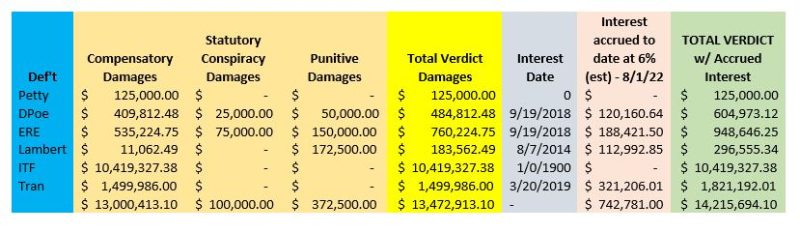
After over five hours of arguments surrounding five EDA civil case defendants’ motions to overturn jury liability verdicts totaling over $14-million, Judge Bruce D. Albertson took those arguments under advisement Wednesday afternoon, November 30th. Some court officials anticipate rulings at some point in the coming week in the cases of April Petty ($125,000 compensatory judgement liability); William Lambert ($296,555.34 compensatory, punitive, & interest liabilities); Donald “Donnie” Poe ($604,973.12 compensatory, punitive, interest); Truc “Curt” Tran ($1,821,192.01 compensatory, interest); and Samuel “Sammy” North (approximately $893,000 compensatory, punitive, interest, & statutory conspiracy).
In addition to the above personal liabilities, Poe’s EarthRight Energy (ERE) company ($948,646.25 in compensatory, punitive, interest) and Tran’s ITFederal ($10,419,327.38 compensatory) were also handed down by Warren County Circuit Court civil case juries in recent months.

Five civil case defendants plus two companies, plaintiff EDA, and a community, await the court’s ruling on motions to overturn verdicts of liability in the EDA financial scandal trials. Below, a chart of EDA civil liability jury findings – Royal Examiner File Photos
All but North’s trial were heard in July. North’s, also originally scheduled for July, was delayed to October by a later withdrawn bankruptcy filing. This week on the final day of November, attorneys for the defendants echoed arguments sometimes heard at trial during earlier motions for dismissal of cases or claims against their clients due to what defense attorneys asserted both then and now, was a lack of substantive evidence of collusion with EDA financial scandal central figure and former Front Royal-Warren County Economic Development Director Jennifer McDonald. Rather, some defense attorneys claimed their clients were unwitting victims of McDonald’s from various business or personal connections.
Those personal connections include North’s marriage to McDonald; Lambert’s former personal relationship with McDonald’s sister; what attorney William Schmidheiser called Petty’s casual acquaintance McDonald, acting as his client’s real estate agent in the sale of her home. On the business side, Poe’s ERE company was contracted through McDonald to perform various solar energy and energy maintenance projects for the EDA under what plaintiff EDA attorneys contended were false pretenses McDonald presented to her board of directors; and Tran’s ITFederal was recruited through the joint effort of McDonald and then Virginia Sixth District U.S. House Representative Bob Goodlatte to become the first commercial redevelopment client at the former Avtex Superfund site, also with what plaintiff counsel said were false contractual and asset information concerning ITFederal alleged to have been presented to the EDA board.
Several attorneys, most prominently Tran attorney David Jones Jr., also argued that several claims categories should not have applied to their clients at trial. Prominent among those were the “ultra vires” claim of profiting off the actions of an official acting outside the range of their legal authority, and associated claims of “conversion” and “unjust enrichment” being applied to their clients for actions of then EDA Executive Director McDonald. Consequently, Jones for Tran particularly and other defense attorneys argued that some jury instructions submitted were improper, creating an incorrect evidentiary scenario for those juries to deliberate on. So, procedural errors on bench rulings on evidence admissibility or jury instructions were claimed as grounds to overturn jury verdicts.
In Poe and ERE’s case, defense counsel William Ashwell also noted that some of the contracted work had been successfully completed by Poe’s company. He told the court that when payments were made by the EDA board to his client’s company: “The EDA eventually adopts her (McDonald’s) actions by their actions” and consequently his client is not the one who should be held liable for the return of money for work accomplished. Ashwell also sought to overturn any personal liability of Poe for payments made to his company.
In opening his arguments to overturn or limit Tran and ITFederal’s liability, Jones noted that he was “in the somewhat unenviable position of not being the trial attorney – Am I in the position of fresh eyes or of where fools rush in where angels fear to tread,” Jones wondered as he launched what would be an approximate hour of argument on his client’s behalf. During that hour Jones questioned the liability finding on a number of grounds and questioned whether ITFederal was, in fact, in breach of contract as claimed by the EDA in seeking recovery of the balance of the $10-million loan the EDA gave ITFederal for development at the former Avtex site.
Plaintiff counsel Cullen Seltzer and Karissa Kaseorg countered, as they had at trial, that McDonald’s assertions to her board about the source of funding for the ERE energy and electrical work being through grants that would compensate the EDA for its payments to ERE; or alleged government contracts held by Tran’s ITFederal company that were non-existent created the path for those payments, and a $10-million loan in ITFederal’s case, substantiating the juries findings of liability on ultra vires, conversion, and unjust enrichment, among other plaintiff claims.
In response to some of Jones’ arguments for reduction or dismissal of his clients’ liability, Kaseorg told Judge Albertson that the motions to overturn hearings should not be an opportunity for defense counsel to retry the case with a “what we wish we had done” at trial. Of Jones’ argument to dismiss based on the inclusion of the plaintiff’s “conversion” jury instruction, plaintiff counsel noted that the defense had agreed to the conversion jury instruction at trial.
In conclusion plaintiff EDA counsel asserted the judicial decisions from the bench at trial had been proper as to both evidence admissibility and jury instructions, and that those jury verdicts of financial liability based on both sides cases as presented at trial should stand as handed down by those five juries. And now we are awaiting a decision on how the court will rate its own performance at those trials based on the defendants’ challenges and the plaintiff’s counter-arguments in support of the judicial rulings made at trial.

Virginia State Police Urge Sober Plans for Saint Patrick’s Day Celebrations

In a One-Party County, Internal Party Decisions Affect Us All

Virginia State Police Seize Nearly 100 Pounds of Narcotics, Recover Firearms in Weekly Crime Suppression Effort

Barton Charles “Bart” Haller (1940 – 2026)

Dawn Lee Dodson (1970 – 2026)

Mary Helen “Nanny” Spires Johnt (1954 – 2026)

Another Round of ‘Momnibus’ Bills Are Headed Towards the Governor This Year

Virginia Joins States Challenging Trump Admin Regulations That Limit Free Birth Control Access

Update: Charlotte Swanson Smith (1951 – 2025)
Why We are Challenging the Republican Mass Meeting

Bruce Norman Showman (1954 – 2026)

EDA Relaunches Small Business Loan Program to Help Warren County Entrepreneurs Access Capital

Targeted Exercises to Improve Your Putting

The Hidden Risks of House Hunting Solely Online

Choosing the Right Cleaner for Every Surface in Your Home

New Church Among Consent Items at County Planning Commission Meeting

Warren County GOP Mass Meeting Results Challenged After Allegations of Voting Irregularities

‘This Is About Equity’: In Richmond, Virginia Workers, Lawmakers Push for Inclusive Labor Rights for All

After Five Years of Attempts, Virginia On Track to Set Up a Prescription Drug Affordability Board

New Drug Take-Back Box at Warren County Sheriff’s Office Offers Safe Way to Dispose of Medications

‘Feeding Our Neighbors’ Continues Local Effort to Provide Free Meals in Front Royal

Blair David Eller (1963 – 2026)

Writing Workshop at Samuels Public Library Aims to Help Community Communicate More Clearly

Simple Steps to Reduce Wildfire Risk Around Your Home
