
Local News
Marlow Heights Baptist Church
“The Bell”
by guest columnist Hoss Feldhauser
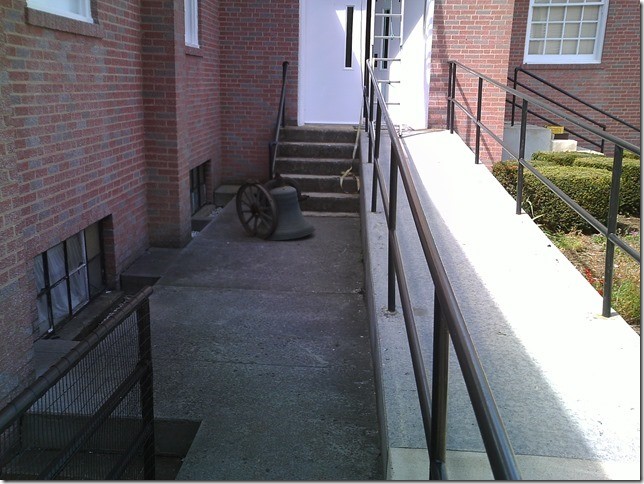
Our church bell has called people to worship for a total of 133 years. It was manufactured in 1883 at Henry McShane & Co. bell foundry in Baltimore, MD.
“Since the conception of the company in 1856, McShane bell foundry has been producing America’s finest Church Bells, Ring Peal, Chimes and Carillons the world has ever heard.“
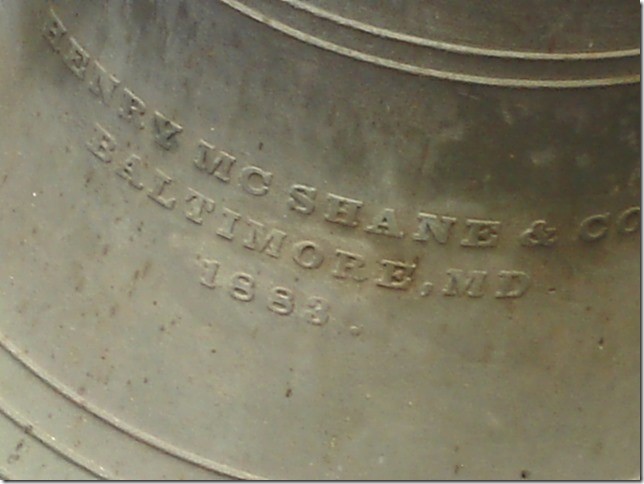 I recently toured the facilities in Baltimore and when I gave them the year the bell was made they pulled a ledger off the shelf in which employees had long ago recorded the statistics of the bell, to whom it was sold, how it was shipped (rail to the depot in Riverton), and how much it cost.
The bronze bell was sold to the Riverton Baptist Church for the charge of .04 a pound. The bell weight without any hardware, is 250 pounds–the whopping sum of $10.00 [that’s $2879.00 in today’s dollars]. There is no record of the cost of shipping or any hardware shipped with the bell (clapper, cradle, fly-wheel, and attachment apparatus) The weight of all the attachments can triple the total weight of a complete bell package.
By 1949-50 the Riverton Baptist Church was defunct when Marlow Heights needed a bell for the soon-to-be finished belfry. The trustees of the Riverton Church offered the bell to us “if we would take it down”.
Millard Williams, Tom Overstreet, Sam Parsons, Warren Watson, and “others” took on the hazardous task of removing the bell from the cramped and deteriorating belfry in Riverton and installing it in our new belfry.
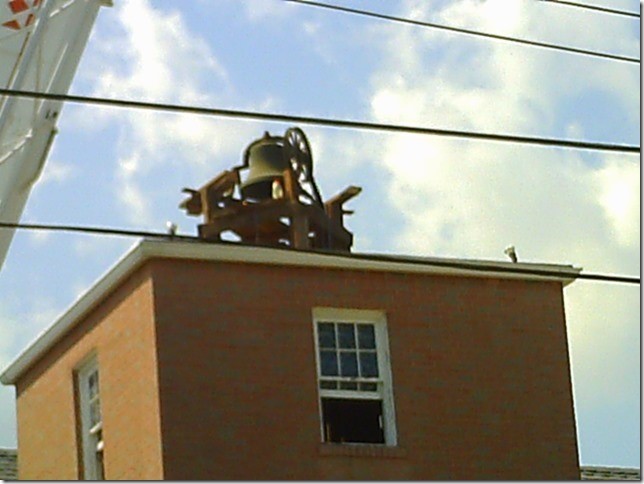 According to local residences the building and foundation of the old church still stands; the foundation has been re-built upon several times after being damaged by flooding.
McShane Bell Foundry still has the original wooden template used to form the mold for the bell. The shape of the template determines the tone of the bell when struck. They have kept (and reused) the templates from the very beginning. My guide shared that they have their templates insured for 10 million dollars.
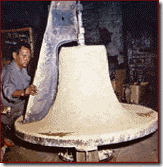
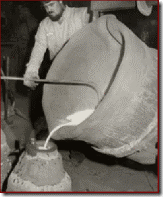
After “pouring the mold” and “revealing” the rough bell it will take at least 50 hours to turn the pebbly ecru finish into the luster of a church bell. Steady hands on equipment guided by keen eyes are key. The goal is to minimize the appearance of the pits in the metal–flaws created during casting –as well as swirls from buffing, while giving the bell an even glow. First comes a buffing with a coarse pad, then with a medium-grade pad, then fine.
With a die grinder with a fine wheel, they will scrub around the lettering and between the raised lines that encircle the bell and provide a small design. But it will take another four hours to polish the bell with a commercial compound that they will mix with water and doctor with what William Parker Sr. says are “secret ingredients”.
They will wipe the polish with soft cloths and tissue, hand-rubbing to achieve the right luster. An air gun will blow off dust or tissue residue, giving the bell a bright shine. A clear enamel coat will deepen the color, providing a protective finish.

Business Growth Series: Why Good Businesses Still Struggle to Grow

Brownies with Mini Chocolate Easter Eggs

Shenandoah Downs Opens 11th Season April 11 with Tribute to Roger Hammer

We Don’t Know Everything About DNA

How PAAS Came to Dominate the Easter Egg Dye Tradition

Spanberger Signs Bipartisan School-Safety, Student Support Bills Into Law

Melanie J. Pomeroy (1958 – 2026)

David Benjamin Heller (1990 – 2026)

1776 Wasn’t Just About Independence

Three-Tiered System for Urban Agriculture Based on Lot Size Takes Shape at Town Planning Commission Work Session

Child Abuse Awareness Month Brings Focus to Reporting, Prevention in Warren County

National Dental Hygienists Week: Is Your Oral Care Routine Optimal?

The Coin That Traveled Through Time and Space

One “What If?” Question Is Changing the Future of Farming

AA Speaker to Explain Recovery Program at United Methodist Men’s Dinner
Jeannette M. Hyland (1944 – 2026)

Allen William Derflinger II (1959 – 2026)

Warehouse Clerk: A High-Demand Job—Even With Robots

FDA Cracking Down on Compounded GLP-1 Drugs

“Christmas in April” or Overspending? Budget Draws Criticism

Court Ruling Voids Prince William Data Center Rezoning, Raising Stakes for Local Debate

Spanberger Signs First Bills Targeting Healthcare, Housing and Energy Costs

Blue Ridge Singers Spring Concerts to Showcase Powerful Blend of Voices and Brass
What Counts as “Good Policy” Depends on Who’s in Power
