
Local Government
Mayor to approach County on creating joint committee to fight growing opioid crisis
At the suggestion of Front Royal Town Council members and Interim Manager Matt Tederick, Front Royal Mayor Eugene Tewalt plans to approach the Warren County Board of Supervisors about establishing a joint committee to investigate options for handling the local area’s opioid epidemic.
The Front Royal Police Department (FRPD) is struggling to fight a rise in local opioid overdoses and deaths from heroin and fentanyl, Police Chief Kahle Magalis told the Town Council during its Tuesday, September 8 special meeting.
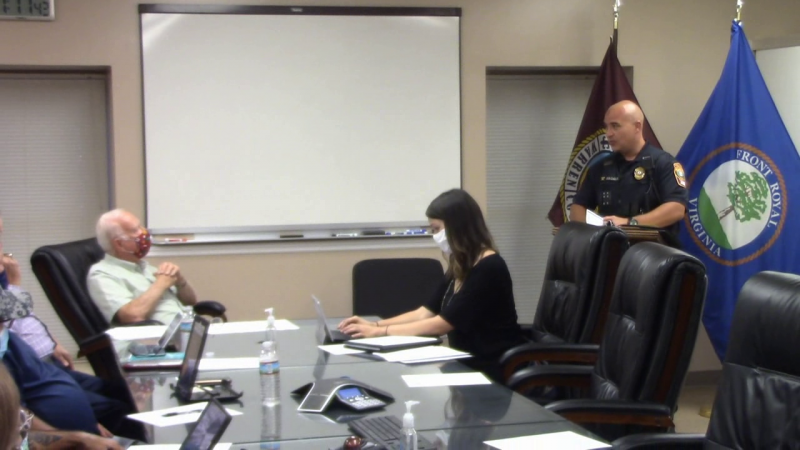
“The numbers of overdoses have risen significantly this year,” said Magalis. “Since January 1st of this year, we’ve had 47 opioid overdoses in Town with 10 deaths, and we’ve had 13 opioid overdoses in the County with three deaths.” Royal Examiner photos and video by Mike McCool.
The Town this year has already outpaced its 2019 numbers, the police chief said, noting that last year, the FRPD responded and administered 49 doses countywide of NARCAN®, or naloxone, which is one of a few drugs capable of reversing the symptoms of an opioid overdose. Comparatively, FRPD thus far in 2020 has administered 50 doses of naloxone “and we’ve just started September,” he said. “Opiates are a much deeper addiction that what we have seen with some other drugs.”
One of the associated challenges faced by FRPD has been tougher state and federal legislation, such as some drug possession laws.
For instance, “when we show up at an overdose now,” Magalis said, “if a person has overdosed and called 9-1-1 or if someone else calls 9-1-1 for a person who is overdosing, they can’t be charged with any crime. Even if they’ve got narcotics on their person, there’s nothing we can do about it. We seize it as contraband and then destroy it, but there’s no recourse for their actions.”
And some of FRPD’s naloxone administrations “have been provided to the same people” more than once, said Magalis, while other drug addicts may need more than one dose of naloxone because of high drug tolerance, for example.
Nevertheless, the police chief said that incarceration is not the answer to addiction.
Vice Mayor William Sealock and Councilman Gary Gillispie asked what the answer should be. “You can’t police addiction,” Magalis answered. “And that’s part of the issue — we don’t have the resources here available for treatment like some places do.”
At the same time, a drug addict “has got to want to do” the treatment, he added. “It’s difficult to have a rosy outlook, but we have to try.”
Magalis said that FRPD is a member of the Northwest Virginia Regional Drug Task Force, which is comprised of local, state, and federal agencies, including the Warren County Sheriff’s Office, among others.
However, “we can’t really rely on that to solve all of our opioid problems,” said Magalis. “They’re pretty critical in managing most of the drug issues that we have, but I would say a fair portion of the opioid crisis is unable to be managed by them.”
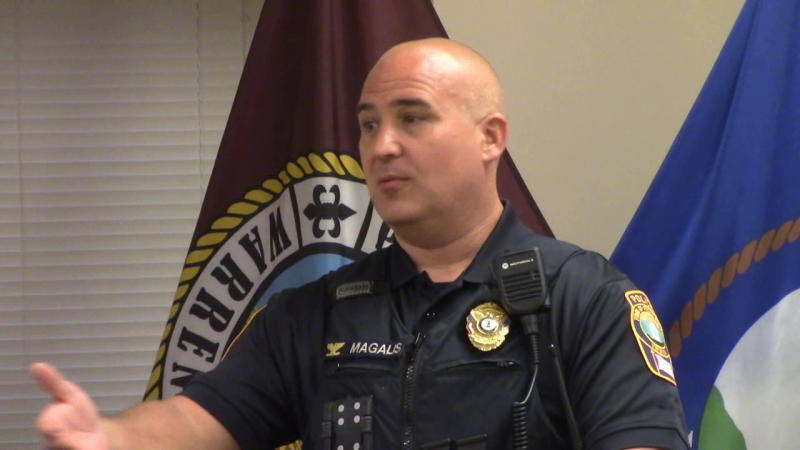
When a larger-scale drug dealer comes to town, the Chief explained, the task force is designed to target mid-level and high-level drug dealers, not drug users. “And drug users are where the drug overdoses are actually happening,” Magalis said.
On a positive note, the police chief told council members that the Warren County Community Health Coalition, which is known simply as the Warren Coalition and partners with the FRPD on prevention, just secured a $1 million grant for harm reduction. FRPD met last week with the coalition to discuss how the grant funding should be used. “So that’s a bright spot,” Magalis said. “Hopefully, we’ll be able to see some relief from this epidemic.”
Interim Town Manager Tederick told council members that it’s important to clarify that law enforcement’s primary job is dealing with this national problem “is to arrest bad people for breaking the law. Their job is not to address the mental illness of a patient or to address the dependency on the drug itself.”

“So, from a Town perspective, we’re limited from the social services angle, we’re limited as far as the healthcare — that’s just not within our structure to provide those services,” Tederick said. “If I could suggest, Mr. Mayor and members of the council, that we maybe get together with the County supervisors and set up a true committee for partnering with the Warren Coalition and other stakeholders, including nonprofits and churches.
“I think this is a community problem and it’s going to take a community to drop these cases down,” he added. “The County is going to have to take a significant lead on this because the resources are at the County level.”
Vice Mayor Sealock agreed and asked the mayor to approach Warren County Board of Supervisors Chairman Walter Mabe as soon as possible about setting up such a committee. Mayor Tewalt said he would do so as soon as possible.
To watch the entire exchange on the drug issue, as well as the rest of the Town Council special meeting, watch the video below.


James Christopher “Chris” Sain (1948 – 2026)
Alice “Maybelle” Henson (1938 – 2026)

How Sleep and Stress Affect Cancer Risk

Spanberger Signs Sweeping Public Safety and Gun Violence Bills

Horses, Fans Return as Shenandoah Downs Season Begins

Skill Games Halted Again as Spanberger Issues Veto

VDOT: Warren County Traffic Alert for April 13 – 17, 2026

The Cat Who Outlasted Six Prime Ministers

Front Royal, Virginia. Vacation Destination?

Virginia State Police Report Major Drug Seizures in Weekly Crime Suppression Effort

Virginia Secures Birth Control Access as Other Southern States Eye Abortion Pill Manufacturers

SCC Approves Loudoun Transmission Line, Nixes Undergrounding; Final Route to be Determined

Slate of New Virginia Laws Address Health Care and Housing Affordability
James J. Coverston Sr. (1942 – 2026)

Business Growth Series: Your Biggest Problem Isn’t Competition — It’s Being Overlooked

Why Many Experts Say a Concussion Should Be Called a Brain Injury

Missouri Man Arrested in Undercover Operation Targeting Online Crimes Against Children

Trump Tax Plan Credited With Higher Refunds, Lower Taxes

Spanberger Vetoes Fairfax Casino Bill, Citing Local Opposition

Blue Ridge Point-to-Point Races Return Saturday at Woodley Farm

Legislative Effort to Buy Monroe’s Loudoun Estate on Pause, Budget Effort Underway

US House Democrats Call for Congress to Come Back Into Session for Iran War Debate

Virginia to Raise Minimum Wage to $15 by 2028 Under New Law

Spanberger Signs Bills to Aid Low-Income Utility Customers, Manage Power Demand
