
Local Government
Member confirms mass resignation of Town Urban Forestry Advisory Commission – Happy Creek project exclusion cited
Royal Examiner has received verification from one member of the Town of Front Royal’s Urban Forestry Advisory Commission (UFAC) that the current four-member commission board has resigned en masse. Individual letters to the Town announcing the resignations were delivered the morning of December 15, according to UFAC member Vincent Resch.
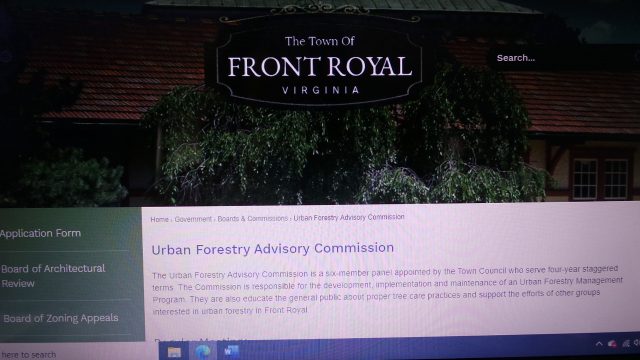
As of our Dec. 23 publication, the Urban Forestry Advisory Commission was still listed as a functioning, Town-established ‘board or commission’ – it’s just a long-ignored, and now vacant one. Royal Examiner Photos by Roger Bianchini unless otherwise indicated
Resch told us in an email response of Sunday, December 20, “I will confirm on record the mass resignation of all members on UFAC. I will not speak for any other members of UFAC’s reasoning other than my own.”
A hint at Resch’s reasoning was delivered during a November 23rd appearance as a public speaker at the Front Royal Town Council meeting during which he addressed concerns about the absence of Town Code-mandated involvement of UFAC on environmental matters like the elimination of trees on public property, as on Happy Creek’s riparian buffer along a portion of the community’s Shenandoah Greenway trail.
Of that appearance, Resch told Royal Examiner on December 20, “I spoke on public record to the town council and (interim) town manager at the public session November 23, 2020 to address my concerns on the Happy Creek project and the Town’s disregard of even contacting UFAC as required by its own Town Code – see 156-3, paragraph 9; state violation of standards for soil and sediment control under VMRC permit 2020-1561, item 20; and Town’s line clearing tree contractor that did not employ an ISA certified arborist per the contract, and did not carry Virginia Workman’s Compensation Insurance.
“Even after addressing the town council and town manager UFAC was not consulted for advice or recommendations, or even given a copy of the revised – or the original for that matter – plan that came out a week later. I finally obtained a copy from the Save Happy Creek Coalition. There was not a single mention of replanting or mitigation of the stream bank’s vegetation that was lost except putting up ‘tree protection zones’ around trees to be saved – problem is the majority of the trees and vegetation were already removed!!!” Resch concluded with written triple emphasis.
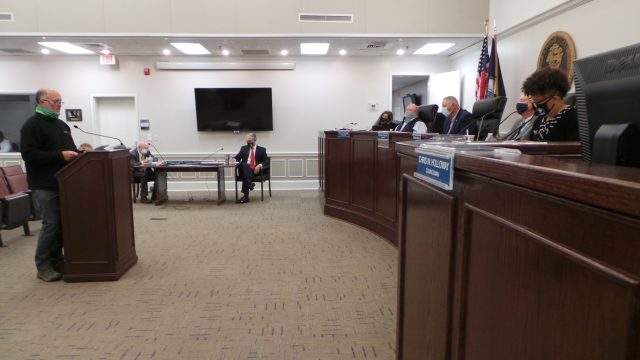
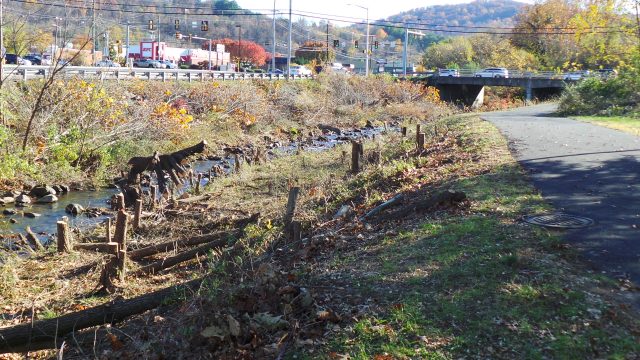
Above, Shenandoah Riverkeeper Mark Frondorf joined UFAC member Vincent Resch, Tree Steward David Means among other citizens criticizing the Town’s Happy Creek stormwater management plan at Nov. 23 council meeting. Below, Happy Creek’s bank near South St. after Town-contracted clearing work – wonder if this is a ‘Tree Protection Zone’ now?
As to his resignation, Resch said, “I personally have volunteered over 500 hours of my professional time over the past 4 years as a citizen of Warren County, member of UFAC, and member of Warren County/Front Royal Tree Stewards to help out the Town and County that we all call home. I’m not alone, many other volunteers have combined 1000’s of hours giving back to our community. I was no longer willing to give my valuable time to a Town Council that showed this level of disregard and disrespect, just so they can keep a ‘Tree City USA’ label.”
While his colleagues – Chair Jason Lanham, Co-Chair Cary Hulse and Jack Donohue – have to this point remained silent on the mass resignation, one might guess the group rationale wouldn’t stray far from Resch’s stated above. As noted by Resch, the Town Code reference to the creation of UFAC mandates certain responsibilities and oversight of environmentally related work inside the town limits.
That 156-3 Town Code on “Duties of UFAC” begins, “An Urban Forestry Advisory Commission shall be established to perform the following duties,” with Resch’s referenced paragraph 9 elaborating: “9/ Review plantings, maintenance, and removal of trees and other vegetation on Town-owned public property, landscaping easements and rights-of-way.”
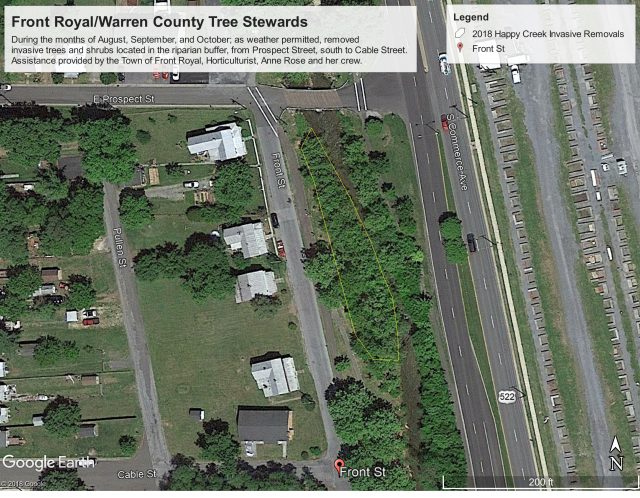
Aerial perspective of section of Shenandoah Greenway Trail and Happy Creek between Prospect and Cable St. approaching South Street, indicating past Tree Steward work clearing invasive species – used to be a tree canopy there, even after properly vetted work.
A further exploration of the Urban Forestry Advisory Commission’s founding Code Section 156-3 indicates the intent of development of, and Town adherence to, standards developed by the UFAC membership regarding planning and management of the tree presence giving Front Royal its “Tree City USA” status as a quality of life and tourism destination. The five opening graphs of UFAC’s duties mandated by the Town Code creating it state:
- To develop and monitor a Tree Canopy Cover Plan.
- To develop, implement, and maintain an urban forestry management program and adopt an Urban Forestry Management Plan.
- To develop, implement and maintain a program that recognizes trees of significance for heritage, memorial or specimen designation.
- To develop standards and guidelines for planting, maintenance, preservation, and replacement of trees on public property and any land disturbing activities on private property.
- To promote education of the general public, Town Officials, and Town Employees regarding proper tree-care and planting practices.

Above, Happy Creek project consultant CHA photo of a portion of the work area looking south from Prospect St. Bridge prior to the start of work. Below, looking back toward that section after work commenced.
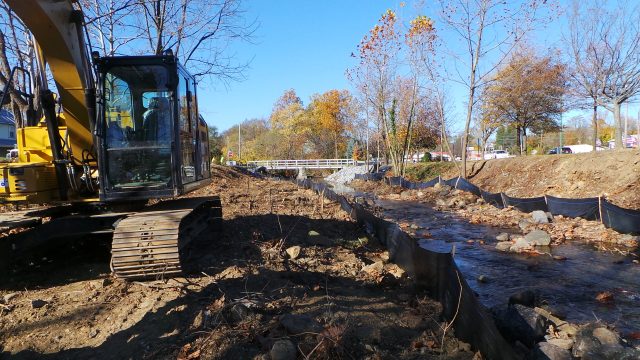
Asked about that planning and past UFAC-Town staff and elected official educational role, Resch deferred to fellow Tree Steward David Means, whom he pointed out had a longer tenure on the UFAC board.
In response to an emailed inquiry, Means replied with three documents – two dating to 2014 included a UFAC report on “The Town of Front Royal’s Existing and Possible Urban Tree Canopy” and a presentation by the Davey Resource Group to UFAC on an “Existing Tree Inventory” and development of an “Urban Forestry Management Plan”. Cary Hulse, UFAC’s most recent and now resigned co-chairman, was an employee of Wetland Studies and Solutions, Inc., a division of the Davey Resource Group at the time.
The third attachment titled “Landscape Preservation and Planting Guide” was a 35-page document prepared by the Town Planning and Zoning Department in the 1990’s, Means said. It clearly illustrates the town government of that time’s priorities that led to UFAC’s eventual formation, the role of the Tree Stewards, and the Town’s “Tree City USA” designation acquired in 1999. It is a designation Resch explained that UFAC reapplies for annually.
“This guide has been prepared to assist property owners and developers in tree planting and preservation during the course of development activities. The Town of Front Royal strongly encourages the retention and preservation of mature trees and woodland areas for environmental, ecological and aesthetic reasons,” the town planning department report’s introductory paragraph reads.
It continues, “It is not the Town’s intention to adversely impact development activities, but to ensure that the environmental need for tree preservation and planting is balanced with all new development activities.”

Above, another CHA photo of Happy Creek’s bank prior to the start of stormwater management work. Below, another ‘after’ view south from the Prospect St. Bridge during ‘Save Happy Creek Coalition’ educational meeting and work protest of Nov. 21.
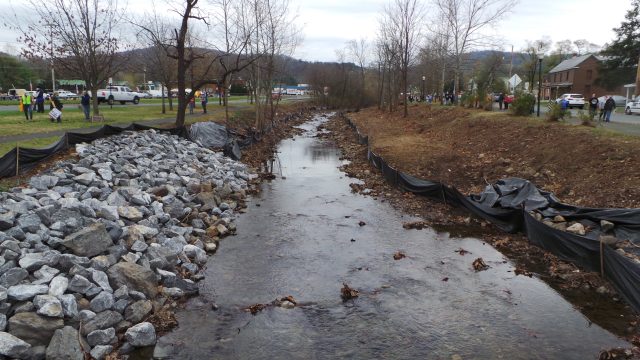
Imagine that, as the last century drew to a close and political partisanship had yet to intrude in town elections Front Royal actually appeared to be at the forefront of balancing the environmental concerns of a rural, small American town with coming development that could threaten its rural Virginia roots, ambience, not to mention its attraction to tourists and the revenue they produce.
Slightly over 20 years later that balance of proactive preservation of the town’s rural setting while accommodating thoughtful growth seems to have shifted to non-communication and outright amnesia of such matters, coupled with efforts focused on avoiding State-imposed financial sanctions or mandated upgrades for the consequences of recent infrastructure neglect.
So, what appears to still be in motion through this 2020 holiday season at year’s end is a Town Council-endorsed plan to turn this formerly heavily treed section of the Shenandoah Greenway Trail and adjacent Happy Creek bank into a rock-strewn high-speed, hard-surface dumped stormwater management “sewer” headed, not only downstream toward some Virginia Department of Wildlife Resources, formerly Department of Game and Inland Fisheries-stocked trout, but eventually into the Shenandoah River without a detour through the Town’s Wastewater Treatment Plant.
So much for the notion once expressed to this reporter by former Warren County Supervisor John Vance, dating to those perhaps simpler mid-to-late-1990’s times, that “Municipal government should be about common sense …”
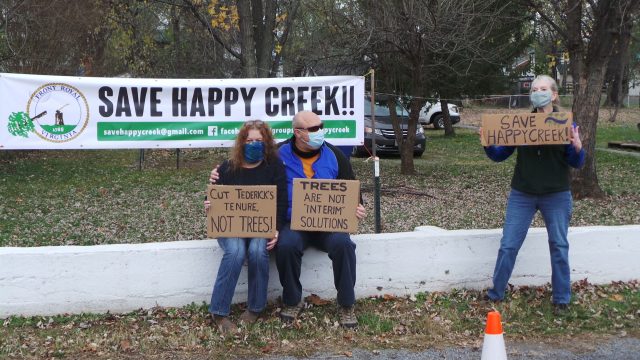
Above and below, citizens express their displeasure over the nature of work being done by Town to allegedly stabilize Happy Creek’s banks, among other project goals.
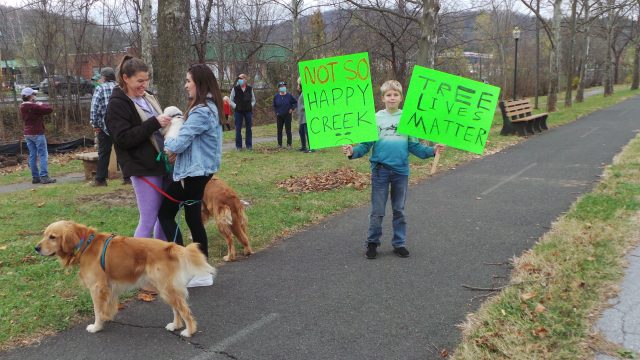
But as 2021 approaches the question remains, is it too late for common sense to kick in to fix an apparently ill-conceived Happy Creek stormwater “corrective” plan based on the recommendations of a storm and wastewater management consultant not given the opportunity to consult, as the Town’s own code mandates it should, with the Town’s own Urban Forestry Advisory Commission and other available experts like the Tree Stewards, versed in creek bank and natural water and stormwater flow and riparian buffer management?
Stay tuned as “Save Happy Creek Coalition” members continue to converse with Town officials, including new Town Manager Steven Hicks, Public Works Director Robbie Boyer and CHA consultant Lawrence Hoffman.
Where there is conversation, even belatedly, there is hope.
But the citizens who elected them are left to wonder why the sitting town council, and its appointed interim municipal manager, initially declined that conversation, as noted above mandated by its own Town Code, with the resource agencies at its disposal before such a major, physically transformative undertaking (pun for our deceased trees intended).
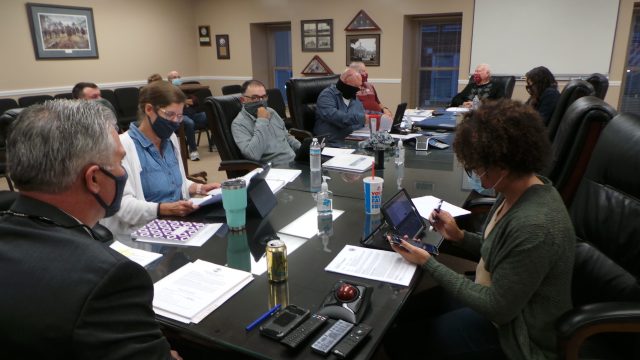
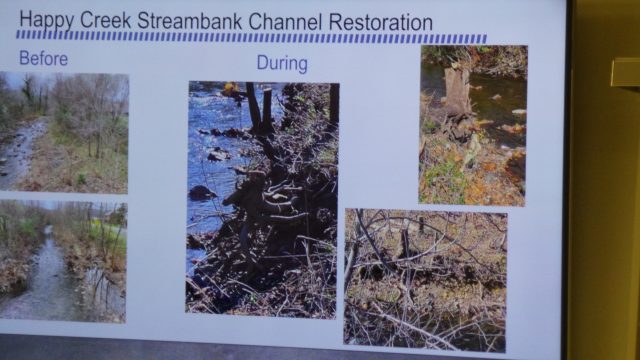
Questions remain to be answered by the town’s elected officials as to how the current Happy Creek project evolved against the Town’s own codes, and why it is proceeding along a clearing and no-replanting path called counterproductive to its stated intent by experts in the field of water and stream bank management. Below, close-up of Nov. 16 council work session power point. ‘During’ photos don’t quite tell the ongoing story of what is happening and at this point is planned to continue with rocks replacing all cleared and to-be-cleared vegetation.

What Factors Are Most Likely to Affect the Cost of a Funeral?

Learn to Spot Scams: Free Workshop Set for June 2

Smart Ways to Use Your Tax Refund This Year

Supervisors Revisit Cross-County Chester Gap F&R Service, See Member-Staff Confrontation After Numbers Apology Offered

Get Your Equipment Ready Before the Start of Fishing Season

Landscaping Careers Offer Outdoor Work and Creative Opportunities

Blue Ridge Wildlife Center Patient of the Week: Virginia Opossum

From Crime Scenes to K9 Units: Citizens Academy Opens in May

Weekly Yard Waste Pickup Begins April 8 in Front Royal

Town Council Reviews Goals at Retreat in Advance of Work Session

New Virginia Laws Target School Construction and Classroom Cellphone Use

Clear Horizons Brings Fresh Approach to Mental Health

Funding Cuts, State Error Strain Virginia’s HIV Care System

Virginia Hospitals Filed More Than 1 Million Medical Debt Lawsuits Since 2010, a New Report Finds

POLICE: 7 Day FRPD Arrest Report 4/6/2026

Spanberger Signs Bipartisan Bills Tied to Billions in Business Investment Across Virginia

Birthright Case Forces US Supreme Court to Confront Prospect of Americans Losing Citizenship

Caleb Benton McKinstry (2010 – 2026)

Ideas for Nurturing — or Rediscovering — Your Inner Child

Protein Takes Center Stage in Updated U.S. Dietary Guidelines

Blue Ridge Wildlife Center Acknowledges a Quarter of a Century of Work in Wildlife Preservation & Human Education

What Does A ‘Fair Share’ Really Mean?

South Warren Ruritan Club Hosts 20th Annual Spaghetti Dinner Fuels Scholarships for Local Teens

Trees Take Root as Virginia’s Frontline Defense Against Urban Heat
