
Local Government
Redundant or not, council moves toward approval of new gun carrying resolution
At Monday’s work session following its August 10th regular meeting, council, the mayor and staff went round and round, not over the advisability of approving a new 2nd Amendment Resolution that would essentially continue a generally unknown lack of any ordinance ban on the carrying of firearms in municipal buildings, offices or public spaces utilized for special events or festivals, but over its redundancy.
According to a summary by Town Attorney Doug Napier, that redundancy is two-fold: first, in that there is no current town code prohibiting such legal concealed or open carrying of firearms into Town public spaces; and second, that following County approval in December 2019, in February the Town passed a “2nd Amendment Sanctuary Resolution” indicating the intent of not prohibiting a very broad interpretation of the 2nd Amendment right to not only own guns without a background check and red flag law prohibitions, but to bear firearms as a gun owner sees fit to.
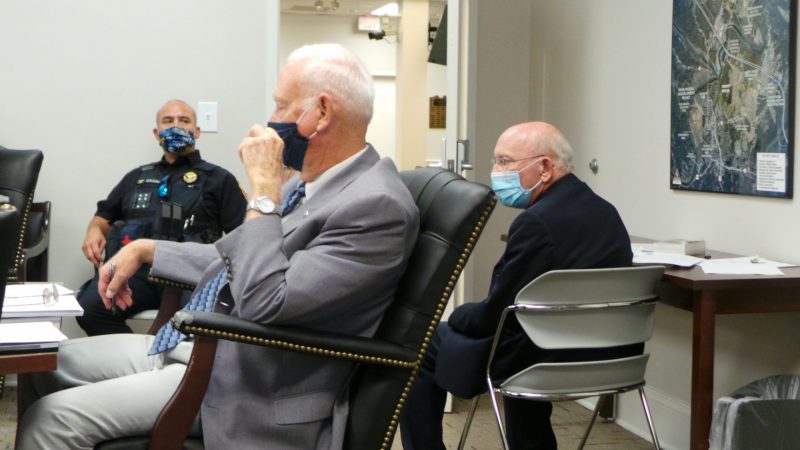
Mayor Tewalt, foreground, and FRPD Chief Magalis listen as Town Attorney Doug Napier explains what currently exists and doesn’t exist concerning the carrying of firearms into local government facilities in Virginia. Royal Examiner Photos/Roger Bianchini – Royal Examiner Video/Mark Williams
The impetus for the new resolution request submitted by Paul Aldrich last month was the enactment of new state legislation passed by the Democratic Virginia General Assembly majority, that went into effect July 1. As previously reported, that legislation for the most part bans the carrying of firearms into state government facilities, offices, meetings, and spaces and allows municipalities to follow suit if they see fit.
“Before then, they never really said what localities could do other than that localities can’t pass laws other than what the General Assembly told them they could do – they didn’t really tell localities what they could or couldn’t do,” Napier explained of the nuances of a Dillon Rule state where local governmental entities cannot enact laws not enabled by existing state law.
However, he continued to describe a previous “mish-mash of laws all around the state” further noting that he and Front Royal Police Chief Kahle Magalis, who was present as meeting security, recalled that some time ago both Warren County and Front Royal had posted “No Firearms Allowed” signs in their government buildings – “But that was quite a while ago,” Napier observed.
During previous council discussion Napier had observed that most people locally believed a firearms ban in local government facilities still existed, as they do at the Warren County Courthouse which has a heavy security-check presence of Sheriff’s Office bailiffs at a metal-detecting single building entrance with no weapons of any kind being allowed in.
No question was raised whether that ongoing courthouse ban could be considered a violation of the U.S. Constitution’s 2nd Amendment right to bear arms, a seemingly logical conclusion of the stance there can be no legal state or municipal limiting of that federal Constitutional right to own and bear arms.

Firearms are not allowed in courthouses – is that a violation of our 2nd Amendment rights?
There was also no discussion of the potential such firearms reinforcing action might negatively impact community tourism if it becomes widely known among citizens with public safety concerns about random or directed mass shooting violence, that the Town of Front Royal has endorsed the carrying of firearms in public spaces and at events without any regulation. – But who wants those worrisome, liberal Northern Virginia tourists anyway, right?
Be that as it may, the issue was raised why pass a resolution of legislative intent, that Napier explained carries no legal weight, that essentially reinforces an existing situation?
Councilman Gary Gillespie asked if approved, would this council’s resolution limit the ability of future councils to take a different stance.
The answer was “no”.
Gillespie then observed that he believed the initially approved resolution from February was “stronger” than the one now on the table.
Queried on redundancy or the relative merits of the previously approved and newly submitted 2nd Amendment resolutions, Aldrich replied, “The resolution I put forward to you was brought forth by the lawyers at the Virginia Citizens Defense League (VCDL). It was brought forth to prevent, not only current, but future,” here Aldrich hesitated before observing his awareness of the changing face of elected bodies, before trying to draw a line between his previous, now approved resolution, and the one on the table about carrying in government spaces.
“The 2nd Amendment Sanctuary Resolution assures us that you will not enforce unconstitutional laws. This resolution puts forward that you will not enact any laws within the town that restricts. It’s slightly different … enforcement versus enactment,” Aldrich assured the town’s elected officials.
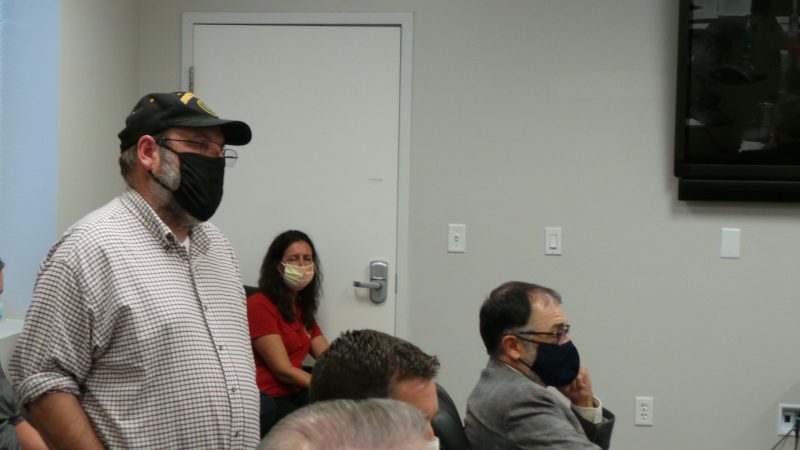
Paul Aldrich, above, explains that Virginia Citizen Defense League (VCDL) attorneys wrote the resolution he presented to council ‘with the intent of challenging anything that goes through the state legislature’ on gun control while Democrats control the state legislature. Below, the council turns to listen to Aldrich’s explanation of why a non-legally binding resolution to change something that doesn’t currently exist is necessary.
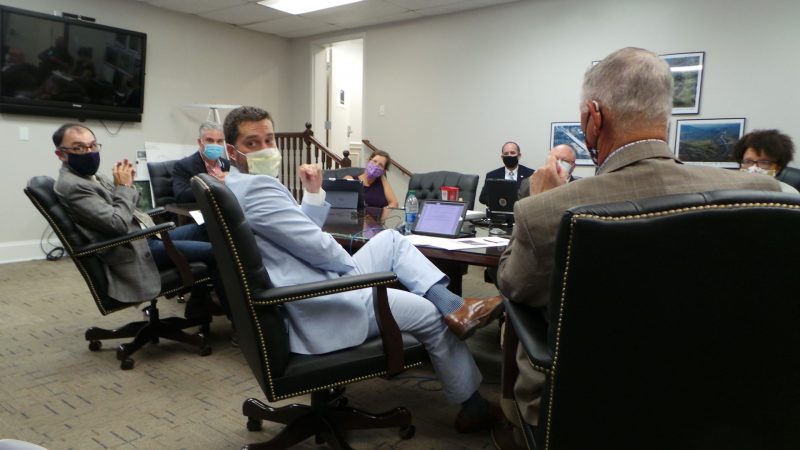
While Aldrich admitted a future council as may be seated next year after the November election, could overturn this council’s action on the resolution, he still urged it be moved forward as suggested by VCDL attorneys.
“It was put forth with the intent of challenging anything that goes through the state legislature,” Aldrich explained of the adversarial relationship that has grown between the Democratic-controlled legislature and the VCDL and its membership.
“Our problem is we have an attorney and chief of police who say we really don’t need it,” Mayor Tewalt pointed out.
“I don’t think it would hurt to pass it anyway – why don’t we just go ahead and put it on the agenda and vote on it. It’s not going to hurt anything,” council’s man who would be mayor-elect as of the November election, Chris Holloway, offered.
Others agreed and the consensus was to move toward a vote at the upcoming council meeting.
Watch the Royal Examiner video of this discussion in its entirety, and other work session discussion, including agreeing to remove the electric car charger in the Village Commons/Town Gazebo area, which is experiencing software issues and appears to be down to one regular customer at taxpayer expense with other chargers now available in the community, Electric Department Director David Jenkins explained to council; Finance Director B. J. Wilson’s FY-21 Revenue report update; and the makeup of and a vacancy on the planning commission, prior to council’s adjournment to closed session to discuss its pending litigation with the EDA:


Virginia State Police Urge Sober Plans for Saint Patrick’s Day Celebrations

In a One-Party County, Internal Party Decisions Affect Us All

Virginia State Police Seize Nearly 100 Pounds of Narcotics, Recover Firearms in Weekly Crime Suppression Effort

Barton Charles “Bart” Haller (1940 – 2026)

Dawn Lee Dodson (1970 – 2026)

Mary Helen “Nanny” Spires Johnt (1954 – 2026)

Another Round of ‘Momnibus’ Bills Are Headed Towards the Governor This Year

Virginia Joins States Challenging Trump Admin Regulations That Limit Free Birth Control Access

Update: Charlotte Swanson Smith (1951 – 2025)
Why We are Challenging the Republican Mass Meeting

Bruce Norman Showman (1954 – 2026)

EDA Relaunches Small Business Loan Program to Help Warren County Entrepreneurs Access Capital

Targeted Exercises to Improve Your Putting

The Hidden Risks of House Hunting Solely Online

Choosing the Right Cleaner for Every Surface in Your Home

New Church Among Consent Items at County Planning Commission Meeting

Warren County GOP Mass Meeting Results Challenged After Allegations of Voting Irregularities

‘This Is About Equity’: In Richmond, Virginia Workers, Lawmakers Push for Inclusive Labor Rights for All

After Five Years of Attempts, Virginia On Track to Set Up a Prescription Drug Affordability Board

New Drug Take-Back Box at Warren County Sheriff’s Office Offers Safe Way to Dispose of Medications

‘Feeding Our Neighbors’ Continues Local Effort to Provide Free Meals in Front Royal

Blair David Eller (1963 – 2026)

Writing Workshop at Samuels Public Library Aims to Help Community Communicate More Clearly

Simple Steps to Reduce Wildfire Risk Around Your Home
