
Local Government
Tension continues between Farms Sanitary District Advisory Committee and County officials on responsibilities and transparency
The disconnect between a number of the residents of Shenandoah Farms placed in advisory roles to the Warren County government’s ongoing management of the Farms Sanitary District and the County officials who placed them there appeared to continue at a Thursday, January 5th meeting of the Shenandoah Farms Sanitary District Advisory Committee. Signs of that disconnect included ongoing committee issues with a lack of response to questions on Sanitary District project costs, revenues and revenue disbursement; county staff interactions with resident complaints on district infrastructure issues; the committee’s access, or lack thereof, to county staff responses to those complaints; and exactly what the parameters of the advisory committee’s role is and what County records or materials are necessary to fulfill its prescribed role.
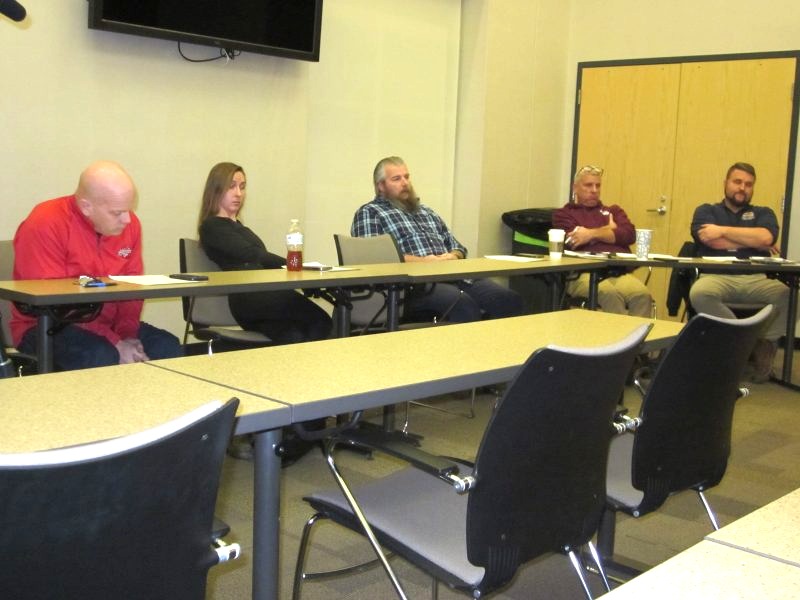
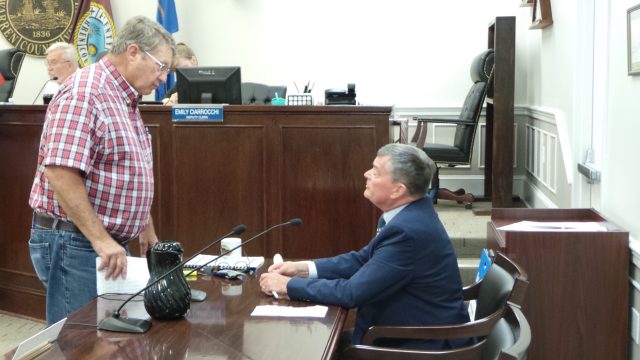
Is there a body language message being sent here? Advisory Committee member Todd Tennant, far left, suggested the involved sides attempt to move beyond past ‘vitriol’ toward ‘a spirit of cooperation moving forward’. Below, new county board Chair Vicky Cook joined Shenandoah District Supervisor Walt Mabe on the County side. Her body language isn’t quite as tight as some. Photos by Roger Bianchini, Video by Mark Williams, Royal Examiner.
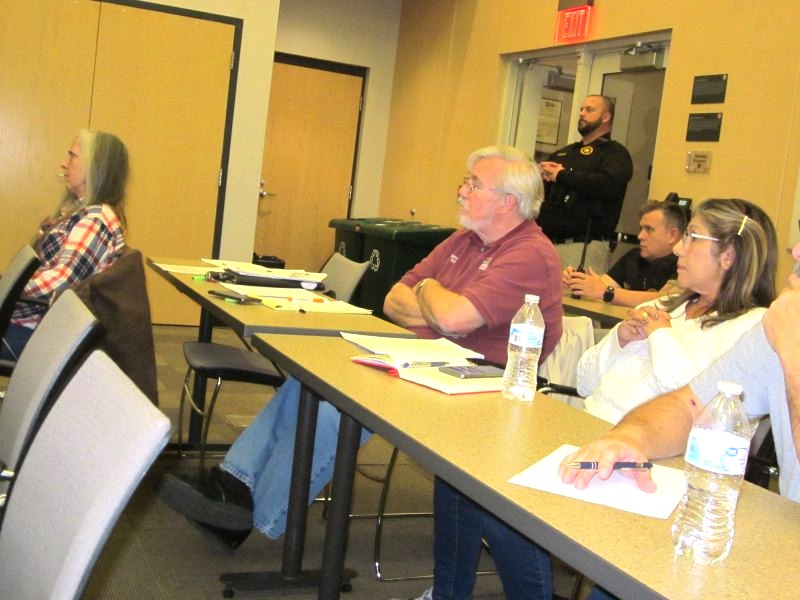
The committee fielded a three-member quorum – new Chairman Sarah Saber, Matt Devine and Todd Tennant – in the wake of initial Chairman Bruce Boyle’s resignation submitted during and effective at the end of the November 3rd committee meeting, and member Charles Thilking’s ongoing struggle with family health issues. Warren County was represented by the board of supervisor’s liaison to the committee, Shenandoah District Representative Walt Mabe, newly installed board Chair Vicky Cook (Fork District), Public Works Director Mike Berry, and Sanitary District Manager Michael Coffelt. According to a sign-in sheet, interested citizens present included Faith White, Paul Lilley, Chris Pollock, and Linda McDonough.
The meeting held at the County Public Safety building adjacent to Skyline High School got off to a somewhat shaky start in the absence of a meeting agenda or meeting minutes for routine approval. However, the November minutes were located in an email forwarded by former Chairman Boyle to County Administrator Daley, and approved. Berry noted that staff had prepared the Advisory Committee Bylaws as a substitute agenda. Coffelt then presented the Sanitary District Manager’s report on recent work projects in the Farms.
It was from there that a divide in relative perceptions of the advisory process began to show. Saber, Tennant, and Devine expressed a desire that the committee receive copies or reports on resident issues with road or other infrastructure and the county staff’s response to those reports. After noting that many of them are made by phone, as opposed to written submissions, Coffelt drew a process line in the sand: “So, to answer your question and to satisfy what I think is the best thing to do – it is our job to manage the maintenance in the Sanitary District. It’s your all’s job to advise the rates and work on the CIP (Capital Improvement Project) part. And we meet quarterly. So, my monthly reports will be read at our quarterly meetings based on the information that I get from the field on a daily basis. I keep daily sheets, I do my monthly invoices, I report everything at that time.
“So, to me, I mean I find it not necessary to involve the Advisory Committee on every complaint that I get,” Coffelt concluded, getting a “WHOA” response from committee Chair Saber who countered by asking Coffelt why it had taken from October to January 5th for monthly reports she had requested to be posted by the County. At issue for Saber and some of her committee co-members, as it was for POSF officials prior, are relative costs of Sanitary District maintenance or work contracted by the County coming out higher than they have been able to find. Saber agreed the committee should not be duplicating staff efforts, but that a record of citizen-initiated repair work and costs would be helpful in advising on future efforts.
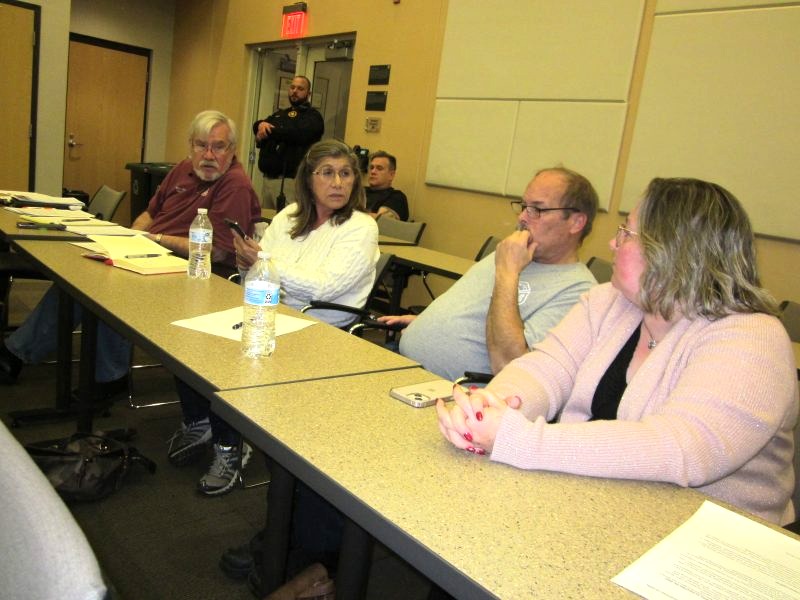
Supervisors Cook and Mabe discuss points raised with Farms residents present, if we read the sign-in sheet correctly, Faith White and Paul Lilley. Below, committee Chair Saber and Farms resident Linda McDonough may be wondering if they’ve hit common ground in a desire for more direct input on Sanitary District decision making from residents.
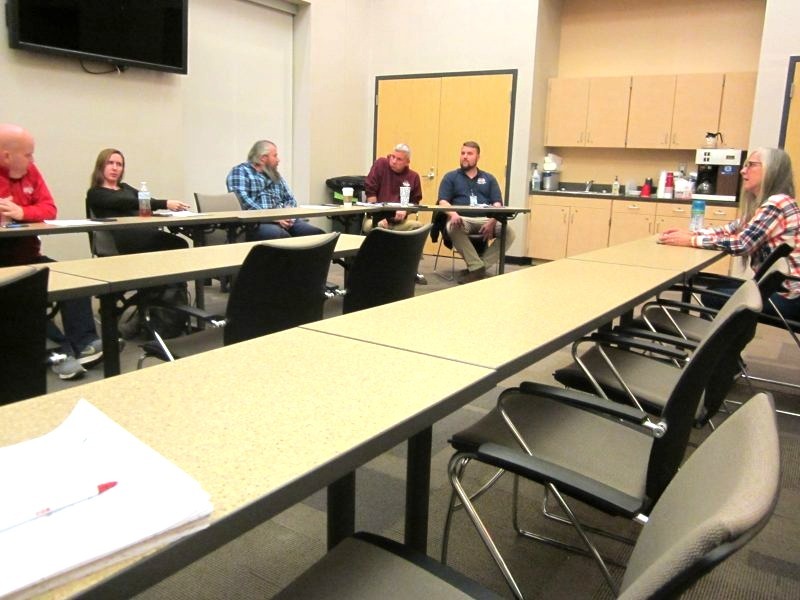
“I have all of these reports dating back to 2012,” Saber said of a history of past work in the Sanitary District she assembled, adding, “So, is there a reason this wasn’t checked in earlier or provided to the community as a whole? … That’s what we’re asking for, is transparency.”
“I understand that and we work toward that. And we’re also an organization that has just started and we’ve got things we’ve got to,” Supervisor Mabe responded leading Saber to interrupt and point out that the Sanitary District and its management was far from a new operation within the county governmental structure. Some involved, like Saber, believe that those older records she referenced back to 2012 indicate a more cooperative and functional management/advisory structure in place prior to the current board’s involvement.
The Farms Advisory Committee was formed mid-2022 after county officials locked out previous advisory group and original Sanitary District management entity (1995-2010), the Property Owners of Shenandoah Farms (POSF), in the wake of POSF voiding the two-party Sanitary District management agreement between them and the county put in place when POSF asked the County to take over management of what was climbing to a six-figure annual Sanitary District budget, circa 2010/11. POSF’s intent last year was to regain management authority in the wake of months of the absence of County financial reports on the Sanitary District and mounting discontent with County road maintenance decisions and costs. However, county officials opted to simply cut funding to POSF, which no longer collects lot fees as a revenue stream, and lock them out of any management or advisory role. The County has since paid $12,219 in insurance costs to cover the POSF-owned community common properties to keep them open, though there seem to be communications gaps regarding related costs and future maintenance of those common properties.
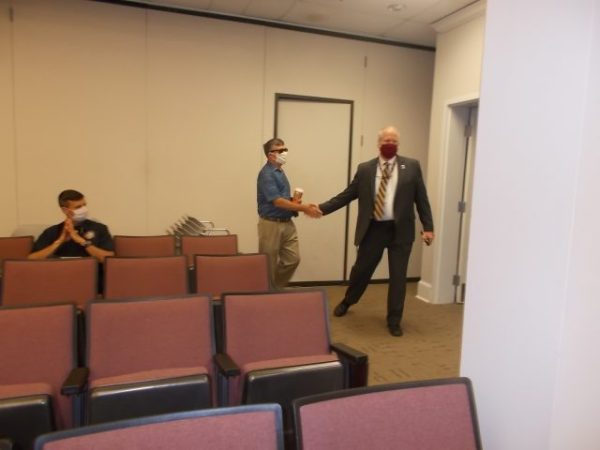
Former POSF Chairman Ralph Rinaldi discusses the group’s move to void the 2-party contract giving WC management authority over the Farms Sanitary District signed in 2011, with County Administrator Ed Daley after presenting that initiative to the supervisors last year. – ‘Your board realizes we’re not trying to cut ourselves OUT of the equation, right?’ Rinaldi may have been thinking. Speaking of Warren county administrators, below are two – one about to become former, one about to become future. Can you tell which masked county administrator is which?
The months of a financial reporting gap and growing POSF discontent over County management came during a period of successive turnovers at the top of the County Finance Department. That coincided with a turnover at the county administrative and sanitary districts management level in the wake of the forced resignation of County Administrator Doug Stanley and the subsequent resignation/retirement of Deputy County Administrator and Sanitary District Manager Robert “Bob” Childress.

Joyce Henderson Banks (1941 – 2026)

Accountability Before Adjustment
Supreme Court Ruling Revives Debate Over Conversion Therapy Bans, Including in Virginia

Growing Pains: Rising Diesel, Fertilizer Costs Spurred by Iran War Impact Virginia Farmers

Virginia, Other States Make It Easier for Physician Assistants to Practice

Working Part-Time After Retirement: For the Paycheck — and the Fun

Compressed Air Safety: Why 30 PSI Is the Limit for Cleaning

ORDER OF PUBLICATION: In the Circuit Court for Warren County, Virginia

Local NAACP Recalls Segregated Criser High/Elementary School During ‘Learn From the Past for a Better Future’ Event

Virginia Revenues Top Forecast, But Economic Concerns Remain

Governor Clarifies: Proposed Tax Changes Never Became Law

Driver Runs After Crash, Caught by Police Moments Later

Debate Continues Over Tax Rate as Supervisor Offers New Option

POLICE: 7 Day FRPD Arrest Report 4/13/2026

Spanberger Joins Other Governors in Push for PJM to Prioritize Ratepayer Protections

Cannabis Testing Challenges Persist as Virginia Retail Market Nears

Quick Quiz on Tooth Decay

The Fat Facts: Busting Common Food Myths

Importance of Chiles v. Salazar and the Protection of Free Speech
MAGA Suicide?

Warnick Posts Natural Hat Trick as Shenandoah Downs Opens Spring Meet

Youngkin Returns to Campaign Trail, Calls for Court to Strike Redistricting Vote

‘We Have To Do Something’: Former U.S. Attorney General Eric Holder Supports Virginia Redistricting

3 Ways to Extend the Life of Your Electric Vehicle Battery
