
Local Government
The Sufficiency of a Sworn Affidavit: Town Planning Commission Favors Administrative Enforcement for Auxiliary Dwelling Units
At a January 7 work session, at the request of the Town Council, the Planning Commission revisited fertile soil for a conversation about auxiliary dwelling units, looking particularly at the special-use permit as a potential enforcement mechanism. Consensus was reached quickly that an SUP process for this routine residential development would not be ideally suited for such a development, which runs parallel to recent legislation at the state level. For developments that are not particularly special, the state code has been adjusted to streamline the process administratively. Thus, plans and plats may never be seen by the commission or council, and instead, they are addressed by a designated agent; regarding ADUs, an affidavit confirming that the owner will abide by all the relevant standards could be administered by staff, honoring the intent and trajectory of the recent and ongoing legislation to expedite the process when it is not exceptional.
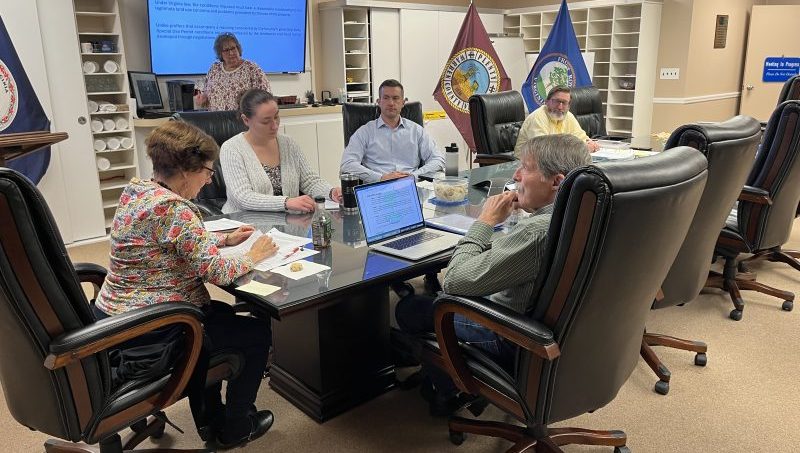
The Town Planning Commission gathers for a work session on January 7. Royal Examiner Photo Credits: Brenden McHugh.
The commission’s rationale is not a secret. Articulated by Vice Chairman Allen Neel, it reads as follows: “Recent actions by the Virginia General Assembly signal a strong policy preference for simplifying and accelerating residential development approvals. Legislation such as SB974 and HB 2293 reduces discretionary review, limits the role of public hearings, and shifts routine development decisions to administrative staff acting as designated agents. The intent is to remove unnecessary processes, lower costs, and make housing production more predictable and affordable. Requiring Accessory Dwelling Units (ADUs) to obtain a Special Use Permit (SUP) runs counter to this policy direction, particularly when even larger and more complex residential projects may now be approved administratively.”
It continues: “ADUs are modest, residential in nature, and subordinate to a primary dwelling. They have predictable impacts that can be addressed through clear, objective zoning standards rather than case-by-case approvals. Treating ADUs as “special” uses introduces added cost, delay, and uncertainty, and reintroduces discretionary review by planning commissions and governing bodies that recent state reforms are intended to minimize. This approach undermines the goal of normalizing small-scale housing and discourages a form of development that many Virginia localities now view as a practical tool for affordability and gentle neighborhood infill.”
It concludes: “A by-right, administrative approval framework is a more effective and policy-consistent approach. Objective standards—such as size limits, setbacks, height, parking, and owner-occupancy requirements—can be enforced through existing zoning permits, inspections, and compliance mechanisms with the addition of a sworn affidavit at the time of construction or conversion. This method preserves local control over form and impacts while avoiding unnecessary procedural hurdles. Allowing ADUs by right aligns with current best practices in Virginia and supports the broader state goal of increasing housing options through efficient, predictable approval processes.”
Commissioner Megan Marrazzo indicated that she had read a communication from Neel in which he established some variation of the above, and she expressed agreement. Neither Chairman Connie Marshner nor Commissioner Andrew Brooks expressed disagreement, and as Commissioner Teresa Fedoryka was absent, the Royal Examiner concluded that the commission has reached a consensus as they prepare to send the item back to the council with a recommendation for administrative enforcement.

The Year of Confusion: What Did the Romans Do in January?

Dustin Blake “D-Ham” Hamilton (1996 – 2026)

Warren County Board of Supervisors Elects 2026 Leadership at Annual Meeting

In Statewide Survey, Employers Say Virginia Child Care Crisis Negatively Impacts Businesses

Commentary: Doing The Happy Dance as Social Security Pays Up

US House Backs Extension of Health Insurance Subsidies After Dems Force Vote

US Senate With GOP Support Advances War Powers Resolution Rebuking Trump on Venezuela

Tribute to an Extrordinary Local Lady and Her Nationwide Legacy

3 Must-Have Accessories to Make Winter Driving More Comfortable

Travel Planner: A Lovely Gem Hides in an Unexpected Place

The Sufficiency of a Sworn Affidavit: Town Planning Commission Favors Administrative Enforcement for Auxiliary Dwelling Units

Warren County Girls’ Basketball Team Set to Face Manassas Park This Friday

Battery Storage Bills Make a Return After Previous Vetoes

Virginia Transportation Board Transfers Rail and Trail Project Amid Public Concerns

Shenandoah River State Park Invites Public Input and Launches Expanded Programming for All Ages

Cancer Cluster Ruled Out In Southwest Virginia, Though More Data Collection Is On The Horizon

Plastic Pellets Known as ‘Nurdles’ Are Polluting Beaches and Waterways

Is Industrial Design Training Right for You?

National Bird Day: How to Help Our Fine Feathered Friends

Peanut Allergies Finally Show Signs of Decline After Years of Steady Rise

What’s at Stake Thursday? Is Transparency a Board Priority or a Slogan?

ICE Officer Fatally Shoots Woman During Immigration Enforcement Encounter in Minneapolis

May D. Landes (1958 – 2026)

Ethel Ritter (1929 – 2026)
