
EDA in Focus
Town, County officials briefed on dynamics of economic development
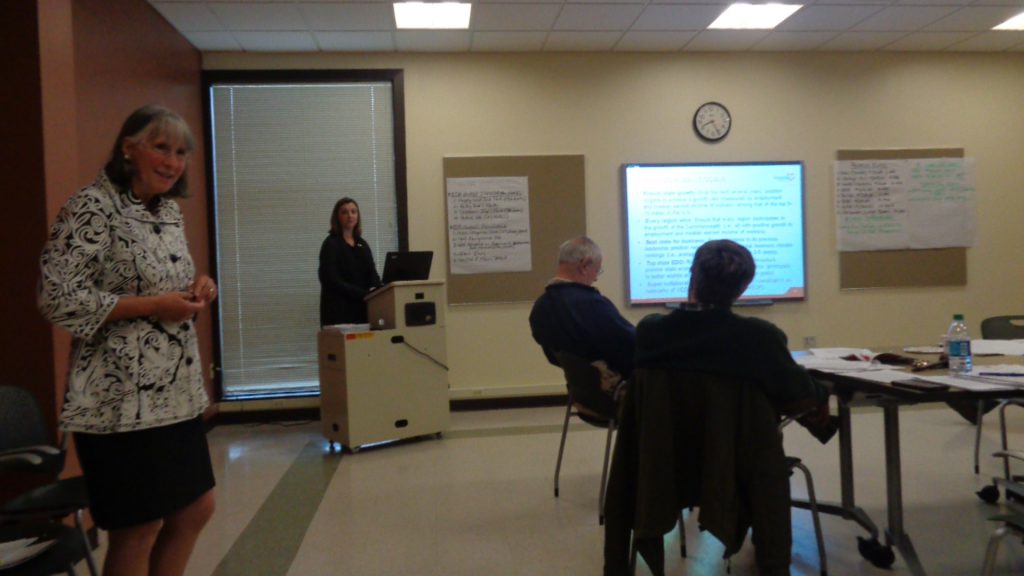
Turn the lights down low – Virginia Economic Development Partnership General Counsel Sandra McNinch, left, presented an overview of the dynamics of economic development work across the commonwealth. Photos/Roger Bianchini
The Front Royal-Warren County Economic Development Authority’s monthly meeting, held jointly with the Front Royal Town Council – well, at least two members (Tewalt and Sealock) – and Warren County Board of Supervisors (4 of 5 members, Fox absent) Friday morning, December 8, served largely as a course in the processes and intent of local municipal EDA’s.
That class was provided in a detailed, 33-slide power point presentation by Virginia Economic Development Partnership (VEDP) General Counsel Sandra Jones McNinch. McNinch began by explaining the role of VEDP at the both the state level and as a facilitator and conduit to municipal EDA’s across the commonwealth.
The VEDP is comprised of a 17-member board of directors, 11 of whom are appointed by the governor or state general assembly; the remaining 6 are ex-officio members. It serves as “Virginia’s Business Welcome Center” to international and national companies seeking new or additional bases of operations; and on the flip side of that equation as a “Global Gateway” for Virginia companies seeking expanded markets. McNinch lauded the work of Governor Terry McAuliffe over the past four years on these economic fronts.
Teams, competition & powers
She also stressed that economic development “is a team sport”. At the state level that is achieved in trying to see “that every region wins” as far as “positive growth in employment and median earned income of workers”. On the local level that “team” partnership involves the municipalities that create EDA’s or IDA’s to oversee the nuts and bolts of economic growth.
One interesting point McNinch noted is that once created, EDA’s have financial powers “that don’t exist at the municipal level”. Such powers include: making grants to private entities; sale of property without public hearings; the lease of sale of properties at, below or above fair market value – not just to the highest bidder; bond issues for the benefit of private entities; the ability to forgive loans that it makes to private entities; and the ability to act beyond the boundaries of the localities it serves.
And with all those powers in hand, McNinch stressed that it can be difficult, particularly in smaller communities, to maintain a primary motivation of helping the outside prospect company, rather than one’s self, family and friends. That can be particularly true as EDA/IDA directors (and also board members) can be “well-positioned to influence economic development in their communities” the power point noted.
And as one might expect, while economic development may be a “team sport”, it is also a highly competitive one as regions and localities try to draw the businesses that will facilitate economic growth, better jobs and higher wages their way. Succeeding in this highly competitive environment depends on a variety of factors revolving around what each community has to offer new business in the way of land, infrastructure, workforce, access, financial assistance when needed, and “reasonable costs and taxes”.
At several points McNinch stressed that “reasonable taxes” does not necessarily translate into “the lowest tax”, but rather “the fairest”.
And while she observed that Virginia is limited in offering tax breaks as incentives because of the State’s “Uniformity of Taxation Clause” that mandates that “all similarly situated property and taxpayers should be taxed similarly”, there is way for Virginia and its EDA’s to compete on that level as well.
“Virginia localities can get to the same place by offering, through the Authority (EDA or IDA), a grant equal to the % of the taxes paid,” the power point stated. One chart showed the circular nature of this system: 1/ Local tax assessed to company; 2/ Company pays tax; 3/ Governing body approves payment to Authority; 4/ Locality pays Authority; 5/ Authority pays $ to company (equal to amount of tax consideration approved in recruitment of the company).
Mission Confidentiality
VEDP counsel McNinch also addressed the sometimes misunderstood role of confidentiality in business recruitment. Her presentation noted that “Maintaining confidentiality is critical” and “Loose lips sink ships”. Among the reasons listed were:
- companies want to maintain confidentiality to preserve relationships with vendors, suppliers, customers and employees;
- publicly-traded companies need to be mindful of any forward-looking statements (which can be illegal);
- known interest in a site may drive its price up;
- if confidentiality is broken a company may be afraid to share relevant information important to reaching a deal;
- the company or its product may be controversial (while I don’t begrudge the others, the reporter in me says this one is NOT a good excuse for confidentiality).
Bottom lines
A bottom line of business recruitment is problem solving, McNinch told Town, County and EDA officials. Among potential problems many relocating businesses are seeking solutions to are a trained workforce; ready access to suppliers and customers; access to innovative resources; access to some level of capital investment; and as mentioned above, those reasonable costs and a fair tax system.
If confidentiality is broken or there are obstacles to their “problems” being solved, a successful recruitment becomes increasingly unlikely.
“They read your papers. So, if you’re fighting about stupid things – stop it,” McNinch advised municipal officials.
At the top of the VEDP list of typical company needs was a “new, expanded or improved facility with good infrastructure”. Perhaps ironically, infrastructure development, who would pay for it and when, has been an issue between our EDA and town council in recent weeks and months.
Specifically that infrastructure involves a primary access way through the Royal Phoenix Business Park at the former Avtex Superfund site – the West Main Street extension (estimated total cost $2 million to $2.5 million) – and a wastewater pumping station (estimated cost $385,000 to $400,000) to serve the first seven or eight commercial clients recruited to the Royal Phoenix site; and off-site road improvements to facilitate access (Phase 1 estimated cost $400,000-$500,000),
The EDA and its first Royal Phoenix client ITFederal are awaiting a final West Main extended design from the Town and a commitment to the idea of a Town-constructed wastewater pumping station developed by former Town Manager Steve Burke. Council has committed $9,200 to the design phase of the pumping station, but not the construction cost.
But if council, 4/6’s of whom were not in attendance at Friday morning’s joint meeting, are having trouble grappling with those infrastructure costs to propel forward economic re-development on the Town’s wish list for over two decades, perhaps another bottom line will help them out.
VEDP General Counsel McNinch presented numbers documenting a $9.1-dollar return on investment for every $1-dollar in incentives offered new businesses in Virginia over a 14-year period from 2002 and 2015. Based on 387 projects where $450.2 million in incentives were paid, net positive revenue to the commonwealth of $3.662 billion was cited. Okay, incentives aren’t exactly infrastructure investment – but apparently you aren’t likely to get to the incentive phase without the infrastructure investment first.
But recent work session discussion see related story indicates a town council majority seems more willing to gamble on New Market Tax Credits that the US House Tax Reform Bill currently on the table is poised to eliminate. – Hey guys, why not gamble on something that might pay off in the end?

Virginia State Police Urge Sober Plans for Saint Patrick’s Day Celebrations

In a One-Party County, Internal Party Decisions Affect Us All

Virginia State Police Seize Nearly 100 Pounds of Narcotics, Recover Firearms in Weekly Crime Suppression Effort

Barton Charles “Bart” Haller (1940 – 2026)

Dawn Lee Dodson (1970 – 2026)

Mary Helen “Nanny” Spires Johnt (1954 – 2026)

Another Round of ‘Momnibus’ Bills Are Headed Towards the Governor This Year

Virginia Joins States Challenging Trump Admin Regulations That Limit Free Birth Control Access

Update: Charlotte Swanson Smith (1951 – 2025)
Why We are Challenging the Republican Mass Meeting

Bruce Norman Showman (1954 – 2026)

EDA Relaunches Small Business Loan Program to Help Warren County Entrepreneurs Access Capital

Targeted Exercises to Improve Your Putting

The Hidden Risks of House Hunting Solely Online

Choosing the Right Cleaner for Every Surface in Your Home

New Church Among Consent Items at County Planning Commission Meeting

Warren County GOP Mass Meeting Results Challenged After Allegations of Voting Irregularities

‘This Is About Equity’: In Richmond, Virginia Workers, Lawmakers Push for Inclusive Labor Rights for All

After Five Years of Attempts, Virginia On Track to Set Up a Prescription Drug Affordability Board

New Drug Take-Back Box at Warren County Sheriff’s Office Offers Safe Way to Dispose of Medications

‘Feeding Our Neighbors’ Continues Local Effort to Provide Free Meals in Front Royal

Blair David Eller (1963 – 2026)

Writing Workshop at Samuels Public Library Aims to Help Community Communicate More Clearly

Simple Steps to Reduce Wildfire Risk Around Your Home
