
Local Government
Urban Agriculture in R-1 Zone Discussed at County Planning Commission Meeting

The County Planning Commission gathers for its regular monthly meeting on Wednesday, December 10. Royal Examiner Photo Credits: Brenden McHugh.
While backyard beekeeping received a favorable consensus to move forward for advertising a public hearing in January, a rooster exception received a recommendation for denial from the County Planning Commission at its monthly regular meeting on Wednesday, December 10. Both urban agriculture enterprises were being considered for the R-1 zone.
Amid short-term rental applications, an application for a potential storage facility, and a rezoning from residential to commercial, these two items complemented each other on parallel tracks, serving as impetus for new allowances and performance standards in the residential zone. For backyard beekeeping, there was a groundswell of support from Commissioners William Gordon and Brigitte Miller to expedite the January hearing. Both commissioners have been vocal advocates of perfecting the performance standards for this item at prior meetings.
As it now stands, this applicant-driven text amendment would regulate backyard beekeeping in several ways. The summary reads: “The proposed permit requirements include a limit of no more than two beehives per one-quarter acre, with a maximum of 6 beehives per one acre lot, or no limit on the number of beehives if all beehives are placed at least 200 feet from all property lines, beehives shall be located in the side or rear yards only, and shall be located a minimum of 10 feet from all property lines, a restriction on the onsite sale of goods or services relating to the honeybees, a flyway barrier requirement for beehives that are less than 40 feet from a property line that is no less than six (6) feet in height and is located between the beehive and the property line or elevate the hive entrance no less than six (6) feet above the property line and should be of sufficient density, length, and height. The proposed limitations on the number of beehives and setback/barrier requirements are consistent with the best management practices for the keeping of honeybees recommended by the state administrative code.”
Miller noted that one of her foremost concerns was the allowance for selling honey, which had originally been prohibited. It is now permitted, provided it does not take place at the residential site where the operation is being conducted. Thus, selling the honey at a farmer’s market or any number of other venues would be permitted. Miller, a beekeeper, has repeatedly said that beekeeping is not an inexpensive hobby, and that the ability to sell honey is pivotal to recouping costs. At past meetings, Gordon has been concerned about setbacks and fence quality, which have encouraged the bees to go up and over the barrier. Both Miller and Gordon were joined by their colleagues in agreeing to advertise, recognizing that the performance standards have reached maturity.
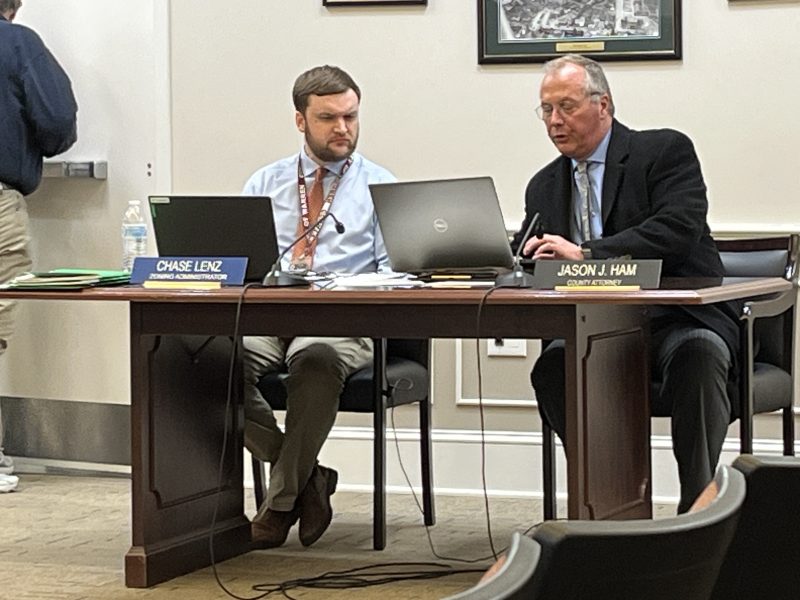
(L) Zoning Administrator Chase Lenz and (R) County Attorney Jason Ham.
Less popular was the rooster exception in the R-1 zone. “One rooster shall be permitted on a lot or contiguous lots under the same ownership,” the proposed regulation reads, “provided such lot or lots total one acre or greater in size. The rooster shall be kept in a coop between the hours of 10:00 PM and 7:00 AM, and the coop shall be insulated for sound.” Public input at this hearing was divided between grim assessments of the sheriff’s office’s apparent inability to enforce the standards and, on the other hand, support centered on the notion that a rooster is no more obnoxious than other noise-producing enterprises, such as those involving a chainsaw. Among the commissioners, there was skepticism about the lack of precise language for “insulated” and about whether the need for proper airflow could be balanced against this noise-reduction technique. Ultimately, the recommendation was for denial, with Miller abstaining.

Planner Kelly Wahl.
A key focus of discussion amid commissioner reports was short-term rentals and their proliferation in the county. After hearing from the public throughout the meeting and at various hearings, the commissioners asked: How best can short-term rentals be regulated? What followed was an intense back-and-forth among commissioners, legal counsel, and planning and zoning staff, establishing that, in any path it pursues, the commission must follow precise legal guidelines, which means conferring with County Attorney Jordan Bowman, who normally guides the commission. Also, planning and zoning explained that the department is open to complaints and already has a process, online and otherwise, for expediting them. Thus, if a report is received about a neighboring short-term rental violating the conditional use permit, staff will contact the owner to confirm compliance. As the owner does not wish to lose the permit, compliance will likely be established. While the sheriff’s office may play a role initially, the planning and zoning department provides a long-term solution.
With no other business to conduct and wishing one another a Merry Christmas, the commission adjourned.
Click here to watch the Warren County Planning Commission Meeting of December 10, 2025.


Commentary: When the Law Is Made in the Dark, Democracy Suffers

Your 401(k): A Simple Guide to Growing Your Retirement Savings

Celebrity Birthdays: Who’s Blowing Out Candles This Month?

Beat the Frost: How to Keep Your Windshield Clear This Winter

POLICE: 14 Day FRPD Arrest Report 12/15/2025

New 8th Street Bridge Opens Early in Front Royal — A Symbol of Progress and Smart Planning

Blue Ridge Wildlife Center Patient of the Week: American Coot

This Week’s Showtimes at Royal Cinemas as of January 1st

Study: Virginia Faces $23 Million Revenue Loss Due to International Student Enrollment Changes

Harry D. Hardin Sr. (1936 – 2025)

Abigail’s Smile, a Family’s Faith, and a Community That Cares

The Diva of the Orchard: Why America Can’t Get Enough of the Honeycrisp Apple

What to Do When Your Pill Looks Different

Library Gears Up for a Busy January with Programs for All Ages

Town of Front Royal Holiday Closures & Waste Collection Schedule

Queen of the San Diego Zoo Passes Peacefully at 141

Virginia Awaits Decision on $1 Billion Rural Health Grant

The Man Who Invented the 401(k), Revolutionizing Retirement

Teach Teens How to Save With These Banking Apps

Quentin James “Que” Diggs (1978 – 2025)

One Big Beautiful Bill Act Complicates State Health Care Affordability Efforts

Deportations, Tariffs, Court Clashes, Record Shutdown Mark a Historic Year in Washington, D.C.

The Rare Earth Puzzle: What They Are and How China Took Control of the World’s Supply

Earl Bradford Robinson (1942 – 2025)
