
EDA in Focus
Warren County’s EDA financial scandal – How did it happen? Robert Goodlatte brings a $140 million fantasy to this community
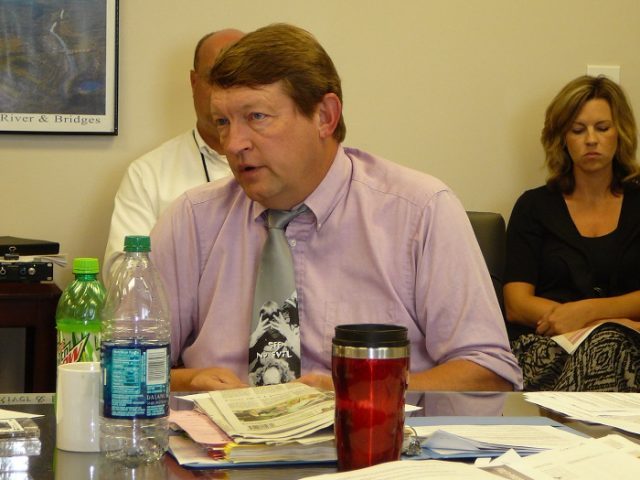
Sorry to use you as the poster boy for a collective failure of due diligence, Tony – but it’s the 3 Stooges ‘See No Evil’ tie sported at a past supervisors work session. Somehow it seemed to fit. File Photos/Roger Bianchini
We closed Part Two of our series on what went wrong within the EDA and local government that allowed an alleged embezzlement-tinged scandal to fester for so long, in so many directions with a one-word question – Why?
Why not trust then U.S. Virginia Sixth District Congressman Robert Goodlatte’s 2014 assertion that ITFederal would invest $40 million dollars and create 600-plus high-paying jobs here based on a $140-million federal government contract – even though there was no evidence that contract existed?
After all, it wasn’t until two years after Goodlatte dropped Truc “Curt” Tran and his ITFederal LLC’s three-phased $40 million business plan at the vacant Avtex Brownfield/Royal Phoenix Business Park site that the congressman managed to get a raised eyebrow from newly-inaugurated President Donald Trump. That raised eyebrow reprimand came in reaction to Goodlatte’s first 2017 Congressional Session initiative that independent ethical oversight of Congress be removed.
Having just been elected on a “drain the inside-the-DC-beltway swamp” promise, I recall Trump Tweet-reacting to his own party’s congressional majority leadership with a “Don’t they have better things to do” admonishment. That presidential Tweet scold – a sign of things to come – resulted in an abrupt about face by congressional Republicans.

A scowling Bob Goodlatte on a ‘Missing’ poster made by disgruntled Warren County constituents used to seeing the congressman’s staff but never the congressman in this part of his district to field legislative questions. Maybe they should have joined the Front Royal Rotary …
But as for “Why not trust” the congressman on his assertions and promises about ITFederal, perhaps as we suggested in Part Two it was the high degree of familiarity on multiple fronts, in this case political with the overwhelming majority of elected county and town officials, and to a lesser extent organizationally and socially.
Because if Goodlatte was oft-criticized for his unwillingness to appear in this part of his district to face constituents at odds with some of his political initiatives, stances and votes, he appeared here to speak to a much less critical audience at the Front Royal Rotary Club on multiple occasions over the years, likely even during Jennifer McDonald’s Front Royal Rotary presidency term, circa 2016-17.
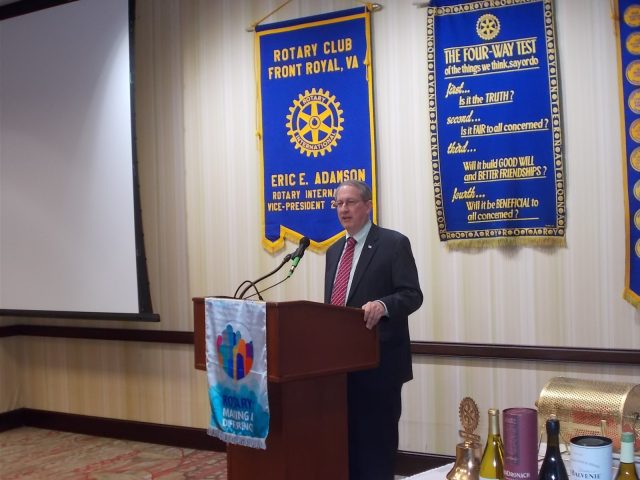
… Where the congressman would occasionally drop by for lunch and remarks among like-minded constituents, including 2016-17 club President Jennifer McDonald
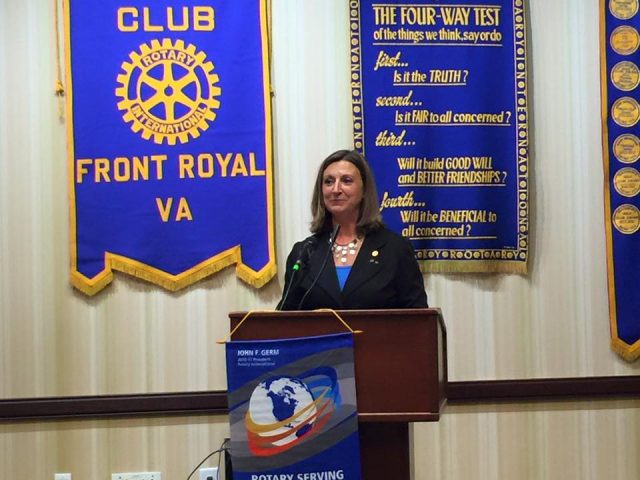
And let’s make one thing clear, the references to the interconnectivity of the local business and political community is not an indictment of Rotary as an entity. In the end Rotary, like any organization, is the sum total of what its membership brings to it. That can be, and often is, an altruistic sense of sharing with those less fortunate by those more successful in the socio-economic sphere. However for those less altruistic by nature Rotary could, like any networking group including political parties, be used as a cover for less altruistic and more personal profiteering ends.
And as we noted in Part 2 of our exploration, one thing the camaraderie and familiarity of Rotary can lead to, much like within a philosophically like-minded political network, is too much of a sense of trust. It is that too easily granted trust borne of familiarity that can cause the absence of the sense of responsibility necessary to look and verify to assure that someone is not playing the system to their advantage in less than ethical, and perhaps even illegal, ways.
There are simple question we ask our elected officials and the Fourth Estate news agencies to ask on the public’s behalf:
1/ is what we have been told true?
2/ to what publicly-beneficial end are these projects being promoted?
And what remains astonishing to this day is the collective degree of institutional hostility that met the one elected municipal official who did initially exhibit the due diligence to ask for such basic verification about EDA projects, particularly ITFederal, in 2016 at the same time the Royal Examiner news staff was seeking answers to the same questions.
Jennifer McDonald’s staunchest supporter on the town council and fellow Rotarian Bret Hrbek warned in late 2016 that the questions being raised about ITFederal from his colleague Bébhinn Egger and the media were threatening to undermine economic redevelopment, particularly the ITFederal project, here.
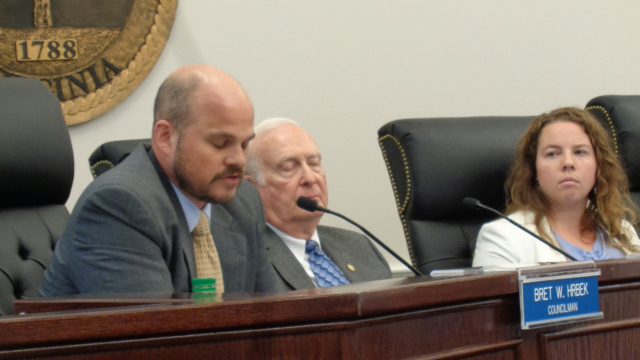
Bret Hrbek warns of the pending departure of ITFederal and its CEO on Nov. 28, 2016, if his colleague two seat to his left and the media kept asking questions about the validity of claims the company could accomplish what was being promised in the way of investment and job creation here. They continued to ask, it’s still here – more or less.
Or as Royal Examiner reported Hrbek stating in the above linked story on the November 28, 2016 Front Royal Town Council meeting: “It has come to my attention, as well as several members of Council’s attention over the past week, it seems that ITFederal, specifically the owner, Mr. Curt Tran, has become highly offended by the hostility that he feels is directed toward him, and the accusations that have been made in his direction, to the point where Ms. McDonald, if she wasn’t dealing with an emergency right now, would be here telling us … (that) she has been scrambling all week trying to appease him and keep him within the Town, if not at least the County. And they’re ready to pull up roots and walk away.”
It appears Tran was able to maneuver that threat to “walk away” from his 30-acre, behind closed doors one-dollar gifted property publicly valued at $2 million into another even sweeter deal on his $10 million loan. That deal was an apparently never publicly discussed EDA arrangement that requires the ITFederal CEO to do nothing more than spend perhaps a fifth of that loan here building a 10,000 square foot building that must have an occupancy permit in place by mid-2020; and to stay current on his loan payments to the EDA over a 30-year payback term.
It is a loan term due circa 2045, 23 years after the EDA’s balloon payoff to First Bank & Trust comes due seven years down the road in 2022.
Why, INDEED?
The essential question about ITFederal had been asked in 2016 – Is what we are being told about this company’s financial status true?
The Perfect Storm of Silence, Part 2: a cattle ranch, $10-mil & …
The answer put forth in the EDA fraud investigation three years later, as it appeared to have been in 2016 for anyone willing to listen, was “No” – what this community was being told about the financial underpinning upon which the ITFederal project would be built did not exist.
Rather than a $140 million federal contract, what ITFederal and its sister company VDN Systems Inc. had was one $5,000 federal contract in 2014. What Royal Examiner also found online then was a five-year history of annual revenues for ITFederal in the range of $35,000 to $50,000 per year, mostly in private sector contracts. Prior to that ITFederal/VDN Systems did have significant federal contracts in the hundreds of thousands of dollars range, one even at $1.2 million. But by 2014 those contracts appeared to have long since vanished.
At the time McDonald disputed that the websites showing this information were legitimate. However three years later financial fraud investigator Cherry Bekaert would reference those sites as an indicator there was no evidence a $140 million federal government contract with ITFederal existed in 2014 or since.
Then EDA Executive Director Jennifer McDonald was questioned by Cherry Bekaert in October 2018 about due diligence regarding ITFederal and the claims brought here by its CEO and Congressional sponsor Robert Goodlatte. The financial fraud investigator’s description of McDonald’s reply remains astonishing to this day:
“MCDONALD stated that the EDA was not allowed to retain any due diligence documentation provided by TRAN, nor did the EDA perform any other due diligence regarding TRAN’s other businesses or ITFederal’s credit worthiness, such as obtaining financial statements, bank records, or research regarding TRAN, ITFederal, or other entities controlled by TRAN.”
So the only substantiation was provided by the company CEO, and that documentation was immediately withdrawn from the EDA’s possession.
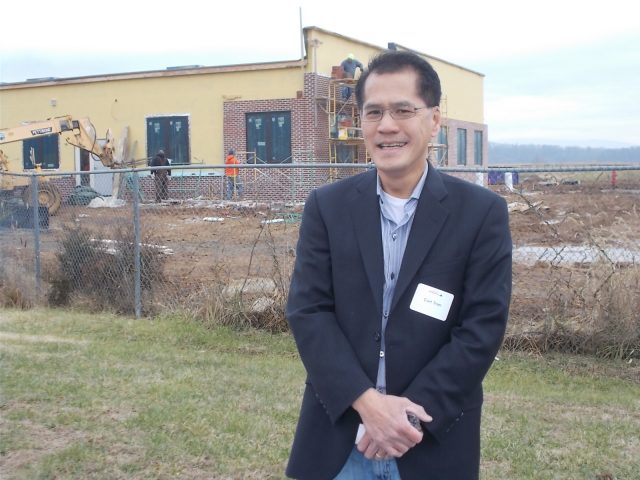
‘Curt’ Tran on site on Dec. 20, 2018 – he expressed distress at the investigative scrutiny Jennifer McDonald was under during closed session after which her resignation was announced.
Red flag?
One would think so, but apparently not if as McDonald reported two months before her December 2018 resignation, the EDA chose to perform no further due diligence investigation of its own. And if that’s not enough to get law enforcement or a grand jury’s attention, the report adds:
“In addition, the EDA did not require any collateral for the $10,000,000 apart from a security interest in the aforementioned 30.11 acre parcel the EDA sold to ITFederal for $1.00. However, the EDA was required to provide a security interest in approximately 147 acres of land known as the Avtex site in order to secure the $10,000,000 loan from FB&T (First Bank & Trust), the EDA source of funds for the ITFederal promissory note …”
Again one must ask WHY?
Why would an EDA Board of Directors and its chief executive accept such loan conditions and offer such sweetheart financial arrangements to a company so close to the vest about its financial condition; and then choose not to perform its own due diligence investigation prior to “selling the 30-acre farm” for a dollar and facilitating a long-term $10 million loan with minimal on-site benefits?
The Cherry Bekaert report continues to explore the alleged impetus for the $10 million loan to ITFederal:
“Per witness statements, TRAN was introduced to the Town and the EDA on or about 06-27-2014, by former Congressman Robert William (Bob) Goodlatte (GOODLATTE), representing Tran as a successful businessman that had secured a business contract with the Federal government and was willing to invest and develop his business in the community. Further, TRAN had represented that ITFederal had obtained a $140,000,000 government contract with the Nuclear Regulatory Commission as evidenced in a business plan (the ‘Business Plan’) presented to the EDA.”
If indeed false as it appears to be, in 2015 that federal contractual pretense was represented in concert by a trio of players: ITFederal CEO Truc “Curt” Tran, his U.S. Congressional sponsor Robert Goodlatte and former EDA Executive Director Jennifer McDonald. Two of those three, Tran and McDonald, are now named as defendants in the EDA civil litigation seeking recovery of as much as $21 million, including the $10 million ITFederal bank loan facilitated through the EDA.
McDonald has thus far been served 28 sealed felony indictments by the Special Grand Jury investigating potential criminality stemming from the EDA civil litigation and financial fraud investigation at its base. And the $10 million loan to ITFederal is being sought for recovery in civil litigation, according to former EDA and County Attorney Dan Whitten because it was acquired “under false pretenses”.
Thus far only Goodlatte has skated through the EDA/ITFederal quagmire unscathed. (Attempts to contact Goodlatte for comment on his 2014/15 assertions about ITFederal through his Congressional successor Ben Cline’s office; his former Chief of Staff Pete Larkin whom Cline’s Communications Director Matthew Hanrahan pointed us to; and Roanoke area telephone information have been unsuccessful for approximately a month prior to publication.)
Whether the $140 million federal contract lie/mistake/misspeak originated with Tran alone is really a moot point. One thing is apparent, that Robert Goodlatte, Jennifer McDonald and Truc “Curt” Tran were of a joint mind in selling the idea of ITFederal as an almost descended from Heaven economic redevelopment Messiah to the elected officials of the Town of Front Royal and Warren County. And those municipal officials, save one, were more than ready to worship at the foot of that alleged economic redevelopment savior.
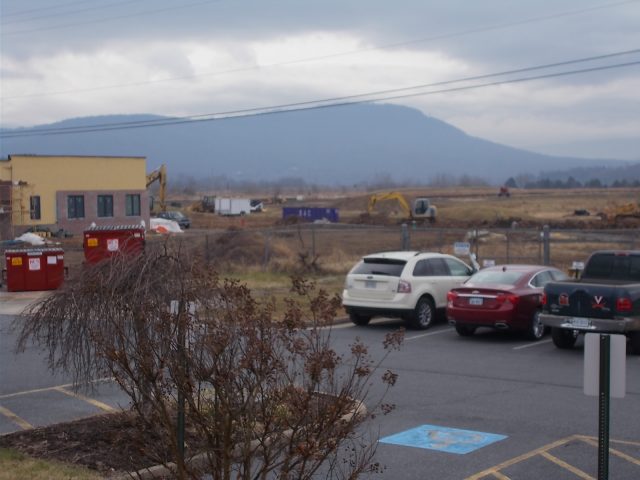
The sky’s the limit at Royal Phoenix – but on Dec. 20, 2018 those skies were becoming cloudy.
Another thing is also apparent, that if Truc Tran was the source of the assertion about a $140 million federal contract with some Department of Defense sub-agency, U.S. House Judiciary Chairman Robert Goodlatte and his staff were in a position to easily verify such a contract’s existence and pass that information on to this community’s EDA and municipal officials.
McDonald told this reporter in 2016 that Goodlatte was the impetus for ITFederal’s arrival at the Avtex Brownfield site. It was a site put under the EDA’s control for marketing for redevelopment in 2014 after decades of federally-overseen Superfund clean up and remediation.
Could there have been some anxiety about seeing the site’s marketing show signs of success after a 25-year process aimed at economic revitalization for the community, specifically the Town of Front Royal? – Certainly.
But is that an excuse for a community’s entire involved elected and appointed official base to go collectively brain dead, save one, in a manner that has raised suspicions of complicity in something fundamentally deceitful, perhaps illegal?
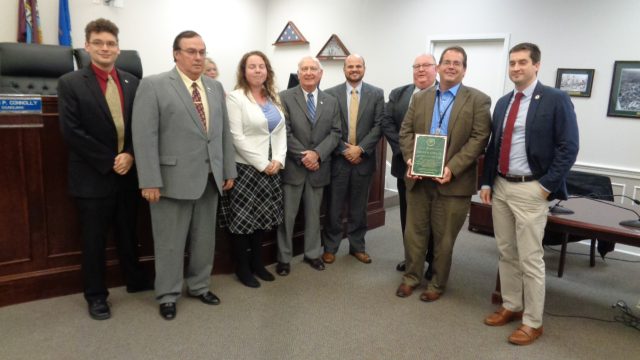
As of Sept. 24, 2019, the Front Royal Town Council, pictured here on Nov. 28, 2016 with then Town Manager Steve Burke, has escaped scrutiny as a player in the absence of municipal oversight of EDA finances, despite its enabling 2015, 3-month $10 million bridge loan that was instrumental in the EDA acquiring bank financing for the ITFederal project.
Goodlatte ballyhooed the ITFederal arrival in press releases and according to McDonald even pushed for the ceremonial October 2015 ribbon cutting/groundbreaking months prior to any contractual arrangement between ITFederal and the EDA having been agreed upon.
If as Royal Examiner’s editorial staff discovered along with Councilman Bébhinn Egger in 2016, and Cherry Bekaert confirmed in its 2018-19 EDA financial fraud investigation, that there is NO evidence a $140 million federal contract ever existed, one of two things appears most likely regarding our Congressional representation at the time:
1/ In 2014 Robert Goodlatte failed to perform his due diligence as Virginia’s Sixth District U.S. Congressional representative in verifying a private-sector contractual basis for the promises he was about to make to his constituents in the Town of Front Royal and Warren County, or;
2/ Goodlatte was an active participant in selling a $140 million hoax to this community.
If the latter, why would a long-tenured U.S. congressman do such a thing?
Could it simply have been to present a rationale for that sweetheart, $10-million EDA facilitated bank loan with the 30-year payback term with little in the way of assurances to the community that much of that money would ever be spent here? (Hypothetical: Yea Curt, tell them you’re pulling up stakes because that councilwoman and the press are being mean to you, see what that gets you.)
What was gotten from a complaint EDA Board of Directors, as previously referenced, was a commitment to spend about $2 million to build a 10,000 s.f. building with an occupancy permit in place by mid-2020; and stay current with the loan payments over the next 30 years.
Or was it a mistake or misrepresentation the congressman thought would be irrelevant in the long run because another source of funding would soon be available to prop up the multiple-phased $40 million ITFederal business plan brought to this community?
Enter the EB-5 Visa Program, or as Councilwoman Bébhinn Egger asked Jennifer McDonald on November 7, 2016, regarding the potential of EB-5 Visa funds being at play in the ITFederal Project:
“There have been some things in the media about certain politicians using EB-5 companies as a front, where the companies don’t actually produce anything,” Egger pressed McDonald on
ITFederal’s potential connection to a federally-controlled foreign funding stream.
Pointing to the Immigrant Investor Program’s troubled history of failed or misrepresented projects nationwide, Egger asked McDonald, “So, I guess if there’s any way you could give Council some concrete evidence that ITFederal is not a money laundering system for this EB-5 visa program – maybe money laundering is the wrong term – but you know what I mean, there is a front … that they invest in … and get their visa.”
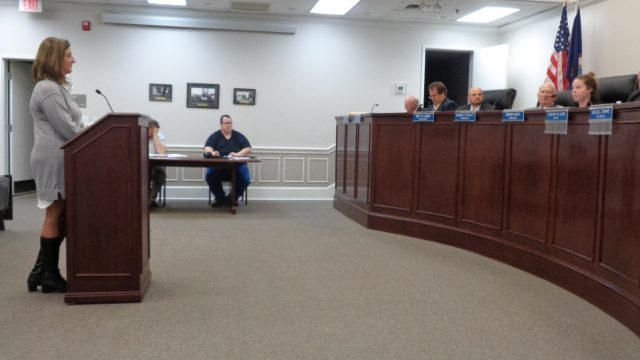
What’s this about EB-5 Visa funding for ITFederal, Bébhinn Egger asked Jennifer McDonald in late October 2016. That promised funding fell through, as it seems has a $40-million ITFederal investment here.
Egger’s reference was to a funding program in which wealthy foreigners invest in local economic development in the U.S. in exchange for visas and green cards for their families to among other things come to the U.S. to study. The program is notorious across the nation for projects that seldom come to fruition, at least as originally presented, if at all.
A ‘Perfect Storm’ of silence raises questions about 1st Avtex client
Right into 2017 and 2018 there appeared confusion on the EDA board as to whether EB-5 Visa funding was at play in the ITFederal project. However Cherry Bekaert reported McDonald writing to potential ITFederal project investors in August 2015 mentioning potential “tax incentives for investors” through an EB-5 funding stream:
“… we noted a letter dated 08-19-2015; signed by McDonald, addressed to Kwang Chul ‘KC’ Whang, President and Principal Broker of The W Group Commercial Real Estate, explaining to him the EDA is in the process of seeking a $10,000,000 loan to help with the construction of a company that has been recruited to the AVTEX site located in Front Royal Virginia, ‘In conjunction with Congressman Bob Goodlatte’s Office we are trying to provide a low-interest financing option to the company … They will be obtaining financing through the EB-5 program which also offers some tax incentives to investors.
“Per WHITTEN, he had never seen the letters, but could not otherwise confirm whether MCDONALD presented these letters to the EDA BOD in closed session,” Cherry Bekaert reported.
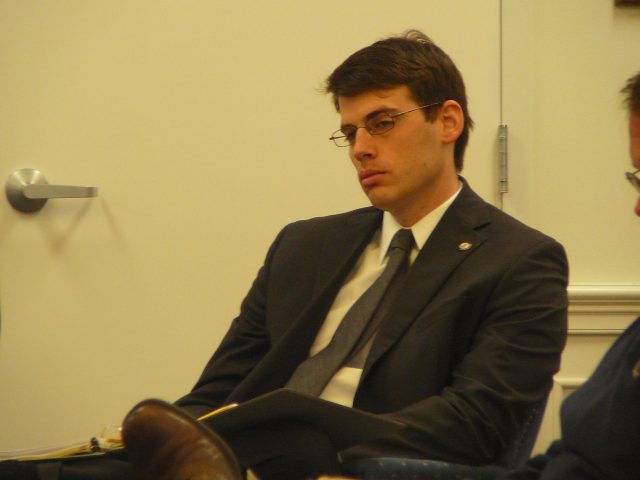
The best years of our lives: above, Dan Whitten as assistant county attorney, circa March 2011; below at his final FR-WC EDA meeting on Sept. 10, 2019. Little did he know what his first full-time job out of law school would bring in the way of experience – maybe they didn’t tell him about the EDA part of it.
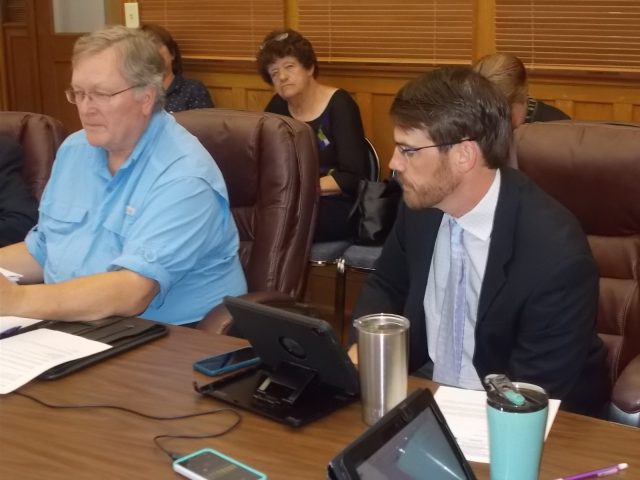
In response to a recent FOIA request to the EDA about any public record of the process of the above-described series of deals offered to ITFederal by the EDA Board of Directors and its chief executive officer we received minutes from several EDA board meetings between 2015 and 2017 during which the ITFederal loan and construction project were discussed and/or voted on. Here is the EDA staff summary of its FOIA response:
“I believe the first appearance is in the minutes of July, 2015. Both the $10 million and $2 million Avtex property/construction project are addressed (Note that they are separate transactions). Also included in the attachment is a public record Deed of Trust of September 2015, which outlined the terms of the $2 million project. The December 2015 minutes show that the Board approved going through First Bank & Trust for the $10 million loan. In February, 2017 the Board approved an Amended Deed of Trust modifying the terms of the $2 million Avtex property/construction project. According to the minutes, no discussions were reported in Open Session.”
Why is that not a surprise?
One question jumps out – if you are discussing a $2 million construction project with a company sitting in $140 million federal contract “Fat City” why are you loaning that company $10 million to prop up a Congressionally promised $40 million investment in your community?
Finally we leave this exploration of what went wrong, with a question about what went right – by accident.
Isolated municipal and media questions aside, one wonders if the Town Finance Director hadn’t stumbled upon eight years of Town debt service overpayments totaling almost $300,000 to the EDA during exploration of an internal loan in May of 2018, would the EDA financial scandal story have broken to this day?
However in the wake of B. J. Wilson’s debt service payment discovery in May of last year, break it did. What would develop into a $20 million-plus financial scandal began unfolding with an apparently volatile August 23, 2018 confrontation between Town auditors and officials in which the word “fraud” was broached to McDonald, then EDA board Chairman Greg Drescher and EDA Attorney Dan Whitten.
Drescher resigned the EDA board chairmanship the following day and within a month investigative public accounting firm Cherry Bekaert was contracted by the County on behalf of the EDA to investigate financial fraud within EDA operations.
And as Royal Examiner reported in a related September 24 story on multiple misdemeanor indictments alleging dereliction of municipal duty by the Warren County Board of Supervisors, staff and multiple past and present members of the EDA Board of Directors, it was also in August 2018 that the Front Royal Police Department requested the Virginia State Police to pick up an investigation of EDA finances.
Grand Jury indicts 14 County and EDA officials for lack of EDA oversight
That request came about a year after FRPD’s investigation of an alleged May 2017 break in, vandalism and theft at the EDA’s Kendrick Lane office was halted at the request of EDA Board Chairman Greg Drescher.
And the rest is legal and municipal history – yet to be written …
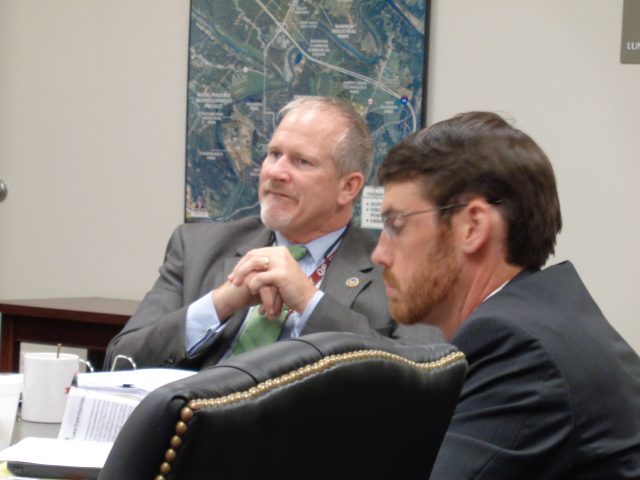
It’s all just nerve racking, even more so as of Sept. 24 when, not only the county administrator and former county attorney, but their five bosses were among 14 booked on misdemeanor criminal charges related to a lapse of EDA financial oversight.

Short-Term Rental, Rezoning, Retaining Wall, ADUs, and Special Events at Town Council Work Session

Celebrate the People Who Keep Your Business Running

Front Royal to Host Tourism Summit April 7

Thomas Ray “Tom” Lomax (1953 – 2026)

Barry Richard Hadley (1959 – 2026)

Public Notice

Rockland Non-Agenarian (90 to 99 years old) Celebrates 94th Birthday with Humane Society Supply Call, Especially for Cats!

Iran War Drives Gas Price Uncertainty Ahead of Busy Summer Season

Three Soldiers Awarded the Medal of Honor in Ceremony Honoring Courage Beyond Measure

Community Policing in Action: Fire Truck Pull Headlines Spring WCSO Events

Death Toll for US Service Members in Iran War Rises to 6 as Trump Projects Weeks of Conflict

In Southwest Virginia, Scott County Parents Search for Answers Amid Children’s Cancer Diagnoses

Blue Ridge Wildlife Center Patient of the Week: Eastern Cottontail

POLICE: 7 Day FRPD Arrest Report 3/2/2026

Virginia Transportation Board Overturns Decision to Transfer Rail and Trail Project

Bill Mandating Ingredient Labels on Menstrual Products Headed to Spanberger

Virginia State Police Continue to Pursue Leads in 1996 Homicide of Alicia Showalter Reynolds

Luna Leads the Pack: America’s Most Popular Dog Names

Virginia Beer Museum and Town Headed to Court on One Remaining Count in Parking Rights Dispute

Snow’s Gone — Now It’s Time to Pick Up the Litter

As Conflict With Iran Widens, Virginia Lawmakers Navigate Political Fallout

Virginia Lawmakers Reach Agreement for First Steps to Monitor PFAS in Biosolids

Virginia Lawmakers Propose Guardrails for Artificial Intelligence Use In Education

Virginia’s New Public Health Leaders Take the Helm as State Agencies Weather Uncharted Waters
