
State News
Virginia Lawmakers Reach Agreement for First Steps to Monitor PFAS in Biosolids
After multiple debates and meetings between stakeholders, a compromise has been reached on how Virginia can begin to monitor the presence of “forever chemicals,” in biosolids that are used as fertilizer on farms across the commonwealth.
What started as an all out ban of the use of biosolids, which is fertilizer made up of treated sewage sludge, through Senate Bill 386 has turned into the first steps towards restricting the use of the substance that is feared to contain per- and polyfluoroalkyl substances (PFAS).
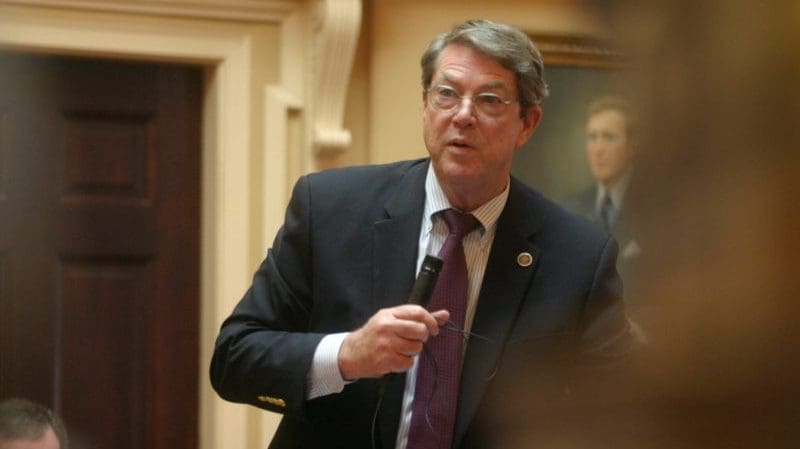
Virginia Sen. Richard Stuart, R-King George. (Photo by Shannon Heckt/Virginia Mercury)
Sen. Richard Stuart, R-King George, has amended his bill to phase in testing the sewage sludge for PFOA and PFOS, chemicals that are under the umbrella of PFAS. When the chemicals in the sludge reach certain levels farmers will be alerted and will not be able to spread the fertilizer on their fields.

“This is a very important first step, and this gives information to people,” Stuart said. “It sets a threshold, and it’s not as aggressive as I would have liked it to have been, but it also provides testing and information to DEQ and farmers.”
Now the bill mandates that beginning Jan. 1, 2027, wastewater treatment facilities that distribute biosolids to land applicators will collect samples monthly to report on the concentration of PFOS and PFOA. If the sewage treatment works are outside of the state but the sewage sludge is to be used in Virginia then the permit holder intending to apply it will need to conduct the tests. This is a stark change from the state currently not testing biosolids at all for the presence of forever chemicals.
In July of 2027, the restrictions of when the sludge may be allowed to be spread on land begin. If the PFOS or PFOA concentration in the biosolids are greater or equal to 50 parts per billion on a rolling 12 month basis then they can not be spread. One part per billion is the equivalent of one drop of water in an Olympic-sized swimming pool.
If the concentration of either or chemical is between 25-50 parts per billion on the rolling average then the permit holder has to reduce the application to three dry tons per acre. If the combined concentration of the chemicals is less than 25 parts per billion then it may still be applied but the landowner must be told about the presence two weeks before application.
If a sample shows that the concentration of one of the chemicals is above 75 parts per billion, then it has to be retested and can’t be used for fertilizer.

There were some concerns about the key word “or” in the bill text between the concentration of PFOA and PFOS. Stuart said in a previous hearing that this may allow for contaminated sludge to still be used if the two are not combined.
“I do think that’s important so that they know there were one or two counties in Texas that actually declared a state of emergency because their land was condemned as a result of those toxic chemicals getting so high they couldn’t use it,” Stuart said in committee.
Starting in July 2029, if the combined PFOS and PFOA concentration is more than 50 parts per billion on a rolling 12-month basis then it can’t be put on land. Having the word “and” included means the two types of chemicals will be calculated together in meeting the threshold rather than the previous either/or method.

Wastewater facilities initially were opposed to the original version of the bill, stating it would be too costly to not be able to dispose of the sludge through biosolid fertilizers. The waste has to go somewhere and Virginia does not have the landfill space or incinerators to dispose of them that way. Farmers also benefit from the cheaper fertilizer option.
Now with the more gradual ramp up and lower restrictions on chemical levels that can be accepted, all parties are on board.
“I think in the spirit of the bill, the goal is to find if there are any higher levels that we should be addressing, despite some challenges that may come with that,” said Chris Pomeroy, representing the Virginia association of municipal wastewater agencies.
Maryland is also currently considering legislation to lower their thresholds of the amount of PFAS that are allowed in biosolids. Del. Alfonso Lopez, D-Arlington, said that the state wants to maintain restrictions either on par or higher than the state to the north.
“With regard to what’s going on in Maryland, what’s going on with the Army Corps, and what’s good for our farmers…this (is an) important first step to address PFAS,” Lopez said.
The bill also establishes a work group to find recommendations on how to reduce the occurrence of PFAS in sewage sludge such as finding the highest sources of the chemicals ending up in waste, disposal options for the sludge, and additional studies for sampling programs.

The House version of the bill, House Bill 1443, is expected to be amended in committee next week to mirror the senate version. Then both bills will need a final floor vote in both chambers before being sent to the governor.
by Shannon Heckt, Virginia Mercury
Virginia Mercury is part of States Newsroom, a nonprofit news network supported by grants and a coalition of donors as a 501c(3) public charity. Virginia Mercury maintains editorial independence. Contact Editor Samantha Willis for questions: info@virginiamercury.com.




Walking Malls Don’t Solve Problems

Festival of Leaves 2026 Wraps Up a Successful Day in Downtown Front Royal

Autumn Delights: Spotlight On Pumpkins!

Lord Fairfax Health District Receives $5,000 Grant To Support Local EMS Crews

Why an AI Bubble Could Reach Your Savings

The Platypus: A Truly Amazing Animal!

A Thing of the Heart: Two-Fold Outreach to Children and Award Presentation Brings Hike Kidz to Stone Branch Arts Center

Virginia State Police Seize Drugs Valued at More Than $830,000, Recover 13 Firearms

Commentary: We Hate Technology. Please Like and Share

One Medicare Open Enrollment Decision That Can Be Hard to Undo

Constitution 101: The Postal Clause

VDOT: Warren County Traffic Alert for October 12 – 16, 2026

UVA Poison Expert Warns of Emerging Synthetic Opioids That Fentanyl Tests May Miss

Pumpkins Will Take to the Skies at Front Royal Warren County Airport Oct. 24

Front Royal Remains Under Mandatory Water Conservation As Shenandoah River Flow Drops

Front Royal Women’s Resource Center Opens 2027 Dare to Dream Grant Applications

Warner, Mizusawa Outline Competing Approaches to Disability Policy

Fable Greenhouse and Gardens Breathes New Life into Former Horton’s Nursery

Louise Virginia “Mom” Messer (1936 – 2026)

Business Growth Series: Doing Everything Yourself Is Slowing You Down

The Mystery of the Purple Seal

Front Royal Outdoors Founder Don Roberts Named 2026 Protector of the Shenandoah

Front Royal Man Held Without Bond Following Child Sexual Abuse Material Investigation

Performing Arts Center Pointing to 2027 Opening as Local Entertainment, Business, and Educational Partner
