
Local News
Beginnings of law enforcement in Stephens City
The earliest reference to the Winchester police department found in city ordinances is on March 12, 1822, when an act of council established the position of superintendent of police, with powers to appoint constables. The superintendent’s salary was $100 annually, the highest paid city official. On March 19, 1841, an act of council stated that constables were to become police officers.[1]
The beginning of the Stephens City (formally Stephensburg, Newtown/Stephensburg) police department is somewhat sketchy. The records that are available are incomplete and currently subject to interpretation. Fortunately, the official minutes of the oldest Town Council meetings begin in 1842 and are kept at Stephens City Town Hall. Sometime in 1989, Deputy Town Clerk Helen Brown meticulously transcribed onto type written pages, the earliest minutes through 1889. The town’s faded minutes are difficult to read because they are written in cursive with quill pen and ink. The minutes from 1908 until 1939 are a mix of hand-written, mimeograph and typed pages loosely placed in folders not especially in chronological order. However, the records maintained at the Town Hall were essential in the writing of this article.
On 8 November 1758, Henry Earnest was appointed to serve as constable in the town of Stephensburg, beginning 1 January 1759. On 5 February, 1760, Nicholas Pittman is appointed constable in the room replacing Henry Earnest who is discharged from that office.[2]
Prior to the modernization of law enforcement in the middle 19th century, before police departments existed, local law enforcement was often performed by constables. A Constable in the Virginia colony was an officer of his county, appointed directly by the Justices of the court, with the general duty of policing and keeping the peace in his district within the county.[3] He did not receive a salary and did not wear a uniform. They were fee officers with fees being set by the General Assembly for each writ served and warrant executed. The constables were paid in pounds of tobacco. For example, a constable would receive five pounds for summoning a witness and ten pounds for serving a warrant or a writ.[4]

The earliest Stephensburg meeting minutes of any form of town government date back to 1830 and survive in a typescript copy transcribed by the late Stephens City historian Mildred Lee Grove. The pages are brief and incomplete but identify an attempt to establish The Corporation of N. T. Stephensburg where the Virginia General Assembly would allow the Corporation to elect town officials and establish regular meeting dates for its local government. The first known president and treasurer of the Corporation were A. S. Brown and Alexander Marks in 1830.[5]
One interesting note in the minutes from August 1831, is the cited responsibility of the Corporation to allocate funding to purchase timber to build or repair an engine (fire) house. In 1831, the Winchester Friendship Fire company is reported to have organized. The fire department had previously used a small gooseneck style hand pumping engine from England (perhaps Newsham & Ragg). The equipment is housed in a shed like engine house in the public square.[6] In the 1830s, more Winchester fire departments are formed and better pumping engines procured. Perhaps an older model was sold to Stephens City in 1831 which would have required an engine house. The Town Sergeant would have been responsible for the hand pumping engine and ladders which were stored in Frogtown (north end of town). This might imply that a town sergeant (first police presence) existed in N.T. Stephensburg as early as 1831.
Winchester had established a Town Sergeant in 1822 and perhaps following the example of British Metropolitan Police in London (1829), the town leaders desired to move away from a court assigned constable and appoint their own police representative. This would be the early beginnings of a police department. It consisted of one officer, known as the Town Sergeant which held responsibilities that included collecting taxes, keeping general law and order, removing trash from the street and regulating speed by people on horses.
The first formal town hall meeting minutes begin in 1842 with the General Assembly officially making it lawful (January 4, 1842) for the Corporation of N.T. Stephensburg to elect officials and to meet annually.

In April, 1848 James Musgrove was elected The Town Sergeant and received $10 annually for assigned duties. The minutes do not state that this was the first Town Sergeant so we can ascertain one previously existed. The Sergeant was ordered to have the town ladders in Frogtown placed under sufficient covering, perhaps in the engine house with the hand pump fire engine.
The Town Sergeant was ordered to see that the streets are kept clear of all lumber and when the laws of the town are violated, it should be his duty to apply for a warrant and proceed against said offender or offenders.
In April, 1850 James L. Johnston was elected Town Sergeant and paid $15 annually for his services.
In 1852 trustees directed that the Sergeant be required to make a return of taxes and fines to the treasurer once every month.

In 1854, John Hoover was elected Town Sergeant and paid twelve dollars annually for his services and five percent for collecting the old tax bills.
In 1860, Nimrod Steel was elected Town Sergeant received no salary but allowed twenty percent of the town taxes and fines collected by him.
In 1872 trustees directed the Sergeant be required to collect a dog tax on all dogs kept within the town limits and kill or have someone kill all dogs owned by such persons who refuse to pay said taxes.
In May, 1874 trustees resolved that the Sergeant be required to call out all hands to work the streets beginning at the north end of town and continue from day to day until the streets are in proper order and the work effort not to exceed eight days. It is not mentioned in the minutes but can be assumed that the work entailed the cleaning or repair of the streets and also included the removal of filth, dirt and rubbish off the street, lanes, alleys and public grounds.

In June, 1874 one motion of thanks was tendered to Mr. George Carver for the efficient services as Sergeant and Collector of The Corporation during the current year.
From the town records, it appears that magistrates and trustees remained in office for extended periods of time, but the Town Sergeant’s position changed frequently. The Sergeant’s duties included the not always popular obligations of collecting taxes and enforcing the laws. In 1875 a law was established to fine the Town Sergeant $1 to $50 for failing to perform any duty imposed on him by the Town or any of the members of the Council.
In May 1876, on motion the town was divided into three divisions in order to work the streets of the Corporation as follows:
No. 1 From the Corporation line South to Steele and Dinges Corner.

No. 2 From thence North to A. Dean’s Corner.
No. 3 From thence North to entirety of the Corporation limits.
On motion Town Sergeant was ordered to summon hands from 16 to 60 according to above divisions to work the streets and to be allowed $1 per day for said services.
In July, 1880 Jacob A. Bucher was appointed Sergeant at a salary of thirty dollars annually and one half the fines for arrests.
In 1883, the Council made a motion for the following ordinance to be added.
“Disorderly Conduct: Be it ordained that any person who shall be guilty of fighting, assaulting, or committing a battery upon any person; or exhibiting himself in a state of intoxication; or whooping, hollering, riotous singing, or using loud and profane swearing, or using obscene language, singing any blackguard or obscene songs, or be guilty of any indecent conduct or exposure of person, or any of the above acts within the Corporation shall be fined not less than one dollar or exceeding fifty-dollars according to the discretion of the Mayor.”
In 1889 the Sergeant reported a copy of the town ordinances had been distributed to every household in the Corporation and that he had completed a dog census. The Sergeant ascertained that the town had a total of thirty male dogs and two females.
In 1907, C. J. Brumback was Mayor and J. D. Lineburg Town Sergeant and Stephens City published Ordinances of the Corporation.
Ordinance 4, Section 1 cites, “It shall be the duty of the Town Sergeant to collect all taxes, levies and fines that may be placed in his hands for collection by order of the mayor or council.
Section 2, The sergeant shall be a police officer, authorized and required to enforce the police laws of the corporation and to recover all fines imposed for breaches thereof.
Section 3. The sergeant shall pay all moneys collected by him for the corporation into the hands of the clerk not later than 5th day of every month.”
In 1924, a motion was passed to pay the Town Sergeant seventy dollars annually.
In July, 1926, it was moved and approved that the town purchase the uniform for the Town Sergeant that will meet the requirements of state law.
A motion was passed that a set rate of $1.50 be paid for hauling a person to jail in Winchester.
On October 8 1929, a motion was passed that Joseph Strode be elected Town Sergeant through the expiration of the term of the present mayor and councilmen at a Salary of $20 per month.
On January 7, 1930, a motion was passed that Sergeant Joseph Strode be instructed to make a survey to determine the amount of or number of gas and oil companies in Stephens City.
A motion was passed at same meeting, that J. A. Bean was to confer with the previous Sergeant, Mr. Hartley about his police badge and see what it could be purchased for and if at a reasonable price.
On March 3 1931, a motion was passed that Sergeant Lemley haul rock to fix the ditch at Mr. John Painters pavement.
From 1947 to 1956 and again from September 1958 through July 1960, Nathan Smallwood served as the town’s policeman. During this period, Officer Smallwood’s responsibilities gradually transitioned from Town Sergeant and tax collector to more of a community policeman. He received letters of recognition for providing security at the Apple Blossom Festival, speaking to Stephens City High School students, and being a splendid protector of elementary school children.
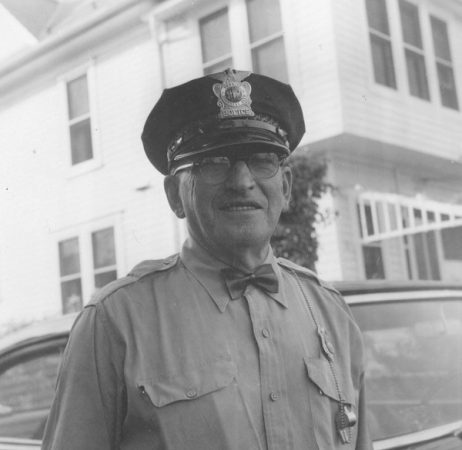
Officer Nathan Smallwood (1947-56, 1958-60) standing in front of the town patrol car. Photo courtesy Charles Pitcock.
Although Smallwood would continue to collect taxes and provide details at the monthly Town Council meetings, by 1950 Smallwood would provide the details prior to the meeting and the Council Treasurer would present the Treasurer’s Report.
In March 1947, a motion was passed to pay Town Sergeant Nathan B. Smallwood a monthly salary of $150 and that Officer Smallwood be granted an allowance of 15 gallons of gasoline in lieu of a car service.
In March 1948, a motion was passed to pay for the replacement of Officer Smallwood’s pistol. On July 5 1949 a motion was passed that officer Smallwood receive 10 days paid vacation annually. On December 7 1949, a motion was passed that Officer Smallwood receive payment for a new uniform.
In 1948, a Police Justice Court was established and Robert E. O’Neal, from Middletown, was appointed Police Justice. The Court was established for handling traffic citations, disorderly conduct and other minor violations. The Police Justice would impose fines payable to the Police (Town) Clerk. The Justice Court was terminated after Town Hall moved from the Lemley Building to the Home Economics Classroom Building at the old Stephens City School in 1976.
In 1950, Sergeant Smallwood was checking town water meters on a daily basis. He was enforcing illegal parking on town streets and on sidewalks. In 1952, Smallwood received $40 a month for personal car expenses which increased to $55 in 1954 and $80 in 1955. There is town council discussion regarding purchasing a patrol car but it is tabled.
In July 1953, Smallwood coordinated a tour of the town’s water supply system with a representative of the state health department. In July 1955, Smallwood was relieved of his duties of reading water meters and repairing and installing water connections so he could spend more time doing police work.
In July 1956, Mayor R. M. Wakeman held a special meeting to discuss hiring an additional policeman and purchasing a patrol car for police and town use. The Council took bids on a Chevrolet, Ford and Plymouth to include a heavy-duty clutch, spotlight, heater, and defroster, 8-cylinder, 2 door, and power pack or interceptor engine. The Chevrolet bid won with a council vote of 4 to 3 over the Ford. B&M Chevrolet was to deliver the car on August 1 at a cost of $1,697. The car would be contracted for periodic servicing at Veterans Service Station on South Main Street. However, the Chevrolet was never purchased and records only reflect that a Ford sedan was procured in 1957.
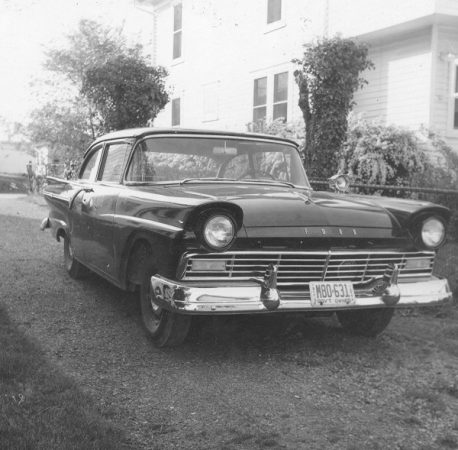
Stephens City’s first patrol car, a 1957 Ford 8 cylinder two-door. Photo courtesy Charles Pitcock
Sergeant J. F. Locke replaced Smallwood in 1956. The hiring of a second police officer was also approved in 1957 and B. F. Carter joined Sergeant J. F. Locke as Stephens City’s finest. Both would be paid a salary of $250.00 a month. The pair would alternate their working schedules with one shift beginning 8 AM to 4 PM and the other from 4 PM to midnight. However, the two-officer system did not work out as Officer Locke resigned in 1956 and then Officer Carter in 1957. Robert Vanhorn replaced Carter.
In September 1958, Officer Vanhorn resigned and turned in one 1957 Ford Sedan, one pistol and holster, one belt, a suit, two pair of pants, three shirts, one cap, one jacket, two ties, and a pair of handcuffs.
In October 1958 the Town Council instructed the rehired Officer Nathan Smallwood to visit Dr. Melton’s office and receive the Asiatic Flu vaccine.
In February 1961, Mayor Lynn Comer thanked Sergeant Fred Cline for supervising all snow removal efforts during several severe snow storms.
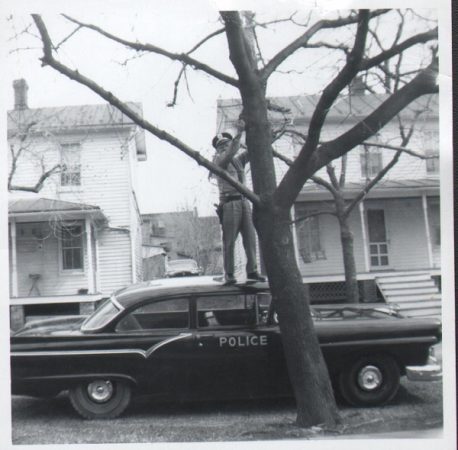
Officer Fred Cline (1960-64) standing on the roof of his police car attempting to reach up and take down a broken tree limb on Germain Street. Photo courtesy Patty Vann Snyder.
Stephens City Police today and the process of community policing.
Police Chief Bill Copp and staff officers believe in the principals of community policing and continue to receive enthusiastic support by maintaining partnerships with local citizens, schools and businesses to promote practices that maintain a low crime rate and increase public safety.
Stephens City’s Police Department strives to attain citizen satisfaction, trust and goodwill. The Department can best achieve its objectives by following a consistent, fair and open program of officer/citizen interaction. Officers continuously work to establish and enhance positive lines of communication with all segments of the service population. Their foremost responsibility is to maintain the community security that we all cherish.
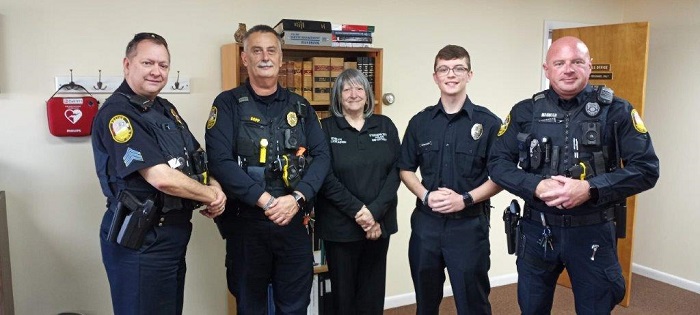
2023 Stephens City Police Department: L to R, Sgt. Chris James, Chief Bill Copp, Administrative Assistant Evelyn Partlow, Officer Cody Jacob Arbogast and Officer Jason Nauman. Photo courtesy Mayor Mike Diaz.
[1] Law Enforcement in Winchester, from the Earliest Settlement to the Present Day, by Allen Barley, 2008-2009 Winchester-Frederick County Historical Society Journal, Vol No. XX on pages 83-115.
[2] Taken from Frederick County Order Book 8, page 146 and page 334.
[3] The Historian’s Guide to Loudoun County, Virginia, Volume 1, Colonial laws of Virginia and County Court Orders 1757-1766 , John T. Phillips II, 1996, page 109.
[4] County Government in Virginia, A Legislative History, 1607-1904, by Albert Ogden Porter, 1947, page 78.
[5] Linden A. Fravel, unpublished notes from Mildred Lee Grove collection of loose papers, in possession of the Stone House Foundation, Stephens City, VA.
[6] Historic Chronology of Frederick County Virginia and Winchester’s Fire Rescue Services, A Fire Buffs Perspective, by G.B. Rusty Gill, page 8, 2006 edition.




Skyline High School Celebrates the Class of 2026

L. Allen Neal Says Smart Growth and Town-County Cooperation Are Key to Front Royal’s Future

Supreme Court of Virginia Strikes Down Redistricting Amendment, Keeps Current Maps In Place

Business Growth Series: Where Are People Seeing Your Business Right Now?

Shenandoah River State Park Announces Junior Ranger Camp Dates

Public Health Officials Warn of Rise in Measles, as Virginia Hantavirus Patient Under Monitor

Warren Coalition Brings Back ‘Let’s Get Cheesy’ for a Night of Food, Laughter and Community Support

Save the Date: Wild Night at the Museum

Nadene Joyce Thomas Murphy (1941 – 2026)

Virginia Hemp Growers Worry About the Future of Their Industry Amid State and Federal Shifts

Gov. Spanberger Signs Wetlands, PFAS and Flooding Bills

Brian Ruffner (1969 – 2026)

County Approves Adjusted Riverbend Farm Campground Proposal in Panhandle Road Area, Considers Staffing Issues

In Favor of Permeable Surface, Town Planning Commission Advances Reduction of Divisibility Per Lot

New Market Battlefield to Mark 162nd Anniversary of Civil War Battle

‘Killing Our Vote’: GOP States Rush to Break Up Black Districts After US Supreme Court Case

Warren County High School Celebrates the Class of 2026

Warren County Addresses Chester Gap Emergency Services Response Coverage Changes Effective July 1st

Warren County High School Awards Over $750,000 in Scholarships to Class of 2026 at Academic Honors Night

Paul Anka to Perform at Shenandoah University on Aug. 15

VDOT Releases Statewide Plan to Expand Multiuse Trails Across Virginia

Warren County DSS to Host Community Resource Fair at Samuels Library

Blue Ridge Wildlife Center Patient of the Week: Common Five-lined Skink

Trump Proclaims May as National Physical Fitness and Sports Month
