
Local Government
In face of ‘Big Brother’ and cited ‘misinformation’ criticism, Council delays approval of school zone speed camera contract
After tackling seven public hearings — most prominently a series of three Conditional Use Permit requests for the multi-unit Trellis Short-Term Rental/Events Center project of Cook Realty on the eastern entrance into town off the 1100 block of John Marshall Highway — at its meeting the evening of June 26, the Front Royal Town Council became mired in an hour-plus effort to respond to critics of the proposed calibrated speed camera contractual arrangement, initially in four school zones throughout town.
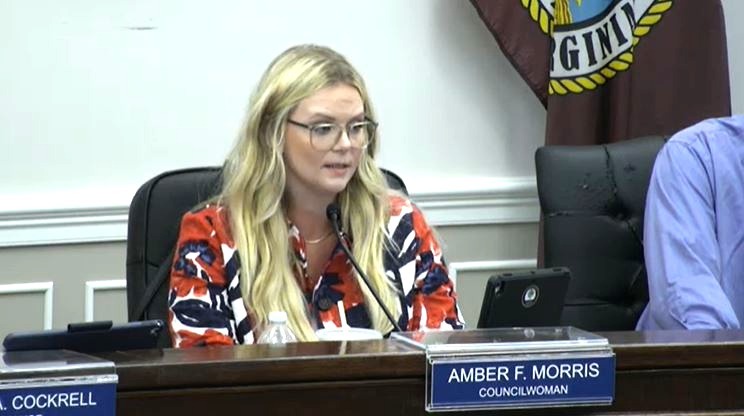
Councilwoman Amber Morris explained her motion to remove the item to the meeting’s “Business” category for discussion as an effort to allow council to respond to an unexpected critical reaction from segments of the community.
The item was originally listed as part of the evening’s Consent Agenda for what is considered routine business, authorizing a budget transfer of $112,500 to launch the effort. However, near the meeting’s outset, Councilwoman Amber Morris explained her motion to remove the item to the meeting’s “Business” category for discussion as an effort to allow council to respond to an unexpected critical reaction from segments of the community.
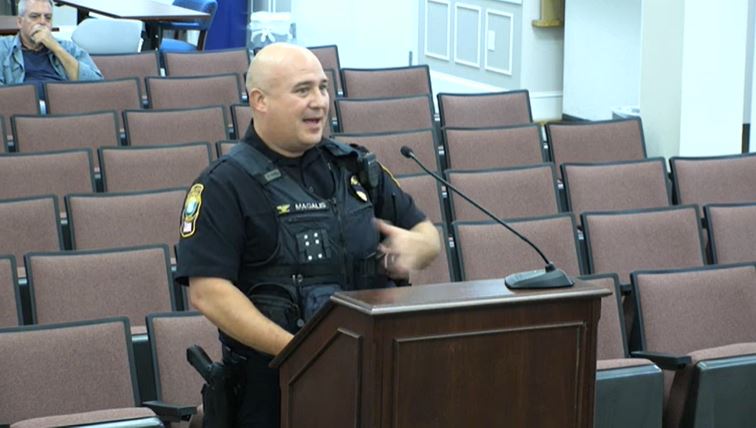
Front Royal Police Chief Kahle Magalis

At the end of that lengthy discussion, including responses to financing and other questions from Front Royal Police Chief Kahle Magalis, council unanimously voted to delay action until further review at a third work session and then a possible public hearing on the matter. No date was set as of yet for that work session discussion.
The proposal was brought forward by Chief Magalis at the May 8 council work session as a low-cost way to increase school zone safety, primarily for the community’s children. During discussion Monday night, it was noted that annually 25,000 children are injured in traffic accidents in school zones nationally, with 100 fatalities.
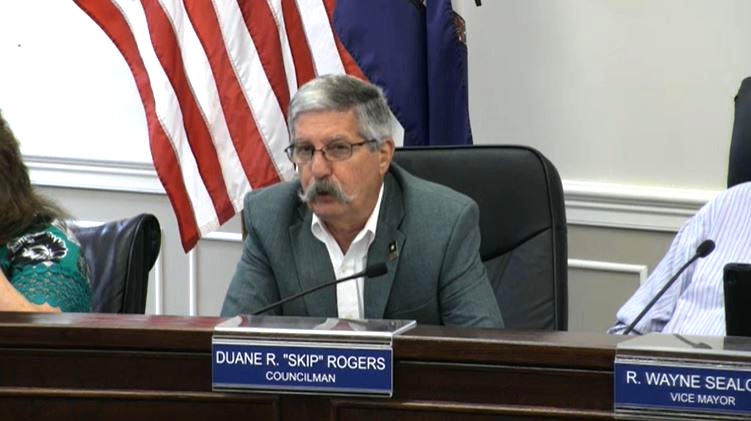
Councilman “Skip” Rogers,
While a potential cost of $300,000 was cited as a concern by Councilman “Skip” Rogers, among others, Chief Magalis explained that cost would only be incurred if the Town pulled out early from the two-year contract. And even then, the compensatory cost would likely be pro-rated down related to the length of time the contract had been in place, the chief said.

The cameras would be acquired “utilizing a Cooperative Contracting Procurement Agreement between Wythe County and Blue Line Solutions,” the staff agenda summary noted. Blue Line Solutions is the provider which also deals with the civil process of collecting fines through civil court action.
During the May work session discussion, Mayor Cockrell observed that it appeared that offenders car insurance rates would not be impacted. “There are no reports to DMV, the consequence is a $100 fine to slow down for the safety of the children. I think it’s a win/win,” the mayor observed of the requested enforcement path, adding, “Because the alternative is to hire more officers, which is going to create a much larger budget item, so I can’t imagine anybody being against this.”
It was explained of the potential $100 fines that vendor Blue Line Solutions would take a $25 cut, with the remaining $75 going back to the Town’s contract representative FRPD. Chief Magalis also noted that the town cut would “go specifically for traffic safety,” being committed to improved signage, crosswalk improvements, and other traffic safety tools.
“I think this is fantastic. I know there’s going to be people who don’t like it, but those people should think of the children’s safety,” Councilwoman Morris added on May 8, seeming to express the council consensus.

However, as Morris observed in making the motion to move the item from the Consent Agenda for routine business to the Business item category for extended discussion, that had not been the case, with a number of people reacting negatively with depictions of “Big Brother” governmental overreach to what was cited as “misinformation” on the logistics and intent of the program.
“We have received some public outcry over this topic,” Morris said on June 26 (beginning at 1:38:35 of the video). After describing watching a youth crossing an intersection in a group of youths on bicycles be struck “by an inattentive driver” several years ago and that incident’s impact on her emotionally — fortunately the youth survived, she noted — Morris wasn’t gentle in her assessment of the outcry against this Town public safety initiative.
“When you’re pro-life, you have to be pro-life beyond conception and birth, throughout life,” she said, continuing to describe witnessing “chaos and recklessness” in multiple trips to drop off and pick up her own children at two schools (four trips a day) in the school year 2022-23.
“One repeat offender often passing double lines on Stonewall Drive to pass everyone to rush to the kids offline, barely missing hitting people every single day, finally caused me to file a complaint with the (school) administration, to which they responded to me that it was a faculty member they had almost hit that day.” School administrators asked Morris if there was a way the Town could help with school zone enforcement while they were facing Sheriff’s Department SRO or other staff shortages. This speed camera initiative is viewed by council as that help.

Morris noted that reports of driving offenses in school zones, all in the town limits she observed, go to a series of town officials, including council, the town manager, and FRPD, rather than to the County School Board. That is why the town government has a stake in school zone public safety, she stated before taking the liberty of speaking, not only for herself but her council colleagues, on the matter.
“I feel very confident in saying tonight that not a single one of us sitting on this dais saw this proposed exploration as a quote-unquote ‘cash cow’ or revenue-making experience,” Morris said of another criticism directed council’s way on the school zone speed camera installation project.
She continued to cite statistics brought forward at the two previous work session discussions of the program, observing that if watched: “You will know the statistics and numbers of the reckless, criminal drivers drastically decreases in the first six months of implementation of such a program … If you don’t want to pay a fine, don’t break the law,” she suggested to speed camera opponents.
“And it’s not a small issue that we’re dealing with here,” Morris asserted, pointing out: “We’re talking about 2,275 people on one road in four hours in front of A.S. Rhodes (elementary school) that were going 20-plus miles per hour over the speed limit. I believe that is a felony reckless driving,” she noted of law-enforcement-initiated criminal traffic stops for speeds over 20 mph above the speed limit. As noted above, speed camera enforcement is considered a civil offense without the consequences of a criminal driving conviction, including insurance coverage cost impacts and potential jail time.

Morris and her colleagues also repeated previous work session discussions noting that the speed cameras would only cite drivers going 11 mph and above the posted, flashing slow-down signal speed during student transit periods. And they added there would be a 10-day grace period where offenders would be issued a warning before tickets would be issued.
“If you do not plan and prepare to leave your home in time to make it to where you are going without driving 20-plus miles an hour over the speed limit, you, in fact, are the problem here, not the speeding cameras or perhaps the proposed technological problems,” Morris said pointedly. But she wasn’t finished. Addressing complaints that such automated speed enforcement was “unfriendly” and even “unconstitutional” she had this to say:
“I am an avid, staunch constitutionalist. There’s nothing in the Constitution that protects you and allows you to be a criminal. If enforcing the speed for only four hours a day on only school days for only four of our traffic school zones burdens your travels that badly, there are other suggestions,” Morris told these critics, giving them predicted unpopular options, including staying off the road or obeying the law in these speed zones.
It was also noted that cited civil offenders would be able to appeal their fines through the normal civil court process. However, the possibility was noted that appealing could add court costs to the fine at the discretion of the judge if the appeal was denied.
Prior to the vote on the amended motion on the speed camera initiative through Blue Line Solutions near the meeting’s end at the 3:01:40 video mark, Morris commented on the irony of the “Big Brother” technological overreach complaint, pointing to the likely use of “i-pads, phones, and computers by the bulk of people at or watching the meeting online and their devices likely use as cameras to circulate information about the meeting.
And then, at Mayor Cockrell’s request, after Council Clerk Tina Presley’s reading of the amended motion of Ms. Morris on the Blue Line Solutions contract, council voted unanimously to continue the matter to a third work session, yet undated and possibly to a subsequent public hearing.
Click here to watch the Town Council Meeting of June 26, 2023.




Front Royal Remains Under Mandatory Water Conservation As Shenandoah River Flow Drops

Front Royal Women’s Resource Center Opens 2027 Dare to Dream Grant Applications

Warner, Mizusawa Outline Competing Approaches to Disability Policy

Fable Greenhouse and Gardens Breathes New Life into Former Horton’s Nursery

Louise Virginia “Mom” Messer (1936 – 2026)

Business Growth Series: Doing Everything Yourself Is Slowing You Down

The Mystery of the Purple Seal

Front Royal Outdoors Founder Don Roberts Named 2026 Protector of the Shenandoah

Front Royal Man Held Without Bond Following Child Sexual Abuse Material Investigation

Performing Arts Center Pointing to 2027 Opening as Local Entertainment, Business, and Educational Partner

Town Planning Commission Continues to Prepare for the Arrival of Cannabis on the Local Market

Warren County Schools Improve, But Federal Rules Lower Seven Ratings

Spanberger Announces $1.3 Million in Scholarships and Incentives for Nursing Students

The First Long-Distance Phone Call Came With Receipts

Middletown Man Killed In I-81 Crash In Frederick County

Cline Backs Veteran Cancer Screening Effort, Highlights Sixth District Programs

Sheriff Cline Details Flock Safeguards, Uses and Limits at Warren County Work Session

Flock Safety: A Tool for the Common Good

Melissa Ichiuji Studio Gallery Reopens With Two Fall Exhibitions

Just Hours Away: Festival Of Leaves Returns To Downtown Front Royal Saturday

Sheriff’s Office Addresses Use of ‘ALPR’ Cameras – Health Insurance, 4-H Week, and Parks & Rec Events Also Presented

Before Relying on a Model, Look at the Assumptions

The Question Is Not Which Apple Tastes Best

Brian Anthony Lamb (1980 – 2026)
