
State News
Virginia Lawmakers Advance $400M Transit Funding Plan as Metro Costs Surge
As inflation drives up the cost of running buses and trains, a panel of Virginia lawmakers has finalized a list of recommendations to help shore up public transit in fast-growing jurisdictions north of Richmond. The move is part of a broader push to address mounting funding pressures on Metro, Virginia Railway Express (VRE) and bus agencies serving Northern Virginia and the Fredericksburg areas.

Metro buses operate in Virginia, Maryland and Washington, D.C. (Photo by Larry Levine/WMATA)
One key recommendation — reforming Virginia’s legislated 3% operating assistance growth cap, which limits how much the state can pay Metro — comes with caveats tied to potential tax increases that could affect overall transit funding.
The committee’s action comes as Virginia faces uncertainty in covering rising transportation costs, driven by inflation, as well as other expenses related to healthcare, early childhood care and food assistance programs due to changes made by President Donald Trump’s administration.

Meeting Wednesday in Arlington, lawmakers on the Northern Virginia Growing Needs of Public Transit Joint Subcommittee endorsed a resolution urging the General Assembly to consider “net new” revenue sources, avoid reductions to current transportation funding to or use of existing transportation funding, and minimize impacts on low-income Virginians.
Ideas on the table include a retail delivery fee, a sales tax on transportation network companies and an expanded sales and use tax that would exempt food and personal hygiene products.
“It’s hard to predict exactly how the General Assembly session will go, but we have a lot to work with, and I think we’ve established a good set of principles and needs,” said Sen. Adam Ebbin, D-Alexandria, who chairs the subcommittee.
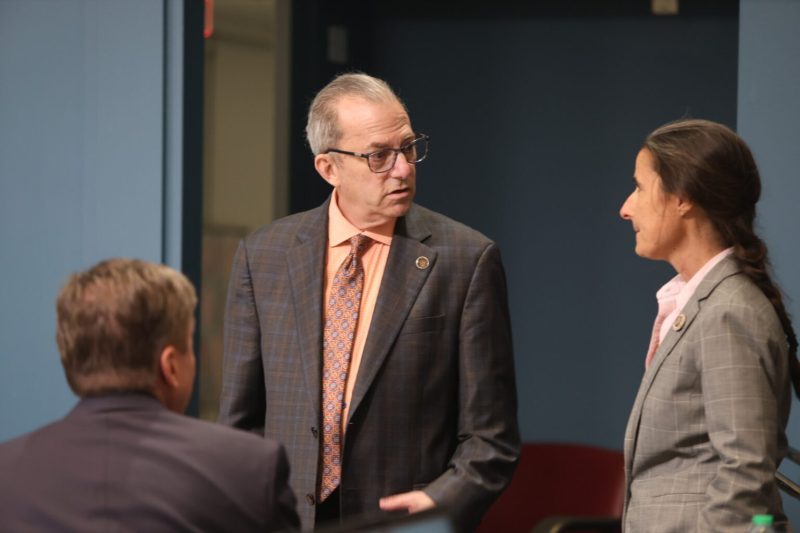
Sen. Adam Ebbin speaking with Sen. Jennifer Boysko at a joint transit subcommittee meeting in Arlington on Nov. 5, 2025. (Photo by Nathaniel Cline/Virginia Mercury)

The General Assembly created the panel last year to study long-term funding solutions for public transit agencies including Washington Metropolitan Area Transit Authority (WMATA), or Metro, and VRE, which serve most Northern Virginia jurisdictions as well as the Potomac and Rappahannock region — Prince William, Spotsylvania, Stafford, Fredericksburg, Manassas and Manassas Park.
Among the recommendations is a plan to cover a projected $400 million annual need beginning in fiscal year 2028 for WMATA, VRE and the bus systems within the Northern Virginia Transportation Commission (NVTC) and Potomac and Rappahannock Transportation Commission (PRTC) transportation districts.
WMATA’s share includes $153 million in operating costs and $136-$150 million in capital funding, while VRE and NVTC bus systems require $35 million each, and OmniRide needs roughly $22 million.
The list also calls for regional surcharges on the highway use fee and mileage-based user fee, and for the creation of new regional transit funds at both NVTC and PRTC using new or additional revenue streams. Another provision directs the Virginia Department of Rail and Public Transportation (DRPT) to report all revenues and interest earned in the WMATA Capital Fund.

Lawmakers also recommend further study of cost efficiency of bus and rail systems, including Metrobus versus local bus operations, accountability metrics for VRE, expansion of Interstate 66 Inside the Beltway tolling and the feasibility of bidirectional commuter rail between Northern Virginia and Maryland.
The resolution notes the subcommittee’s support for WMATA accountability and transparency measures adopted by the DMVMoves task force.
On Oct. 29, that task force approved a separate package including $460 million in new capital funding for Metro starting in fiscal 2028, to be shared by Washington, D.C., Maryland, and Virginia. The money is intended to stabilize service, support long-term investments and give all three jurisdictions greater budget certainty.
Leaders from the Washington Metropolitan Council of Governments and WMATA Board of Directors will meet Nov. 17 to review the proposal before pursuing enabling legislation in all three legislatures.

DMVMoves Task Force Co-Chair and Metro Board Vice Chair Paul Smedberg, who represents Virginia on the board, said in a statement last week that “reaching consensus on a unified transit vision is a major achievement for our region and reflects the countless hours of discussion and deliberation by area leaders.”
“Now the more challenging work begins as we build momentum to turn these recommendations into action and deliver the seamless, integrated, world-class transit experience our region needs and deserves,” Smedberg added.
Tiffany Robinson, VRPT director, acknowledged that Metro is an “important asset” but opposed a tax increase of $300 million annually. She voted against the committee’s resolution in the absence of Transportation Secretary Shep Miller and said that she is concerned about whether Maryland and D.C. can fund their shares despite their commitments.
“We all acknowledge that WMATA is a very important asset for the commonwealth, and I appreciate the work of the committee,” Robinson said. “What we don’t agree on is increasing taxes — up to $300 million annually from hardworking Virginia taxpayers.”


Tiffany Robinson, director for Virginia’s Department of Rail and Public Transportation, listening to remarks at a joint transit subcommittee meeting in Arlington on Nov. 5, 2025. (Photo by Nathaniel Cline/Virginia Mercury)
Robinson also noted that the resolution includes an additional $100 million a year for other Northern Virginia transit needs, bringing the total increase to roughly $400 million annually.
“In fiscal year 2026 alone, Virginia taxpayers will send nearly $800 million to WMATA — and this resolution proposes adding hundreds of millions of dollars to that amount,” she said. “A more practical approach is to focus first on additional savings by looking at items like service levels, overhead, and fares. Over the last five years, the WMATA budget has grown much faster than the incomes of the Virginia taxpayers who fund it — 67% faster — which is unsustainable.”
However, in response, Ebbin emphasized that WMATA has identified over $532 million in cost savings and balanced service levels effectively to support growing rider demand, now passing 54 months of the year over the year growth. He also said after a fare increase of 12.5% last year, the transit agency anticipates another rise in fiscal year 2028 in line with inflation, while revenues were $75 million higher than expected due to strong ridership.
Sen. Jennifer Boysko, D-Fairfax, asked whether the recommendations could be phased in, given the state’s fiscal constraints. Andrew D’huyvetter, NVTC’s director of programs and policy, said lawmakers now have a framework, but implementation is up to the General Assembly.
If lawmakers decline to act, local jurisdictions could face a “difficult set of choices” to meet their $153 million WMATA obligation, and regional transit agencies would also confront major shortfalls.
“I think there certainly could be opportunities to find other ways to meet that need with general fund support,” D’huyvetter said. “But again, we just want to put together this package to recognize what a … longer term solution could look like, and how we build that ramp to get there, recognizing that immediate operating need in fiscal (year) 2027.”
Virginia lawmakers return to Richmond on Jan. 14 for the start of the General Assembly.
by Nathaniel Cline, Virginia Mercury
Virginia Mercury is part of States Newsroom, a nonprofit news network supported by grants and a coalition of donors as a 501c(3) public charity. Virginia Mercury maintains editorial independence. Contact Editor Samantha Willis for questions: info@virginiamercury.com.




Bumblebees Solve Puzzle Without Training, Study Finds

Business Growth Series: “What If” Thinking Is Costing You Money

Blue Ridge Area Food Bank Calls on Community to Take Action Against Hunger in September

Virginia State Police Seize Guns, Nearly $200,000 in Cash During Weekly Crime Operations

The Queen is Gone. There Will Never Be Another

WC Public Schools Gets Engineers Status Assessment on E. Wilson Morrison Physical Plant Issues

Virginia House Speaker Details ‘Concerns’ About NextEra-Dominion Merger in Letter to State Regulators

Consumer Sentiment Tumbles as Virginians Feel Pressure from Inflation, New Poll Finds

Engineers Find Façade Failure at E. Wilson Morrison, Main Structural System Shows No Visible Distress

Buy It in Virginia, Consume It in Virginia, and Leave It in Virginia: The Golden Rule for 2027

Dawson Sheen Academy Plans New Shenandoah Valley High School for 2027

Wittman Voted 60 Times to Undo the Affordable Care Act. Then He Backed Extending Its Subsidies

As Sports Betting Surges, Virginia Weighs How to Curb Gambling Harms

USPS Whistleblower Predicts ‘Catastrophic’ Effect on Elections Under Trump Vote-by-Mail Order

Teenage Gunman Dead After Opening Fire Inside Virginia Elementary School Wednesday Morning

Michael Lee “Mike” “Grandpa” Soyars (1970 – 2026)

Gilbert R. “Skip” Simmons Jr (1949 – 2026)

After Financing Discussions the Supervisors Censure an Apologetic Hugh Henry for Last Meeting Citizen Confrontation

Missing Texas Giraffe Found Safe After Nearly Two Weeks

Profile of a Candidate: Chairman of the Planning Commission Allen Neel Runs for Town Council

Youth Center Goes Forward as Strategic Hub, Supported by Key Community Players Like Honey & Hops

Minnesota Township Keeps Electing Four-Legged Mayors

Data Shows 94,000 Virginians Have Dropped Their ACA Insurance Since Last Year

After FAA Certification, Washington Manassas Airport to Offer Commercial Flights
