
Local News
ATF K-9 Training Facility move – a BAD, DESTRUCTIVE & EXPENSIVE idea

Judiciary Committee Chair Robert Goodlatte promises a hearing start in short order after a slightly late arrival – the ATF handlers and dogs, including Sara pictured left and Able, the dark blur at right bottom, were on time. Photos/Roger Bianchini
A reduced U.S. House Judiciary Committee comprised of Chairman Robert Goodlatte, 10th District Congresswoman Barbara Comstock and a committee attorney heard from one witness at a Monday morning, July 16 field hearing at the Warren County Government Center. That witness addressing a proposal to move the Alcohol-Tobacco-Firearms (ATF) Canine Training Center from Front Royal-Warren County to the Redstone Arsenal site near Huntsville, Alabama was Deputy ATF Director Thomas Brandon.
Brandon’s assessment based on experience with the Front Royal-Warren County ATF training site since its inception here in 2012 and a study of the proposed new site was – well, this story’s headline says it all.
In addition to the $40-million price tag in federal tax revenue placed on the move to Alabama, an environmental assessment study commissioned by the ATF of the proposed new site found circumstances that will have a negative impact on ATF dogs training, rendering them essentially unable to perform crucial portions of their assigned tasks. Those tasks include helping solve and prevent weapons and explosives-based attacks, not only in the U.S., but with international allies of the United States.
“It is truly a world-renowned program, a program that has been very productive and successful throughout the years,” Goodlatte observed, adding, “The training facility in Front Royal provides the clean air and quiet location the dogs need in order to learn how to do their job, but there has been a proposal to move the facility to a place that could adversely impact the canines’ ability to detect explosives and keep the public safe.”
ATF-trained dogs’ roles in solving and preventing explosives and firearms-related attacks were cited during Deputy Director Brandon’s testimony. They included helping local authorities solve the Austin, Texas serial bombing case; work on the Santa Fe, Texas school shooting; and on the preventative end Brandon noted that ATF dogs are now an annual presence at the Boston Marathon and all Super Bowls.

Six-year-old Able looks somewhat distressed after ATF handler/Special Agent Randall Dockens told him what the hearing was about.
The primary negative training impact Brandon cited are consequences of two nearby explosive and weapons research facilities, the Redstone Arsenal now apparently a federal Superfund site, and the active Corkern Range.
As for Redstone, both Goodlatte and Brandon referenced the findings of a 2016 Senate Appropriations Committee-financed feasibility study ATF was directed to conduct.
“The study found that building a comparable canine training and kennel facility at Redstone would cost millions of taxpayer dollars, require intensive talent recruitment for the new facility, and result in the loss of key National Canine Division personnel due to the move. Altogether, the study concluded that the move would substantially disrupt continuity of operations and mission readiness,” Goodlatte read in prepared statement to open the hearing. Brandon elaborated that cost estimates for the move included about $37 million for the move and new construction, and another $3-million in recruitment and training expenses.
Hot on the heels of that report ATF commissioned an independent environmental evaluation of the proposed Alabama site by AECOM Technical Services. ATF Deputy Director Brandon explained that ATF wanted a finding that could not be accused of internal manipulation or influence by the agency.
“My agents love being out here; heck, I love being out here,” Brandon said at one point in his testimony, drawing appreciative laughter from Town and County officials present for the hearing.
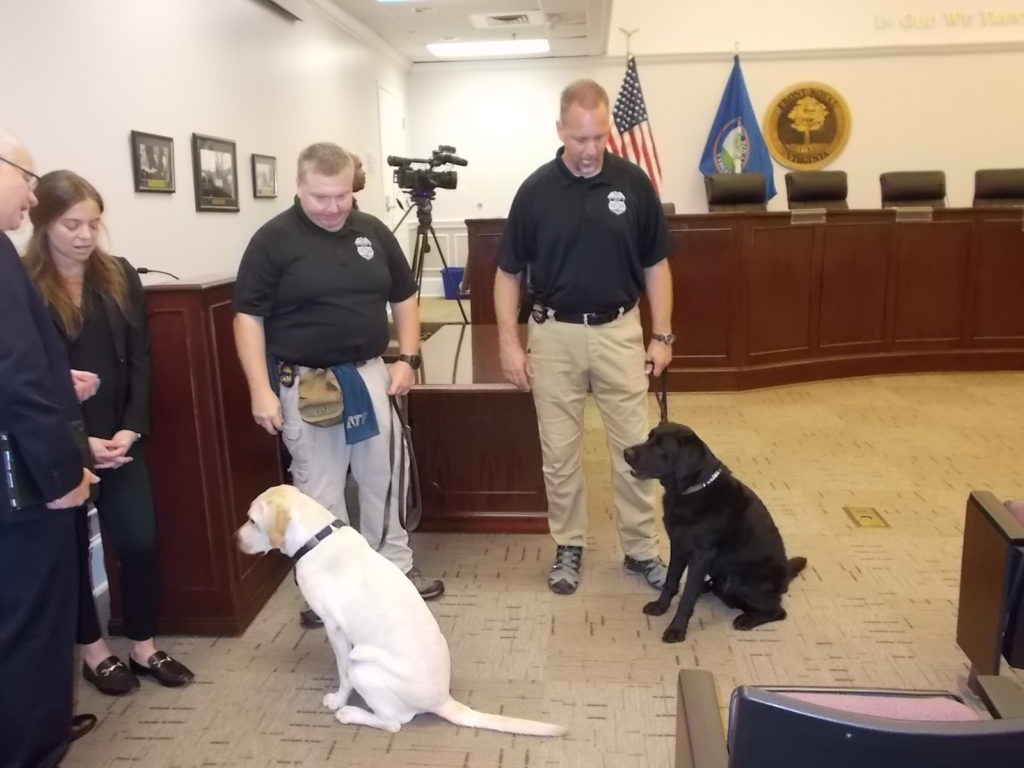
Two-year-old Sara and handler Michael Hodnett join Able and Dockens in pouting about the proposed move to an Alabama site where the ambient explosives smell could negate ATF training methods enabling their K-9s to detect miniscule amounts of explosive and firearms residue materials.
Brandon elaborated that he was not only referencing the quiet, rural setting at the ATF facility on a portion of 150 acres sublet from the longer-standing local Customs-Border Patrol Canine Training Facility in Harmony Hollow, but also the positive working relationship with the Front Royal and Warren County business community that financial and training arrangements have been established with over the years.
Those relationships and mutual trust and benefit are not things that are established over night, but over years, Brandon testified.
The second study of the proposed move from Virginia to Alabama, the independent environmental assessment, focused on three categories: surface soil assessment; noise evaluation; and air dispersion modeling. And with both the past and present explosives development and research facilities presence in the Huntsville area, the conclusions weren’t positive about the impact on training ATF dogs to detect explosives.
“The canines will become unreliable … You can’t train a bomb-sniffing dog at a place where everything smells like a bomb,” Brandon and Goodlatte concurred of a short version of the study’s conclusion.
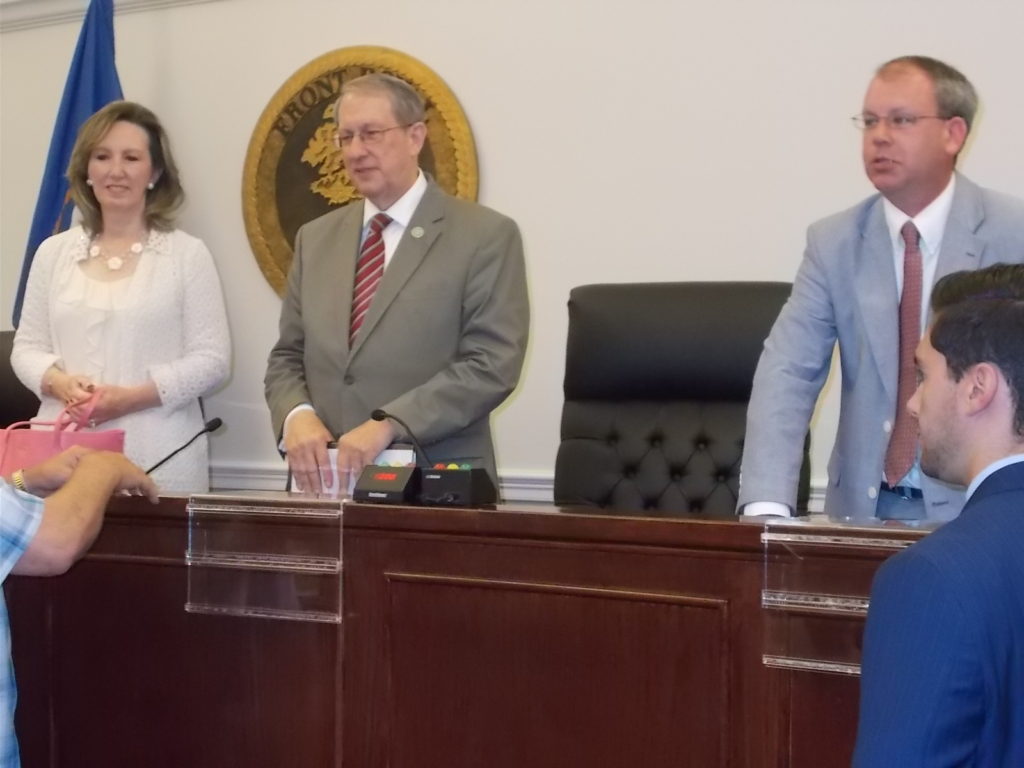
From left, Barbara Comstock, Robert Goodlatte and Judiciary Committee attorney mingle after the hearing’s adjournment.
Specifically, Brandon elaborated that the levels of explosive contaminants in the soil “present obstacles that are likely insurmountable to the initial imprinting of the canines to detect explosives and accelerants.” He explained the importance of “initial imprinting” as “absolutely essential” to ATF’s well-established and internationally-recognized training regimes.
Brandon said the concern was that young dogs beginning their training would associate the pervasive amount of explosive contaminants remaining in the environment with the “target odors” they are being trained to detect in order to save lives or solve crimes in order to prevent further loss of life.
“This isn’t a game, this is real life. We have situations where we are catching killers from the bombings in Austin to the case I just mentioned …It would set us back,” Brandon said of the proposed move.
The previously-mentioned case Brandon referenced was a 2017 case in New Jersey. He used it to illustrate ATF-trained dogs’ ability to detect exceptionally small traces of those “target odors” involved in firearms cases, often some time after they occur. Called by New Jersey State Police to a traffic stop, ATF dogs were able to find two well-concealed guns.
“Our dog got on the trunk of the car; and within that trunk were two firearms that would never have been detected because of such a low level (of target odors) … And those guns turned out to be murder weapons,” Brandon said. Those weapons were taken off the streets because of the initial target odor imprinting that ATF dogs receive at the Harmony Hollow training facility.
The noise issues comes from blasting at the active Corkern Range “that has a clear potential to affect dogs at the proposed kennel site, especially if the dogs are outside at the time of the blasting activity.” It was noted that ATF dogs are outdoors for approximately six of their eight-hour training shifts.
“So, why are we even talking about this?” was the post-meeting, parking lot assessment of one journalist and a spectator from one local business, AirServe, who observed the hearing.
Apparently because some politicians in Alabama would like the peripheral economic benefit such a facility would bring to their community – estimated at over $300,000 annually by the local Chamber of Commerce – not to mention the prestige of such a vital national security agency’s presence there.
Chairman Goodlatte, in whose Sixth Virginia Congressional District Front Royal, Warren County and the ATF Canine Training Facility in Harmony Hollow all lie, predicted charges of district protectionism in his effort to keep the facility here.
However, based on the ATF assessment of the impacts of the proposed move versus the success of their facility’s six-year training experience in Front Royal-Warren County, it would appear the district “nepotism” and attempt to hijack a federal agency that is perfectly comfortable where it is, lies a bit further southwest.
And we doubt Huntsville has the proud war dog-training heritage that Front Royal has dating back to World War II as is commemorated annually at the town’s Memorial Day ceremonies that include a salute to the dogs of war.

Cheer up, Sara, they’ll never move us after this info comes to light – Able tries to console a still-distressed ATF Canine Training Center pal.

Uptick in Continued Virginia General Assembly Legislation Reflects Varied Motivations

Mini Quiches with Ham and Swiss Cheese

Tips to Help Employers Sort Job Applications More Efficiently

Town Council Finishes Retreat, Considers Memorandum of Understanding with Smithsonian for Water Conservation

Spanberger Amends, Signs Sweeping Gun Legislation Reshaping Virginia’s Firearm Laws

Governor Pitches Amendments to Prescription Drug Affordability Board Bill That Some Say ‘Nullify’ It

Debate Continues Over Tax Rate as Supervisor Offers New Option

Blue Ridge Wildlife Center Patient of the Week: Eastern Fence Lizard

Joyce Henderson Banks (1941 – 2026)
Accountability Before Adjustment

Supreme Court Ruling Revives Debate Over Conversion Therapy Bans, Including in Virginia

Growing Pains: Rising Diesel, Fertilizer Costs Spurred by Iran War Impact Virginia Farmers

Virginia, Other States Make It Easier for Physician Assistants to Practice

Working Part-Time After Retirement: For the Paycheck — and the Fun

Compressed Air Safety: Why 30 PSI Is the Limit for Cleaning

ORDER OF PUBLICATION: In the Circuit Court for Warren County, Virginia

Local NAACP Recalls Segregated Criser High/Elementary School During ‘Learn From the Past for a Better Future’ Event

Virginia Revenues Top Forecast, But Economic Concerns Remain

Governor Clarifies: Proposed Tax Changes Never Became Law

Driver Runs After Crash, Caught by Police Moments Later

Debate Continues Over Tax Rate as Supervisor Offers New Option

POLICE: 7 Day FRPD Arrest Report 4/13/2026

Spanberger Joins Other Governors in Push for PJM to Prioritize Ratepayer Protections

Cannabis Testing Challenges Persist as Virginia Retail Market Nears
