
Looking Back
Ben Franklin and his miraculous lightning rod
What would you think if you saw a man on horseback chasing a thunder and lightning storm? You might probably wonder what on Earth he was trying to do. Well, if you lived in the mid-1700s and knew Benjamin Franklin, this is just what you might see during a terrible storm. Ben was fascinated by thunderstorms; he loved to study them. If he were alive today, we could probably add a “storm-chaser” to his long list of titles and achievements.
In a dialogue held in Philadelphia on a very warm morning at the end of June 1776, when Massachusetts delegate to the Continental Congress John Adams had a conversation with Pennsylvania delegate Dr. Benjamin Franklin about the writing of the Declaration of Independence by Virginia delegate Thomas Jefferson; they were discussing the importance of the document and who might be remembered for their part in bringing it to reality :
John Adams: “It doesn’t matter, Franklin. I won’t be in the history books anyway, only you. Franklin did this and Franklin did that and Franklin did some other damn thing. Franklin smote the ground and out sprang George Washington, fully grown and on his horse. Franklin then electrified him with his miraculous lightning rod and the three of them – Franklin, Washington, and the horse – conducted the entire revolution by themselves.”
Ben Franklin is known for his experiments with electricity (most notably the kite experiment in June 1752, described in the previous edition of LOOKING BACK), a fascination that began in earnest after he accidentally shocked himself six years earlier, in 1746. By 1749, he had turned his attention to the possibility of protecting buildings—and the people inside—from lightning strikes. Having noticed that a sharp iron needle conducted electricity away from a charged metal sphere, he theorized that such a design could be useful:
“May not the knowledge of this power of points be of use to mankind, in preserving houses, churches, ships, etc., from the stroke of lightning, by directing us to fix, on the highest parts of those edifices, upright rods of iron made sharp as a needle…Would not these pointed rods probably draw the electrical fire silently out of a cloud before it came nigh enough to strike, and thereby secure us from that most sudden and terrible mischief!”
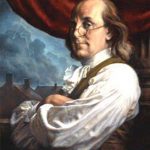
Dr. Benjamin Franklin: “I like it.”
In other words, lightning rods would draw the static electricity from the air during a thunderstorm, and conduct it safely to the ground, thus eliminating the accumulation of electrical charges which results in a discharge of lightning.
Franklin’s pointed lightning rod design proved very effective and soon topped buildings throughout the Thirteen Colonies.
It was in Boston, Massachusetts, in the year 1746 when Franklin first stumbled upon other scientists’ electrical experiments. He quickly turned his home into a little laboratory, much to wife Deborah’s chagrin, using machines made out of items he found around the house. During one experiment, Ben accidentally shocked himself. In one of his letters, he described the shock as “…a universal blow throughout my whole body from head to foot, which seemed within as well as without; after which the first thing I took notice of was a violent quick shaking of my body…” (He also had a feeling of numbness in his arms and the back of his neck which gradually wore off.)
Franklin spent the summer of 1747 conducting a series of groundbreaking experiments with electricity. He wrote down all of his results and ideas for future experiments in letters to Peter Collinson, a fellow scientist and friend in London who was interested in publishing Ben’s work.
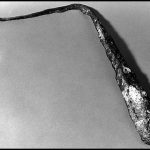
Franklin’s original pointed lightning rod, after being struck by lightning during his experiments. Courtesy The Franklin Institute, Philadelphia.
By July of 1747, Ben used the terms positive and negative (plus and minus, or + and -) to describe the positive and negative electrical charges, instead of the previously used words “vitreous” and “resinous” used in describing liquids; lightning at the time was universally believed to have been a fluid—electric fluid. Franklin described the concept of an electrical storage battery in a letter to Collinson in the spring of 1749, but he wasn’t sure how it could be useful. Later the same year, he explained what he believed were similarities between electricity and lightning, such as the color of the light, its crooked direction, crackling noise, a distinct smell now known to be ozone, and other things. There were other scientists who believed that lightning was electricity, but Franklin was determined to find a method of proving it.
By 1750, in addition to wanting to prove that lightning was electricity, Franklin began to think about protecting people, buildings, and other structures from lightning. This grew into his idea for the lightning rod. Franklin described an iron rod about 8 or 10 feet long that was sharpened to a point at the end.
Ben wrote, “the electrical fire would, I think, be drawn out of a cloud silently before it could come near enough to strike…”
Two years later, Franklin decided to try his own lightning kite experiment. Surprisingly, he never wrote letters about the legendary kite experiment, and only one article which appeared in the Pennsylvania Gazette in October 1752; the British scientist Joseph Priestly wrote the only other account fifteen years after it took place.
To recap from the previous LOOKING BACK column: in June of 1752, Franklin was living in Philadelphia and waiting for the steeple on top of Christ Church to be completed so he could conduct his lightning experiment (the steeple would act as the “lightning rod”). He grew impatient and decided that a kite would be able to get close to the storm clouds just as well. Ben needed to determine what he would use to attract an electrical charge; he decided on a metal house key and attached it to the kite. Then he tied the kite string to an insulating silk ribbon for the knuckles of his hand. Even though this was a very dangerous experiment, (you can see what the lightning rod in the photograph looks like after being struck), some people believe that Ben wasn’t injured because he didn’t conduct his test during the worst part of the storm. At the first sign of the key receiving an electrical charge from the air, Franklin knew that lightning was a form of electricity and not a fluid. His son William was the only witness to the event.

The very first photograph of lightning, by William N. Jennings. Courtesy George Eastman Museum, Rochester, N.Y.
Two years before the kite and key experiment, in 1750, Ben had observed that a sharp iron needle would conduct electricity away from a charged metal sphere. He first theorized that a lightning strike might be preventable by using an elevated iron rod connected to earth to empty static electricity from a cloud. Franklin articulated these thoughts as he pondered the usefulness of a lightning rod:
“May not the knowledge of this power of points be of use to mankind, in preserving houses, churches, ships, etc., from the stroke of lightning, by directing us to fix, on the highest parts of those edifices, upright rods of iron made sharp as a needle…Would not these pointed rods probably draw the electrical fire silently out of a cloud before it came nigh enough to strike, and thereby secure us from that most sudden and terrible mischief !”
Franklin began to advocate lightning rods with sharp points. Conversely, his English colleagues favored blunt-tipped lightning rods, reasoning that sharp ones attracted lightning and increased the risk of strikes; they thought blunt rods were less likely to be struck. King George III had his palace equipped with blunt lightning rods. When it came time to protect the buildings in the English American colonies’ buildings with lightning rods, the decision became a political statement. The pointed lightning rod expressed support for Franklin’s theories of protecting public buildings and the rejection of theories of blunt iron rods supported by the King. The English thought this was just another example of the flourishing American colonies being disobedient to the British crown.
Franklin’s lightning rods could soon be found protecting many buildings and homes. This BRI journalist’s note: My two-story home near Amissville, constructed in 1999, is built upon the highest point of my property, and with a metal roof, the contractor thought it wise to have lightning rods installed. There are four of them, with dark green glass globes, placed on the ridge of the pitched roof, and a fifth pointed rod mounted on the chimney.
All of the pointed lightning rods are connected to a large-diameter stranded copper wire which is attached to a copper grounding rod buried deep in the ground in the front of my house. Knock on wood, in the past twenty years, my home has not been struck by lightning.
The lightning rod constructed on the dome of the State House in Maryland was the largest “Franklin” lightning rod ever attached to a public or private building in Ben’s lifetime.
It was built in accord with Ben’s recommendations, and in the more than two hundred plus years ever since, has had only one recorded instance of a lightning strike:
Three years ago today, July 1st, 2016: Maryland Gov. Larry Hogan said the Maryland State House in Annapolis was saved from a lightning strike “by a 208-year-old original Ben Franklin lightning rod.”
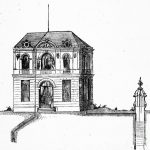
Ben Franklin’s original design for structural lightning protection.
Courtesy The Franklin Institute, Philadelphia.
The nation’s oldest State House was hit by lightning Friday evening [July 1st], triggering a sprinkler system in its historic dome. Fire officials said there was no smoke or fire in the building, no damages, and no one was injured.
The governor said that the lightning rod on the dome “was constructed and grounded to Franklin’s exact specifications.” He said at the time it was added to the building, it served as “a powerful symbol of the independence and ingenuity of our young nation.”
The pointed lightning rod placed on the Maryland State House and other buildings also is a symbol of the intellect and the inventiveness of Dr. Benjamin Franklin, one of the Founding Fathers of our country, and the inventor of the miraculous lightning rod.

Missouri Man Arrested in Undercover Operation Targeting Online Crimes Against Children

Trump Tax Plan Credited With Higher Refunds, Lower Taxes

Spanberger Vetoes Fairfax Casino Bill, Citing Local Opposition

Blue Ridge Point-to-Point Races Return Saturday at Woodley Farm

Legislative Effort to Buy Monroe’s Loudoun Estate on Pause, Budget Effort Underway

US House Democrats Call for Congress to Come Back Into Session for Iran War Debate

Virginia to Raise Minimum Wage to $15 by 2028 Under New Law

Spanberger Signs Bills to Aid Low-Income Utility Customers, Manage Power Demand

FTC Wants to Hear from Renters About ‘Unfair and Deceptive Housing Fees’

As Redistricting Referendum Nears, Spanberger Balances Governing and Campaigning

Drive for More Housing Sparks Rare Bipartisanship in Statehouses, Including in Virginia

Community Breakfast at Riverton Church Serves More Than Just Pancakes

Proposed Electric Substation Declared Compliant with Comprehensive Plan at County Planning Commission Meeting

Christopher Todd Thomas (1975 – 2026)

Constitution 101: The Commerce Clause

What Factors Are Most Likely to Affect the Cost of a Funeral?

Learn to Spot Scams: Free Workshop Set for June 2

Smart Ways to Use Your Tax Refund This Year

Supervisors Revisit Cross-County Chester Gap F&R Service, See Member-Staff Confrontation After Numbers Apology Offered

Get Your Equipment Ready Before the Start of Fishing Season

Landscaping Careers Offer Outdoor Work and Creative Opportunities

Blue Ridge Wildlife Center Patient of the Week: Virginia Opossum

From Crime Scenes to K9 Units: Citizens Academy Opens in May

Weekly Yard Waste Pickup Begins April 8 in Front Royal
