
State News
Bill Would Put More Energy Costs on Data Centers, Slash Residential Customers’ Rates
Sen. L. Louise Lucas, D-Portsmouth, on Monday introduced an amendment to her Senate Bill 253, which would levy more energy costs onto data centers served by Dominion Energy and less on residential customers, a move the utility, state regulators, and lawmakers say would immediately drop residential bills by about $5.50 per month.
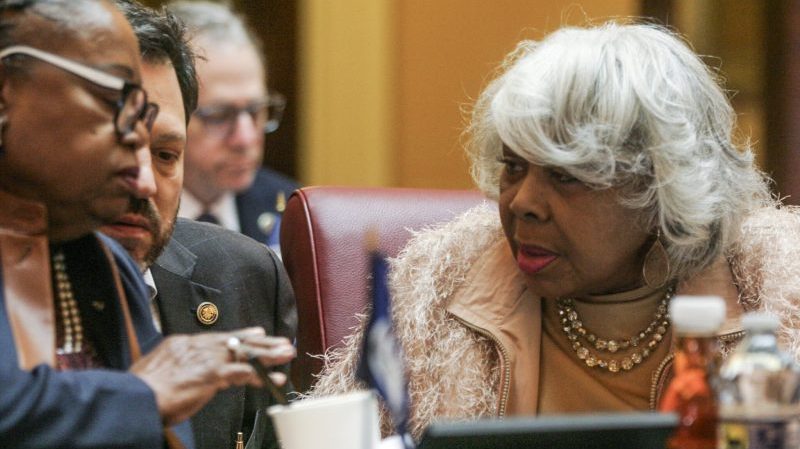
Virginia Sen. Louise Lucas, D-Portsmouth, talking with colleagues during the 2026 General Assembly session. (Photo by Shannon Heckt/Virginia Mercury)
The amended bill now allows the State Corporation Commission to determine if it is in the public interest for large-load customers instead of residential ones to cover the cost of distributing power to data centers and for Dominion’s capacity auctions, where the utility buys additional power from other states to meet demand, largely driven by data centers.
If the SCC approves, those costs could shift to new and existing data centers through 2033. Lucas described the measure as an attempt to make data centers pay their fair share of the cost of power generation and distribution in Virginia.
“There are more than 200 energy bills this session, and as far as I’m aware, this is the only proposal to actually reduce rates in the near term,” Lucas said.
In a letter analyzing the shift, the SCC projected that putting those costs on Dominion’s new rate class for GS5 customers, who are mostly data centers, will take some pressure off residential customers.
The SCC would only be allowed to put these costs onto that specific rate class for the next few years to address the rising costs, since rising capacity auction prices continue to break records.
The SCC estimated that typical residential customers will see their rate reduced by 3.4%, about $5.52 monthly, and the data center customers’ rate will increase by a projected 15.8%. The state would save an estimated $8.3 million in 2027 for local governments through this cost shift.
Dominion fully supports the legislation, representatives said.
“Capacity prices are going up because of the load growth, which is being driven by the data centers,” said Joe Reid, a lawyer for Dominion. “There is the cost just to connect the data centers to the system, which is hundreds of millions of dollars. Over time, they’ll start paying for those costs… They’re going to pay a little bit more for the next few years, so that the rest of the customers’ share of the pie will get smaller and there will be immediate rate relief for the residential customers, for the small commercial customers, and for the industrial customers.”
In the last rate case, in response to concerns over whether the data center customers are paying enough to cover the increased demand in energy production, Dominion created the new rate class that calls for 14-year contracts with customers over 25 megawatts. The minimum demand charges for these users is 85% for transmission, 85% for distribution, and 60% for generation. They are charged more if they exceed those minimums.
Consumer advocates, including the Southern Environmental Law Center, said that the rate case was a good first step to protecting non-data center ratepayers from increased costs and that Lucas’ amended bill will provide additional protections.
Representatives for the data center industry said they first read the amendment over the weekend and hope to work with Lucas on potentially changing it.
“I would like to be clear that the data center industry is committed to paying for the power it uses,” said Nicole Riley with the Data Center Coalition. “We also request clarification that the SCC should investigate, as part of the proceeding, how much the capacity costs are due to data centers. We are concerned that the language as drafted precludes any analysis of that.”
The amended bill allows high-load industrial and manufacturing customers a one-time chance to opt out of the GS5 rate class so they would not be subject to the same costs as data centers and be charged a different rate. But data centers are not permitted to opt out under the current version of the bill.
Lucas’s bill originally focused on continuing utilities’ weatherization programs for low-income households, an effort to boost energy efficiency. It laid out funding requirements and extended the program through 2038.
The amendment also extends the strategic undergrounding pilot program for an additional ten years, which will maintain the $4.88 added to monthly bills. These suggestions were key recommendations from the Commission on Electric Utility Regulation and are part of the governor’s affordability platform.
The bill advanced out of the Senate Labor and Commerce committee on Monday and now heads to the Senate Finance committee, which Lucas chairs.
by Shannon Heckt, Virginia Mercury
Virginia Mercury is part of States Newsroom, a nonprofit news network supported by grants and a coalition of donors as a 501c(3) public charity. Virginia Mercury maintains editorial independence. Contact Editor Samantha Willis for questions: info@virginiamercury.com.

Virginia Seeks Public Input for 2026 Statewide Rail Plan

Front Royal Craftsmen Revive Centuries-Old Timber Framing Tradition

Local NewsVDOT: Warren County Traffic Alert for March 16 – 20, 2026

Virginia Lawmakers End Session Without Final Budget

Your Personal Mission Statement: A Guide to Getting What You Want Out of Life

Disappointed In Our Olympic Spirit

How St. Patrick’s Day Became America’s Biggest Irish Party

Virginia State Police Urge Sober Plans for Saint Patrick’s Day Celebrations

In a One-Party County, Internal Party Decisions Affect Us All

Virginia State Police Seize Nearly 100 Pounds of Narcotics, Recover Firearms in Weekly Crime Suppression Effort

Barton Charles “Bart” Haller (1940 – 2026)

Dawn Lee Dodson (1970 – 2026)

Mary Helen “Nanny” Spires Johnt (1954 – 2026)

Another Round of ‘Momnibus’ Bills Are Headed Towards the Governor This Year

Virginia Joins States Challenging Trump Admin Regulations That Limit Free Birth Control Access

Update: Charlotte Swanson Smith (1951 – 2025)
Why We are Challenging the Republican Mass Meeting

Bruce Norman Showman (1954 – 2026)

EDA Relaunches Small Business Loan Program to Help Warren County Entrepreneurs Access Capital

Targeted Exercises to Improve Your Putting

The Hidden Risks of House Hunting Solely Online

Choosing the Right Cleaner for Every Surface in Your Home

New Church Among Consent Items at County Planning Commission Meeting

Warren County GOP Mass Meeting Results Challenged After Allegations of Voting Irregularities
