
State News
Debate Over Social Studies Testing Delays Virginia Accountability Decision
A resolution on how the state measures students’ performance in history and social science was delayed for two months during the Board of Education’s business meeting on Thursday, giving Virginia and social studies leaders time to reach a compromise.
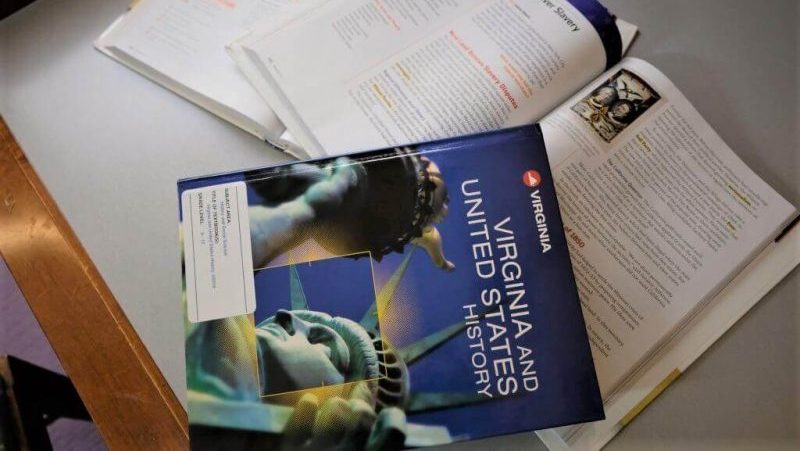
Virginia is considering how it will measure student performance in history and social science. (Mechelle Hankerson/Virginia Mercury)
Measuring student success helps address a number of factors, including ensuring students are meeting state academic standards, informing curriculum and improvements to teaching and learning, and encouraging critical thinking and civic knowledge, all of which align with the State Board of Education’s months-long discussions and accountability changes.
However, the problem facing the board is determining how much flexibility social studies leaders will have once the combined subject of history and social science is added to the state’s Consolidated State Plan, the recognized accountability system, and ultimately approved by the board and the U.S. Department of Education.
“We’re not opposed to accountability, but we want the option for performance assessments because it is what is better for students and more reflective of what our discipline goes in our defense, what historians do,” Danyael Graham, Virginia Social Studies Leaders Consortium president, said in an interview last week. “Historians don’t sit there and answer multiple-choice or select-response questions about all their historical knowledge. They’re developing arguments. They’re using evidence.”
In addition to expanding opportunities for students and incorporating JROTC leadership courses into the state plan, the board is considering adding U.S. History or Civics to the state accountability system for the 2027-28 school year. Virginia is preparing the update following last year’s redesign of the plan.
The federal government requires states to assess students only in math, reading, and science.
A January study published by the Joint Legislative Audit and Review Commission found that the proposal could face challenges due to the current scarcity of qualified instructors and the logistical difficulty of fitting extra classes into existing schedules.
Board member Beth Ackerman said at the board’s meeting last week that what makes her “nervous” about adding social studies to the accountability system is hearing concerns from the social studies community and from special education, “because they will also need significant time” to prepare new assessments.
She said the board must consider requirements if the subject of history and social studies becomes an alternate assessment for students with significant cognitive disabilities.
Given these concerns, Ackerman suggested, “Maybe we move forward and exclude social studies for now, but I really feel like we should yield to some of the concerns we’re hearing around social studies.”
Vice President Bill Hansen opposed the idea.
“I hear your concerns, and I appreciate them, and we’ll take them into account … but I just think we’ve got to proceed with what we have and get the input from folks,” Hansen said.

Virginia Board of Education Member Beth Ackerman reading during a business meeting. (Photo by Nathaniel Cline/Virginia Mercury)
Sen. Schuyler VanValkenburg, D-Henrico, who is also a teacher, threw his support behind adding history and social science to the accountability system into a letter shared with the board last summer. Recognizing this, the letter argued that although Virginia is “stronger than many other states in emphasizing social studies education,” the subject has still been “deprioritized” in recent years.
Todd Truitt, a parent who spoke at Thursday’s meeting, said he, too, supports the ESSA amendment, citing the value of standardized tests for ensuring schools teach essential historical knowledge and support educational equity.
“Opposition to content-based standardized exams often rests on the assumption that critical thinking skills transfer independently of knowledge, yet cognitive science consistently shows that thinking is domain-specific and driven by the content students know, making these exams one of the few reliable ways to verify whether schools have taught this essential knowledge,” Truitt said.
Social studies leaders have advocated for flexible, performance-based local assessments. These allow schools to measure student learning in meaningful, varied ways, while maintaining alignment with state standards. Such assessments balance accountability with recognition that students learn and demonstrate knowledge differently.
Neely Minton, president-elect of the Virginia Social Studies Leaders Consortium, said the group supports accountability but argued that the amendment conflicts with last year’s approved House Bill 1957, which she said allows for local alternative assessments instead of standardized Standards of Learning tests.
Minton and other social studies leaders are concerned that moving the subject into the state’s accountability system will provide less flexibility and potentially rely on an older testing method that emphasizes rote memorization.
Virginia social studies leaders warn proposed testing shift could sideline critical thinking
“Returning to rote instruction and selected response testing will not solve the literacy crisis that we’re in; it will make it worse,” Minton said.
Since November, interest in local alternative assessments in history and social science has grown, sparking further dialogue between the state education agency and social studies leaders across the commonwealth.
Graham said she has been pleased to see the agency’s engagement on the subject, clarifying that history and social science courses differ from math because their progression is not “linear” and course sequencing varies.
She maintained on Thursday that existing “rigorous, equitable, and scalable” assessment systems should be prioritized and called for greater transparency and collaboration in the amendment process.
“We want it done right,” Graham said in an interview. “If (history and social science) are in there, let’s take our time. Let’s do it right. Let’s not rush it just to say we got it in the ESSA Consolidated Plan.”
The board delayed any action to amend changes to the state accountability plan until March, when it meets for its work session and business meeting on March 25 and 26.
by Nathaniel Cline, Virginia Mercury
Virginia Mercury is part of States Newsroom, a nonprofit news network supported by grants and a coalition of donors as a 501c(3) public charity. Virginia Mercury maintains editorial independence. Contact Editor Samantha Willis for questions: info@virginiamercury.com.

4 Stimulating Activities for a Healthy Brain After 50

The First Amendment: America’s Unique Foundation of Freedom

How to Tackle Credit Card Debt

Summer Enrichment Camp Gives Teens Hands-On Learning Opportunities

VDOT: Warren County Traffic Alert for April 6 – 10, 2026

David Silek to Remain in Chairman’s Seat of WC Republican Committee Pending 6th District Appeal Decision

Sales Set to Bloom Like Daffodils This Spring

America 250: The Bookseller Who Helped Save the Revolution

Business Growth Series: Why Good Businesses Still Struggle to Grow

Brownies with Mini Chocolate Easter Eggs

Shenandoah Downs Opens 11th Season April 11 with Tribute to Roger Hammer

We Don’t Know Everything About DNA

How PAAS Came to Dominate the Easter Egg Dye Tradition

Spanberger Signs Bipartisan School-Safety, Student Support Bills Into Law

Melanie J. Pomeroy (1958 – 2026)

David Benjamin Heller (1990 – 2026)
1776 Wasn’t Just About Independence

Three-Tiered System for Urban Agriculture Based on Lot Size Takes Shape at Town Planning Commission Work Session

Child Abuse Awareness Month Brings Focus to Reporting, Prevention in Warren County

National Dental Hygienists Week: Is Your Oral Care Routine Optimal?

The Coin That Traveled Through Time and Space

One “What If?” Question Is Changing the Future of Farming

AA Speaker to Explain Recovery Program at United Methodist Men’s Dinner
Jeannette M. Hyland (1944 – 2026)
