
Local News
Early days of Stephens City government
History of the town office
There was no permanent town hall before the current building was opened on Locust Steet in December 1978. Beginning in the 1830s, the members of the Council would offer their own places of business for meetings. Meetings took place at the Market House, Captain Joseph Long’s Tavern, Daniel Carver’s shop, Adam Dean’s shop, John C. Lemley’s office, G. W. Lemley’s counting room, M. H. Albin school room, Steel and Brothers counting room as well as other businesses.
Retired Winchester City Police Officer, Charles Pitcock recalls the town office being located at 5337 Main Street during the early 1950s. According to former Mayor Ray Ewing, the north side of the Lemley Building at 5339 and 5341 Main Street was used as a town office from 1956, when the post office relocated, to the 1970s. Former Town Clerk, Joyce Blevins (1972-2000) remembers meeting in the Agriculture and Home Economics Classroom Building at the old Stephens City School campus around 1976. Blevins said that the lease ran out at the school campus and the town council convened in a trailer at the town park ball field for three months prior to moving into the current structure in 1978.

The Stephens City Jail circa 1890, unknown location and unidentified people, could be Town Sergeant and family members. The jail was known to local residents as the “chicken coop.” Contributed by Louise Stover Brim, Stewart Bell Jr. Archives, Handley Regional Library.
In the beginning
The beginning of Stephens City (formally Stephensburg, Newtown/Stephensburg) government is loosely documented and unclear. Some documentation is available to assist us in determining how the town transitioned from a “Proprietorship” to a freely elected government. The official minutes of the oldest Town Council meetings exist and are kept at Town Hall. Sometime in 1989, Deputy Town Clerk Helen Brown meticulously transcribed onto type written pages, the earliest minutes from 1842 through 1889. The town’s faded minutes are difficult to read because they are written in cursive with quill pen and ink. The minutes from 1908 until 1939 are a mix of hand-written, mimeograph and typed pages placed in folders not especially in chronological order.
Lewis Stephens, Sr. was founder of Stephensburg (Chartered 1758) and was referred to as “the proprietor of the town” in many of the early documents. Lewis Stephens, Jr. inherited his father’s rights as proprietor, around 1800, and held a measure of respect and influence over the town’s citizens. Virtually all of the commonly used areas of the town (town graveyard, academy, market house and town commons), were owned or controlled by Stephens Jr. He gradually transferred the ownership of some of these publicly used properties to the townspeople by appointing trustees to manage these facilities. The trustees did not act in any official government capacity outside of their respective trusts.[1]

The Allemong and Myers building circa 1900-1915. The Italianate style commercial building supported a grocery store and farm implement business on the first floor and a second-floor cigar factory. Later, Eldridge Lemley has his photography studio in this building. The building then served a first-floor post office (1946-56), and the town office (1956-1976). Courtesy Ray Ewing.
The earliest Stephensburg meeting minutes of any form of town government date back to 1830 and survive in a typescript copy transcribed by the late Stephens City historian, Mildred Lee Grove. The pages are brief and incomplete but identify an attempt to establish The Corporation of N. T. Stephensburg where the Virginia General Assembly would allow the Corporation to elect town officials and establish regular meeting dates for its local government. The first known president and treasurer of the Corporation were A. S. Brown and Alexander Marks in 1830.
The first formal town hall meeting minutes began in 1842 with the General Assembly making it lawful (January 4, 1842) for the Corporation of N.T. Stephensburg to elect officials and to meet annually.
Stephens City continued to grow and prosper during the late-ante-bellum period. According to Martin’s 1836 Gazetteer of Virginia, Stephens City had a population of seven hundred, four of whom were physicians. It was made up of eighty-eight dwellings, a market house, a Methodist and a jointly-held Lutheran and German Reformed church, three schools, two mercantile stores, three tan yards, three saddlers and nine different wagonmakers, making it the principal industry. By the mid-1850s, Stephens City had grown to about a hundred dwellings and had a population of over eight hundred.[2] The town’s population would decrease after the Civil War and not exceed pre 1850 numbers until 1980 with a US Census figure of 1,179.
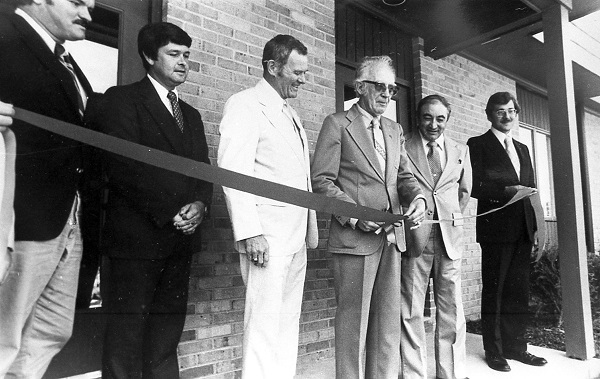
Stephens City Municipal Building ribbon cutting. L to R: State Delegate Andy Guest, Councilman Dale Barley, Congressman J. Kenneth Robinson (key note speaker), Mayor Lynn Comer, State Senator Bill Truban and Building Committee Member James Golladay Jr. on September 9 1979. Courtesy Scott Mason, Stewart Bell Jr. Archives, Handley Regional Library.
Citizens of this small but prosperous village were tightly bound by the covenants of their town code. They had to take care of the sidewalks in front of their homes and were forbidden to drink [alcohol] and fight in public. For health reasons, residents were required to eliminate stagnant water on their property. Because fire was a major threat in the days when virtually all buildings were made of wood, residents were told they had to keep a fire bucket at home and return any fire ladders they borrowed. Failure to comply with the law brought stiff fines, ranging from fifty cents to several dollars, which could amount to a whole week’s wages for some people.[3]
During this period of new government, the Town Council passed many laws to cover almost any type of offence. Citizens could be fined for “letting a horse to a mare on the town commons.”
The Town Sergeant was ordered to see that the streets were kept clear of all lumber, trash, and dead animals, regulating speed by people on horses, allowing no firing of pistols in the town, and maintaining general law and order. When the Sergeant observed the laws of the town were violated, it was his duty to apply for a warrant and proceed against said offender or offenders.
On April 16, 1859, a motion passed, “be it enacted that every tithable in the Corporation be required to pay a tax of twenty-five cents and also that a tax of five cents on every one hundred dollars’ worth of real estate within the limits of the town be paid in force from passage.”
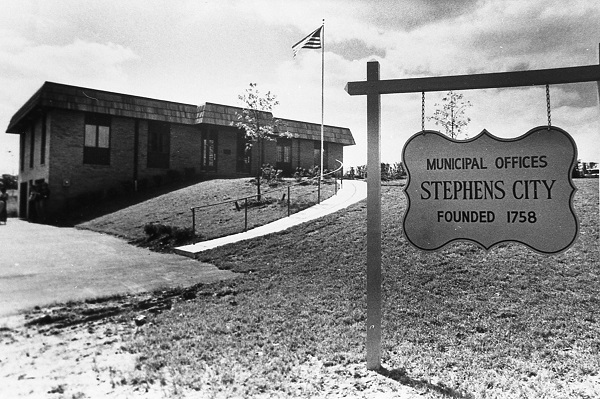
Stephens City Municipal Building on Locust Street, circa 1980. Courtesy Scott Mason, Stewart Bell Jr. Archives, Handley Regional Library.
No meeting minutes were recorded from 1861 until December 1870. The Civil War brought deprivation, horror, and loss straight into people’s homes. Perhaps the town leaders chose to wait until 1871 to elect new Trustees, when Virginia began a new era after the passage of a new constitution and reentry into the United States.
In 1871, town citizens deemed it important that something should be done in the fire department in order to secure the safety of all property in the town. A motion was passed to examine the old hand pumper fire engine to determine if it could be repaired or replaced. New fire ladders had to be procured and placed at convenient locations for all residents. Later that year, the town repaired the fire engine for twenty-five dollars and procured eight new fire ladders (of good material and made in workman like manner) for one dollar each.
Trustees of the Corporation of N. T. Stephensburg met in the counting room of Steele and Brothers on March 12, 1874 to consider a petition from the citizens and freeholders of the Corporation praying this body to grant to Green Hill N. T. Stephensburg Cemetery Company three acres of land off the southeast corner of the Town Commons for the purpose of laying out a cemetery. On motion of John W. Beaty, it was unanimously resolved that this body grant and convey by deed to Green Hill N. T. Stephensburg Cemetery Company, 3 acres of land lying west of town and deeded to said town as a lot let by Lewis Stephens, founder of said N. T. Stephensburg.
On motion of James R. Campbell, the Secretary was requested to prepare a deed of conveyance to said Green Hill Cemetery Company for the purpose of laying out and establishing a cemetery thereon.[4]
In 1876, the Town Sergeant was ordered to summon male hands from 16 to 60 to donate service to work the streets and to he be allowed $1 per day for said services. Male citizens were fined fifty cents a day for not working. Each section of town was to be worked no longer than eight days.
A meeting of Town Council met on April 8, 1880. On motion of Captain George A. Grove, a grant of one-half an acre of ground on the western side of the village on what is known as Academy Hill was made to the African American people as a burial place. The burial ground would later be named Locust Grove Cemetery.
The Winchester Telephone Company was founded in 1885 and made plans for expansion of a telephone line to Stephens City as early as 1886. Electrical service was first introduced in 1915 when a line was run from the generator plant on the Shenandoah River to the M. J. Grove Lime Company west of the town.
January 30, 1918, at a special meeting of the Council, Mr. Leslie D. Kline appeared before the Council and made a statement in reference to a new school building for African American people of Stephens City. On motion it was decided to grant one acre of land near the African American cemetery for a school building. The Council suggested that the School Board be required to pay not less than $300 an acre.
During the late 1920s, the meeting minutes became more structured to include the Treasurer’s Report by the Town Sergeant (tax collection), Street, Light and Health (sanitation) Committees and New Business.
In April 1939, Robert E. Aylor and ten others organized the Independent Hose Company. The new fire company requested financial assistance from the town council. Mayor Lomax Parker called a bond issue election for providing a water system to improve firefighting efficiency. On November 4, 1939, during a special meeting, the council voted to build the first town water system with a cost not to exceed $9,000. Prior to 1940, the town had no water system and cisterns were the primary source of water.
The Works Progress Administration (WPA) built the town’s water storage tower in July and August of 1940. The eventual bond approved by the town was for $15,500 and matched by a $13,600 grant from the WPA. The town well and storage tank were located at the north end of Germain Street.[5]
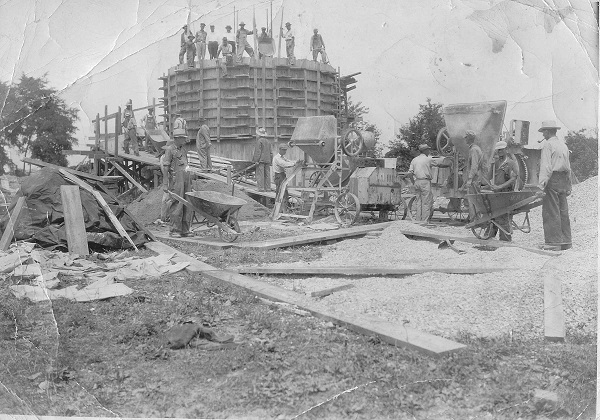
119,000-gallon water tank was forty feet high and twenty-two feet in diameter. It supported the town’s first water system completed in August 1940. Courtesy Ray Ewing.
The Independent Hose Company’s first fire engine was a 1933 Dodge 6-cylinder which the members purchased for $1,000. The truck was housed in the school basement on Main Street until members built the original one bay door section of today’s fire hall on Mulberry Street in 1941. In November 1947, the company’s name was changed to Stephens City Fire Company, Inc.
In July 1956, Mayor R. M. Wakeman called a Special Meeting of the Council to discuss a new location for the town office. A large room (former post office), in the Lemley Building would be rented out for twenty-five dollars a month with the town furnishing their own heat. E. M. Lemley agreed to remodel the office to include a new bathroom, new inside paint, front door repair, installation of new floor boards and heater replacement.
In 1962, under Mayor Lynn Comer, Council approved the plans for the sewage collection system and treatment facilities. Bond issues are discussed.
In 1962, Council passed a motion to prohibit house trailers from being placed within the town limits.
In 1963, a contract was entered between Buckley-Lages, INC. and the Town of Stephens City for the construction of the sewage disposal system.
In 1964, the State Highway Department approved a traffic light at the intersection of Route 11 (Main Street) and 277 (Fairfax Street) where many accidents had previously occurred.
Town sewer system was introduced in 1964 and rates set at ($50, $100 and $200) for connection fees.
The water tower served the town until 1966, when the town council determined it was beyond repair. The town water system was then hooked into Winchester’s 24-inch main and the old tower was demolished.[6]
In 1968, Town of Stephens City connected with the Frederick County Sheriff’s Department for their radio communication system.
Contemporary Stephens City government
According to Joyce Blevins, the Council appointed H. Bruce Edens as the first Town Manager to act as administrative head of the town on September 2, 1975. Mike Kehoe was appointed in July 1981, when the position was changed from Town Manager to Town Administrator/Engineer. “When I worked part time (1972-76), former Councilman Monte Conner was the town inspector and would review plans and sign off for the town,” Blevins said. The Town Sergeant would also assist with the daily operations of the town, before the hiring of maintenance staffer, David Denny around 1982.

Joyce J. Blevins, was hired as Deputy Town Clerk and then appointed Town Clerk and served from 1972 through 2000. Blevins collaborating with Mark Gunderman, shared her personal notes from the town council meeting minutes and newspaper articles which were essential in the writing of this article. Courtesy Marty Barley.
Former Town Manager Mike Kehoe (1981 to 2015) said that prior to his employment, Bob Harriman had worked for the town for a short period. “Before Bob, Bruce Edens, a surveyor and owner of Greenway Engineering Company, was the part time Town Manager. Prior to that Stephens City did not have an administrative head but Charlie Bass who was the superintendent of M. J. Grove Lime Company served as Engineer, which meant he reviewed plans and performed inspections and signed off on subdivision plans, etc. The Mayor and Clerk did much of the work prior to those positions,” said Kehoe.
The current Town Manager and Planner, Mike Majher, carries out policies and directs business procedures. Duties and responsibilities of the Town Manager include preparation, submittal, and administration of the capital and operating budgets; advising the Council on the affairs of the town; handling citizens’ complaints; maintenance of all personnel records; enforcement of the Town Charter and laws of the Town; and direction and supervision of all departments.[7]
[1] Linden A. Fravel, unpublished notes from Mildred Lee Grove collection of loose papers in possession of the Stone House Foundation, Stephens City, VA.
[2] National Register of Historic Places, Newtown-Stephensburg Historic District, VDHR File No. 304-1, pages 5-6, August 18, 1992.
[3] Looking Back, Though the years in minutes, Stephens City History from the files of The Winchester Star, by Linda McCarty, May 1993.
[4] Frederick County Deed Book 203, page 238.
[5] Images of America, Stephens City, by Linden A. Fravel and Byron C. Smith on behalf of the Stone House Foundation, page 86, dated 2008.
[6] Ibid, page 85.
[7] Town of Stephens City web site

Stephen Paul Sill (1955 – 2026)

Virginia Seeks Public Input for 2026 Statewide Rail Plan

Front Royal Craftsmen Revive Centuries-Old Timber Framing Tradition

Local NewsVDOT: Warren County Traffic Alert for March 16 – 20, 2026

Virginia Lawmakers End Session Without Final Budget

Your Personal Mission Statement: A Guide to Getting What You Want Out of Life

Disappointed In Our Olympic Spirit

How St. Patrick’s Day Became America’s Biggest Irish Party

Virginia State Police Urge Sober Plans for Saint Patrick’s Day Celebrations

In a One-Party County, Internal Party Decisions Affect Us All

Virginia State Police Seize Nearly 100 Pounds of Narcotics, Recover Firearms in Weekly Crime Suppression Effort

Barton Charles “Bart” Haller (1940 – 2026)

Dawn Lee Dodson (1970 – 2026)

Mary Helen “Nanny” Spires Johnt (1954 – 2026)

Another Round of ‘Momnibus’ Bills Are Headed Towards the Governor This Year

Virginia Joins States Challenging Trump Admin Regulations That Limit Free Birth Control Access

Update: Charlotte Swanson Smith (1951 – 2025)
Why We are Challenging the Republican Mass Meeting

Bruce Norman Showman (1954 – 2026)

EDA Relaunches Small Business Loan Program to Help Warren County Entrepreneurs Access Capital

Targeted Exercises to Improve Your Putting

The Hidden Risks of House Hunting Solely Online

Choosing the Right Cleaner for Every Surface in Your Home

New Church Among Consent Items at County Planning Commission Meeting
