
Local News
Fraud Alert: Public warned about increasing COVID-19 scams
The Virginia Department of Health website has the below Department of Health and Human Services (DHHS) information on fraudulent scams being circulated, not only online, but also by phone, text and in-person, door-to-door visits. The site notes that: “COVID-19 fraud is rapidly evolving” and that their information page “is frequently updated”. The below update was done on March 15 and was found under the “Media” option on informational dissemination. Also available are links to informational videos, some posted on YouTube. Below is the full text of the March 15 DHHS update on COVID-related fraud:
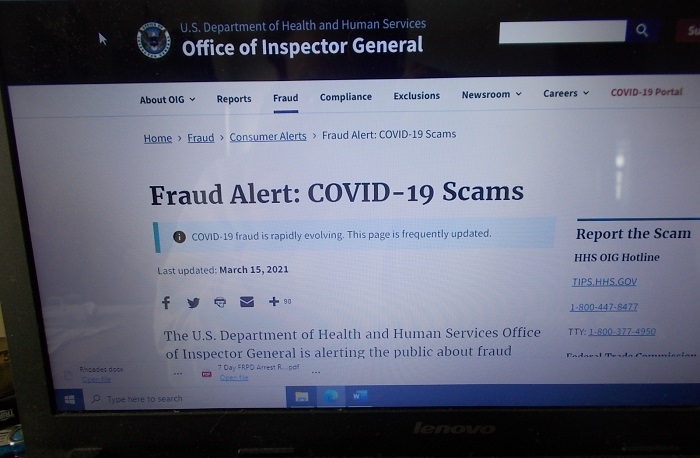
Federal and State departments are partnering to protect the public from COVID-related scams designed to access citizen health care and financial information. Photos from VDH website
The U.S. Department of Health and Human Services Office of Inspector General is alerting the public about fraud schemes related to the novel coronavirus (COVID-19). Scammers are using telemarketing calls, text messages, social media platforms, and door-to-door visits to perpetrate COVID-19-related scams.
Fraudsters are offering COVID-19 tests, HHS grants, and Medicare prescription cards in exchange for personal details, including Medicare information. However, these services are unapproved and illegitimate (Bold in context).
These scammers use the coronavirus pandemic to benefit themselves, and beneficiaries face potential harm. The personal information collected can be used to fraudulently bill federal health care programs and commit medical identity theft.
Protect Yourself
- Be mindful of how you dispose of COVID-19 materials such as syringes, vials, vial container boxes, vaccination record cards, and shipment or tracking records. Improper disposal of these items could be used by bad actors to commit fraud.
- Offers to purchase COVID-19 vaccination cards are scams. Valid proof of COVID-19 vaccination can only be provided to individuals by legitimate providers administering vaccines.
- Photos of COVID-19 vaccination cards should not be shared on social media. Posting content that includes your date of birth, health care details or other personally identifiable information can be used to steal your identity.
- Be vigilant and protect yourself from potential fraud concerning COVID-19 vaccines. You will not be asked for money to enhance your ranking for vaccine eligibility. Government and state officials will not call you to obtain personal information in order to receive the vaccine.
- Beneficiaries should be cautious of unsolicited requests for their personal, medical, and financial information. Medicare will not call beneficiaries to offer COVID-19 related products, services, or benefit review.
- Be suspicious of any unexpected calls or visitors offering COVID-19 tests or supplies. If you receive a suspicious call, hang up immediately.
- Do not respond to, or open hyperlinks in, text messages about COVID-19 from unknown individuals.
- Ignore offers or advertisements for COVID-19 testing or treatments on social media sites. If you make an appointment for a COVID-19 test online, make sure the location is an official testing site.
- Do not give your personal or financial information to anyone claiming to offer HHS grants related to COVID-19.
- Be aware of scammers pretending to be COVID-19 contact tracers. Legitimate contact tracers will never ask for your Medicare number, financial information, or attempt to set up a COVID-19 test for you and collect payment information for the test.
- If you suspect COVID-19 health care fraud, report it immediately online or call 800-HHS-TIPS (800-447-8477)

Videos accompany the VDH and DHHS anti-fraud efforts and are accessible on their websites or by online searches, including ‘DHHS COVID health care fraud alert’ or more generalized searches also accessing news coverage of the issue.

Virginia Seeks Public Input for 2026 Statewide Rail Plan

Front Royal Craftsmen Revive Centuries-Old Timber Framing Tradition

Local NewsVDOT: Warren County Traffic Alert for March 16 – 20, 2026

Virginia Lawmakers End Session Without Final Budget

Your Personal Mission Statement: A Guide to Getting What You Want Out of Life

Disappointed In Our Olympic Spirit

How St. Patrick’s Day Became America’s Biggest Irish Party

Virginia State Police Urge Sober Plans for Saint Patrick’s Day Celebrations

In a One-Party County, Internal Party Decisions Affect Us All

Virginia State Police Seize Nearly 100 Pounds of Narcotics, Recover Firearms in Weekly Crime Suppression Effort

Barton Charles “Bart” Haller (1940 – 2026)

Dawn Lee Dodson (1970 – 2026)

Mary Helen “Nanny” Spires Johnt (1954 – 2026)

Another Round of ‘Momnibus’ Bills Are Headed Towards the Governor This Year

Virginia Joins States Challenging Trump Admin Regulations That Limit Free Birth Control Access

Update: Charlotte Swanson Smith (1951 – 2025)
Why We are Challenging the Republican Mass Meeting

Bruce Norman Showman (1954 – 2026)

EDA Relaunches Small Business Loan Program to Help Warren County Entrepreneurs Access Capital

Targeted Exercises to Improve Your Putting

The Hidden Risks of House Hunting Solely Online

Choosing the Right Cleaner for Every Surface in Your Home

New Church Among Consent Items at County Planning Commission Meeting

Warren County GOP Mass Meeting Results Challenged After Allegations of Voting Irregularities
