
Local Government
Front Royal receives first installment of Corridor meals and lodging tax from County
At the first January 2017 meeting of the Warren County Board of Supervisors, County Administrator Doug Stanley verified that the County had made its first payment to the Town of Front Royal regarding the latest chapter of how the County should compensate the Town for the water and sewer utility service that has allowed commercial and industrial development to burgeon in the 340/522 North Corridor.
As Stanley reminded his Board, “Pursuant to the Memorandum of Agreement Compromise for Pilot Meals and Lodging Fees, beginning with FY2015-2016 the County agreed to … provide funding to the Town the equivalent of 30% of the meals tax and 5% of the lodging tax collected in the Corridor. Such payments were to be made in equal bi-annual payments beginning December 2016.”
So, in December the Town received a check for $113,937 on the way to a total first year payment of $227,874 based on FY2016, which ended June 30, 2016. The second installment will be paid in June 2017. A summary of the payment noted that an auditor’s report indicated the County collected $750,887 in meals tax and $52,165 in lodging tax in the corridor in FY 2016.
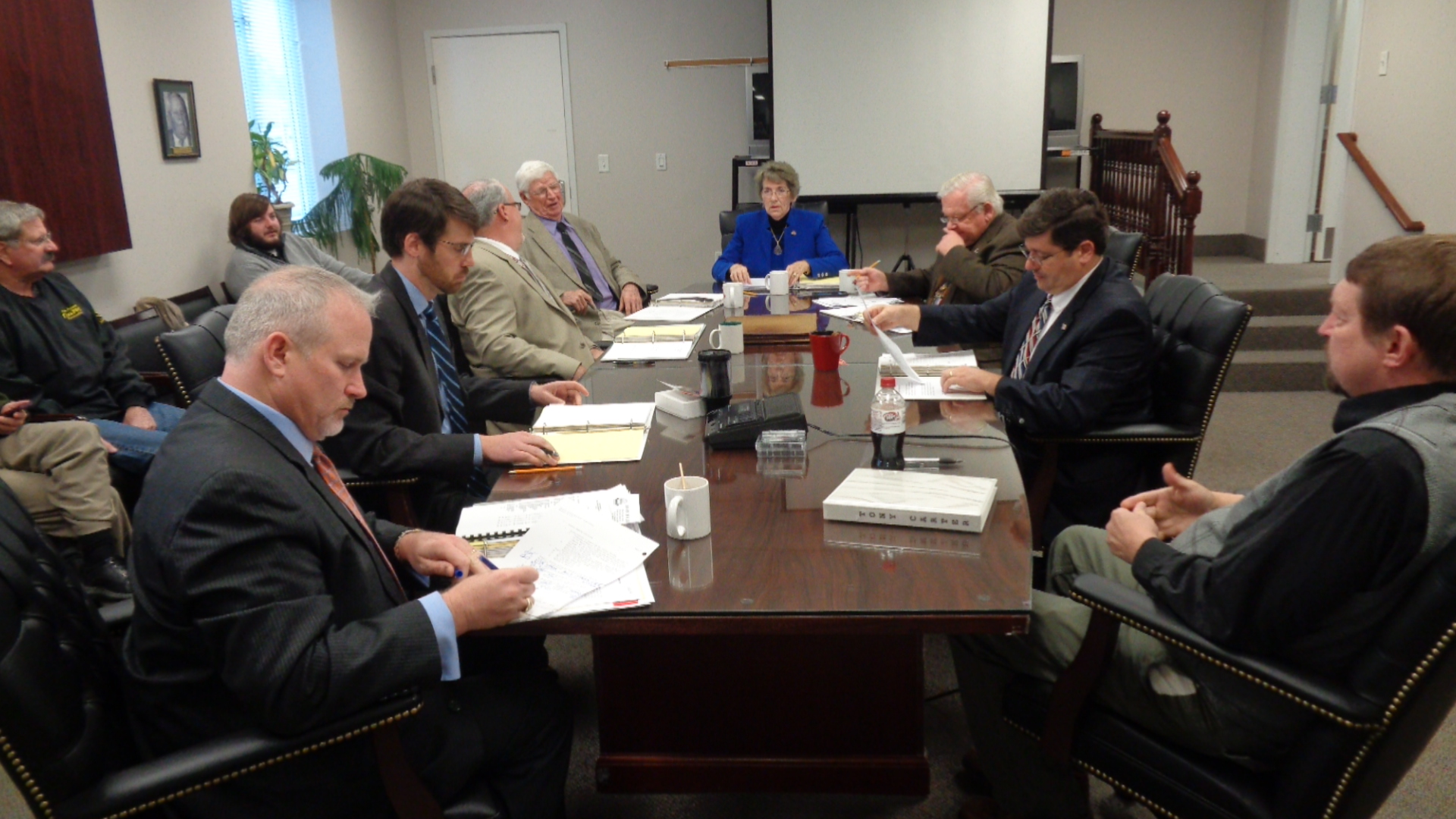
The Warren County Supervisors catch their breath between the Jan. 3 meeting, where they were briefed on the first Corridor Tax payment to the Town of Front Royal, and work session were they discussed South Warren Emergency Services funding and staffing options. Photo/Roger Bianchini
The new tax sharing plan appears to be an agreement achieved after about six years of negotiations over the Town’s loss of PILOT (Payment In Lieu Of Taxes) fees attached to its water-sewer utility bills to corridor businesses. PILOT fees were designed as part of the original Corridor Agreement to compensate the Town for lost tax revenue, primarily as it turned out meals tax.
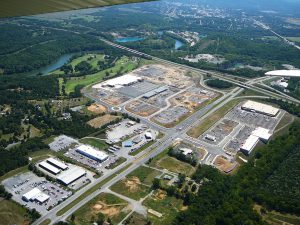
The North Corridor Shopping Centers in 2007 just before things began to get testy on taxing and fees on retail businesses, primarily restaurants. The Crooked Run Center, at right, with Target and its main commercial strip and TGIF all under roof was first to get up and running. The Lowe’s building, far left, and Cracker Barrel, center, are the lone major structures then completed in Riverton Commons. Photo/Roger Bianchini
However, in 2008 three corridor chain restaurants sued over their inclusion in their utility bills. A 2009 Court ruling agreed with the restaurants on several technical points, most prominently that meals taxes were a pay-through tax actually paid by customers, rather than a direct tax burden of the restaurant to a municipality.
Town and County elected boards have periodically battled over compensation since the initial Corridor Agreement was developed in 1998, but more pointedly once retail businesses began to open doors in 2007-08. Over the years the County agreed to pick up the Town’s portion of funding for Parks & Recreation, Animal Control, Fire & Rescue Company One (2000); Samuels Public Library and the Economic Development Authority (2013).
There also was a 1998 boundary adjustment bringing the northside McDonalds, Exxon, Dominion Fitness and Hampton Inn into the Town limits for taxing purposes; and a 2012 agreement the County would not collect BPOL (Business, Professional & Occupational Licensing) taxes in Town.
A chart provided by the County estimated a total value to the Town from those earlier assumptions as $1.38 million, with a corresponding cost to the County of $1.77 million.
However, Town officials had long argued that those services presented a double taxing burden on Town citizens who paid BOTH Town and County taxes to support services provided for the benefit of all county residents, inside and outside the Town limits. A similar situation existed for businesses inside the Town limits paying BPOL taxes to both the Town and County.
But with the new meals and lodging tax compensation agreement replacing the lost PILOT fees, we may be seeing the end of nearly a decade of sometimes contentious municipal sparring over a VERY complicated symbiotic economic relationship – not that, that relationship is getting any less complicated at fundamental levels.
I have an idea for that money
About 11 hours later at the Front Royal Town Council’s first meeting of 2017, Councilman Gene Tewalt suggested a use for that Corridor payment money in the coming year. That idea was road infrastructure repair. Tewalt told his colleagues he believed the Town has too long ignored repairs to its secondary streets – “And if we don’t soon do it, it will cost us a fortune,” he surmised.
As it is, Tewalt, a former Town Public Works Director, estimated the Town would have to add another $300,000 from its General Fund to adequately cover all the Town’s secondary street deterioration as it now stands.
Staff noted some of the Corridor money had already been committed to Community Development and the process of Community Development Block Grant acquisition. However, the total amount of that commitment was estimated at only $20,000, not a significant dent in the $227,874 Corridor Tax payment portion of Tewalt’s half-million-dollar-plus road repair proposal. As Tewalt explained, that proposal is not for repaving, but slurry sealing of the Town’s deteriorating secondary roads.

Mayor Hollis Tharpe, pink shirt, hand in air, appears excited to finally be at the Council helm. New Councilman and former EDA Board member Bill Sealock, blue shirt, seems to be absorbing his new municipal environment. Photo/Roger Bianchini
“So you’re suggesting an aggressive stand on streets,” Mayor Tharpe asked. Tewalt agreed he was, indeed, asking his colleagues to become aggressive on infrastructure repair.
John Connolly appeared to speak for those colleagues when he said he was “willing to consider” Tewalt’s suggestion.

Virginia State Police Urge Sober Plans for Saint Patrick’s Day Celebrations

In a One-Party County, Internal Party Decisions Affect Us All

Virginia State Police Seize Nearly 100 Pounds of Narcotics, Recover Firearms in Weekly Crime Suppression Effort

Barton Charles “Bart” Haller (1940 – 2026)

Dawn Lee Dodson (1970 – 2026)

Mary Helen “Nanny” Spires Johnt (1954 – 2026)

Another Round of ‘Momnibus’ Bills Are Headed Towards the Governor This Year

Virginia Joins States Challenging Trump Admin Regulations That Limit Free Birth Control Access

Update: Charlotte Swanson Smith (1951 – 2025)
Why We are Challenging the Republican Mass Meeting

Bruce Norman Showman (1954 – 2026)

EDA Relaunches Small Business Loan Program to Help Warren County Entrepreneurs Access Capital

Targeted Exercises to Improve Your Putting

The Hidden Risks of House Hunting Solely Online

Choosing the Right Cleaner for Every Surface in Your Home

New Church Among Consent Items at County Planning Commission Meeting

Warren County GOP Mass Meeting Results Challenged After Allegations of Voting Irregularities

‘This Is About Equity’: In Richmond, Virginia Workers, Lawmakers Push for Inclusive Labor Rights for All

After Five Years of Attempts, Virginia On Track to Set Up a Prescription Drug Affordability Board

New Drug Take-Back Box at Warren County Sheriff’s Office Offers Safe Way to Dispose of Medications

‘Feeding Our Neighbors’ Continues Local Effort to Provide Free Meals in Front Royal

Blair David Eller (1963 – 2026)

Writing Workshop at Samuels Public Library Aims to Help Community Communicate More Clearly

Simple Steps to Reduce Wildfire Risk Around Your Home
