
Local News
History of Stephens City’s early school days
Byron C. Smith’s article, “Where is the Grave of Samuel Kercheval? And Other Matters Relating to the Life of the ‘Herodotus of the Valley,’” Winchester-Frederick County Historical Society Journal, (2015), makes known that Stephensburg Academy was the first formal school in Stephens City. The article informs that in December 1808, the Virginia General Assembly recognized Samuel Kercheval along with twelve other prominent men from the Stephensburg community as trustees of the Stephensburg Academy. When in September 1809, and again in December of the same year, Kercheval wrote as the Secretary and a Trustee of the Academy to Thomas Jefferson requesting money to support this new community school, Jefferson politely declined.
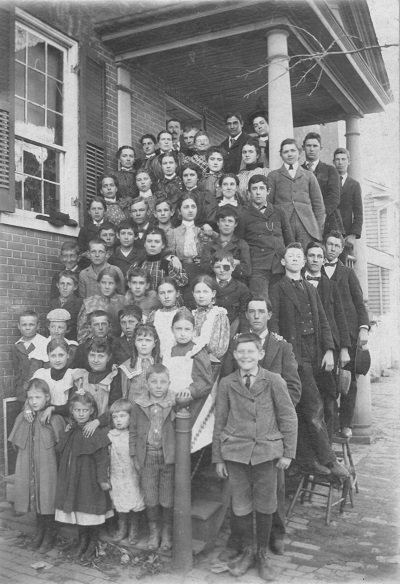
Students who attended Stephens City Academy private school at Captain Joseph Long Tavern are standing on the front steps of this building on Main and Locust Streets in 1899. Photos courtesy of Stone House Foundation.
Old Public Schools Report of Frederick County, VA, undated, compiled by James V. Hutton, Jr., cites the following; “prior to the establishment of public schools in Frederick County in 1870 pursuant to the act of the Virginia General Assembly of 1869-1870, there were many private, subscription and community Old Field schools.”
As early as 1846 a state law passed allowing Virginia counties the option of establishing “free” schools, however local voters opposed them in both 1847 and 1856. In the pre-war years and throughout the nineteenth century, many citizens preferred to minimize state involvement regarding the education of children. They believed education for all was not a function of government. Instead, they maintained such training came within the scope of the home as a family responsibility. On the family farm, parents needed their children for planting and harvesting crops, tending farm animals and a multitude of other survival chores.
In Thomas Kemp Cartmell’s book, Shenandoah Valley Pioneers and their Descendants, Chapter XXX, Educational Developments, published in 1909, Cartmell cites “When the Civil War closed, the changed conditions of the State, with her new Constitution, provided for a free school system through special taxation. We may endorse freely the principle, though we condemn much of the mismanagement, throughout the State; but in late years the subject has received more careful attention by our legislators; and rapid strides are now being made in this laudable work.”
The James V. Hutton, Jr. document cites, ”the first public schools placed in operation in 1870—1871 are not known. It is known that by the spring of 1871, the district school trustees of Stonewall, Gainesboro, Back Creek and Opequon (Shawnee had not been formed yet) established about seven free schools per district.”

Captain Joseph Long Tavern on right and McArtor store on left about 1880.
Most, if not all, were private schools converted to public use, primarily small one-room buildings, built with brick and later rusticated concrete block. The first three in the Opequon District nearest Stephens City were Canterburg, built in 1879 on Route 522 near Nineveh (conveyed by James H. Canter and wife), Painter Hill, built in 1886 on south side of Marlboro Road 2 miles west of Stephens City (conveyed by Lemuel Painter and wife) and Deerfield, built in 1888 on Marlboro Road, 4 miles west of Stephens City (conveyed by Harvey A. Richard).
During this time period, citizens of various communities had constructed many of these schools without tax monies from general county funds. Frequently land had been loaned by the owners with the understanding that it was to be used for educational purposes, reverting back to the owners if use was discontinued. Back then before busses and improved rural roads, the schools themselves had to be scattered out within walking distance of the students’ homes or they did not attend school. These community-based schools contributed to the small village cohesiveness and allowed students of farming families to travel to school by foot.
A Rosenwald elementary public school for African Americans in Stephens City was built on the northeast corner of Grove and Martin streets in 1921. The school was destroyed by arson on December 26, 1939. African American students then attended class at the St. John’s Baptist Church on the south end of Main Street until a replacement school was built at the same site in the early 1940s. Students who finished the seventh-grade then attended Douglas School in Winchester, built in 1927, which had upper grades (up to 11th grade by 1941) and was the only African American higher-grade school in Frederick County. The Douglas school closed after Winchester schools were integrated in 1966.
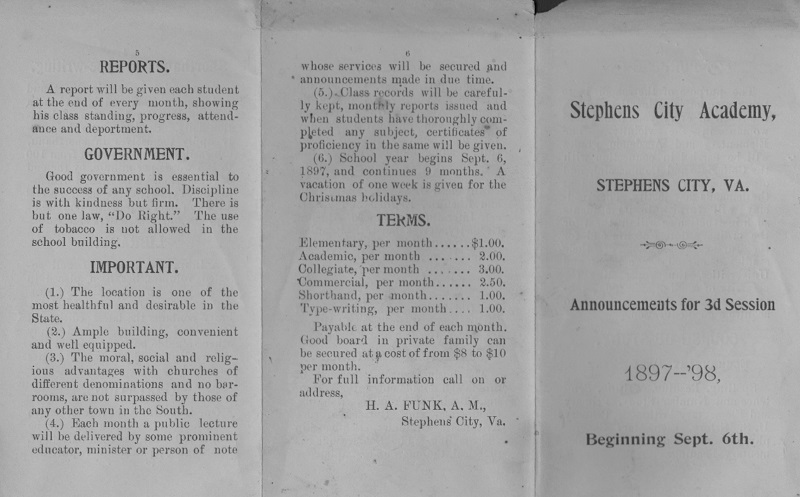
Stephens City Academy brochure for 1897-1898 school year.
According to the first annual Frederick County Public School Report, the average monthly teacher’s salary in 1871-1872 was $27.30. By 1885, the teacher’s salary had increased to $30.00 per month and in 1921 the monthly salary was $55.00.
An 1874 First Grade Teaching Certificate for the Commonwealth of Virginia required proven ability in the subjects of spelling, reading, writing, arithmetic, gramma and geography. The teacher would need to furnish satisfactory evidence of professional ability, zeal, experience and good morals and general fitness.
Byron C. Smith, Executive Director & Curator for the Newtown History Center, provided insight about local oral tradition. Tradition maintains there was a time in the late 1800s, through 1920 when children attended school buildings that served more than just students and teachers. In the rural Opequon School District which included Stephens City, churches and even private homes doubled as classrooms. One of the earlier buildings leased by the Stephens City Academy, was a brick house that once resided where the Methodist Church now stands on Main and Locust Streets. Known in the period as the old Captain Joseph Long Tavern, it was a brick Federal-style house built and licensed as a tavern in 1835. Like many hotel buildings at the time, it was used by local militia and magistrates and by town trustees for frequently scheduled meetings.
“The Joseph Long Tavern served as a private school from approximately the 1870s until 1913,” Smith said. This building was demolished to make way for the current Methodist Church which was completed in 1915. “Oral tradition also maintains that in the time between the demolition of the old Joseph Long Tavern School building in 1913 (to make way for the Methodist Church) and the opening of the Stephens City elementary/high school (5516 Main Street), students were spread out around town in different houses and buildings that leased space for classrooms,” Smith said.
One of them was at 5381 Main Street (Thornton McLeod wainwright building) where the upstairs room on the brick side of that house (warehouse space) was used as a classroom. Smith continues with local lore. “At one time there was an exterior stairway that ran up the south gable of the brick side of that house. At the top of that stairway was a door that opened into that room on the second floor. Today there are louvered shutters covering that doorway on the outside. This is the one known occurrence for buildings used as classroom space between 1913 and 1916. There could be others but we do not have any written or oral traditions about them.” It would not surprise Smith if the churches here in town served as temporary classroom space during that transition period between the demolition of the Long Tavern and the opening of the Stephens City School.
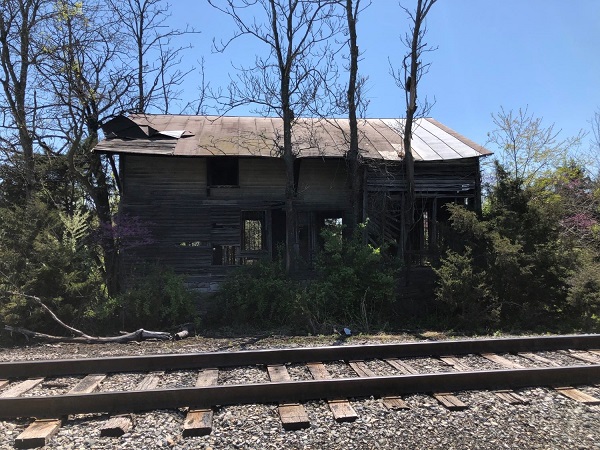
Vaucluse Train Station just south of Stephens City where both Claude and Harry Strickler attended school on the second floor in the early 1900s. A school house called High View was later built near Vaucluse in 1920. Photo courtesy Mark Gunderman.
At Vaucluse just a few miles south of Stephens City, a second-floor room of the train station functioned as a public-school classroom (approximately 1900 through 1920) for children of that neighborhood. Smith recalls a Sessions Oak Cased Drop Octagon “Schoolhouse” clock which was donated by a former Stone House Foundation board member, David Powers. Powers received the clock from the Claude Strickler estate. Powers informed Smith that both Claude and his bother Harry Strickler attended school on the second floor of that railroad station. Claude and Harry spent many afternoons watching and anxiously waiting for that clock to signal the end of the school day. Claude became a collector of railroad antiques and rescued the clock from the Vaucluse Station before it closed.
Compulsory school attendance laws were first passed in Massachusetts in 1852 and invariably spread to other sections of the country. Virginia passed its first compulsory school attendance laws in 1908. The first high school in Stephens City was built in 1916, however, children had to acquire their own transportation in order to attend. Since Frederick County was an agricultural area, many children completed their education, received their certificates at the end of 7th grade and went to work on the family farm.
During the early 20th century, the school was in session just seven months a year. Even so, attendance remained a serious problem; parent cooperation, integral to getting children to attend school, was less than robust. The state responded to the problem in 1922, when the General Assembly enacted legislation requiring student attendance and providing for the distribution of textbooks. Although mandatory attendance in Frederick County schools was not initially imposed, by the 1920s the idea of sending one’s child to school rather than to work not only was legislated and implemented but also was promoted and voluntarily accepted by increasing numbers in society.
The Later School Years
Kim Begnaud, a resident of Middletown explains how her families attending Frederick County Schools reflect their gradual evolution through the years. Her grandmother Mildred Luttrell Christian grew up in Shockeysville, Virginia and attended the Salem School (built in 1889) near Timber Ridge. The building closed in the 1930s. Her dad Jerry Christian was raised up on Cedar Creek Grade and attended Mt. Airy School until it closed in 1950, then finished up at Stephens City School. Kim lived on Perry Road and attended Stephens City Elementary until it closed in 1975, then moved on to Bass-Hoover Elementary, then Aylor Middle and James Wood High (both Amherst and Ridge Campuses), graduating in 1983. These days Stephens City students attend Sherando High School, opened in 1993.

“Christmas in April” or Overspending? Budget Draws Criticism

Court Ruling Voids Prince William Data Center Rezoning, Raising Stakes for Local Debate

Spanberger Signs First Bills Targeting Healthcare, Housing and Energy Costs

Blue Ridge Singers Spring Concerts to Showcase Powerful Blend of Voices and Brass
What Counts as “Good Policy” Depends on Who’s in Power

Planned Parenthood Presses Virginia to Restore State Funding for Contraception Program

Weapon Offenses Rise on Virginia University Campuses

Trump Steps In to Pay TSA Workers as Congress Remains Stalled

Escaping the ‘Captivity of Activity’ by Making Time to Rest

Why Wearing a Bike Helmet Matters

Wilma J. Martin (1927 – 2026)

Michael Fanning (1957 – 2026)

Spanberger Order, RNC Lawsuit Highlight Divide Over Virginia Voter Roll Maintenance

DNC Kicks Off Voter Registration Blitz, Unveils New Campaign Playbook Ahead of Midterms

Republican State Lawmakers Propose Three-Month Gas Tax Holiday in Virginia

April Star Birthdays: Famous Faces Celebrating This Month

Time to Strengthen Those Hips Again

Supervisors Discuss Evolving FY-26/27 Budget Priorities and Revenue Sources, Including Real Estate Tax Hike & Cigarette Tax

From Students to Leaders: Mountain Vista Governor’s School Hall of Fame Honors Two Graduates

Hundreds Gather in Front Royal for “No Kings Day” Rally

How Public EV Charging Stations Work

A Social Network Just for AI? Bots Chat About Life, Love and More

Out of Closed Session FR-WC EDA Approves Resolutions Regarding Evolving Property Sales and Brokerage Services

Driver Dies After Crash While Fleeing Police on I-81
