
Local Government
Industrial Well Water Prohibition Ordinance Mentioned by Jamieson at Town-County Liaison Committee Meeting
Smoothly written, evoking doctoral elegance, in which the controlling idea is the protection of a finite resource, Supervisor Richard Jamieson’s paper on groundwater is available on the Warren County website, where it serves as his defense of the Warren County Groundwater Protection Ordinance that was recently discussed at a work session of the Board of Supervisors and mentioned by Jamieson at the October 16 liaison committee meeting between Town and County. The ordinance, if implemented, would prohibit industrial users from drawing groundwater. This would, in effect, put any prospective industrial users in the corridor at the grace of the Town, insofar as the latter may or may not be inclined to extend to them a municipal water connection.

The Town-County liaison committee meeting sits down on the evening of Thursday, October 16. Royal Examiner Photo Credits: Brenden McHugh.
The rationale behind Jamieson’s paper is the importance of being proactive instead of reactive. Because depletion or pollution of this finite resource could happen in the foreseeable future, likely by a data center, this prohibition, inclusive of all industrial users, not just data centers, is a suitable solution, in his mind, to that possible problem. He highlights a worst-case scenario that took place in Georgia, where a data center impacted a neighboring well, costing the owners more than $25,000 in damages and repairs. One cannot argue with such a story except to ask whether it is a representative sample. Again, this is a data center. Should every industrial user pay a price for which only a species of the genus is truly responsible?
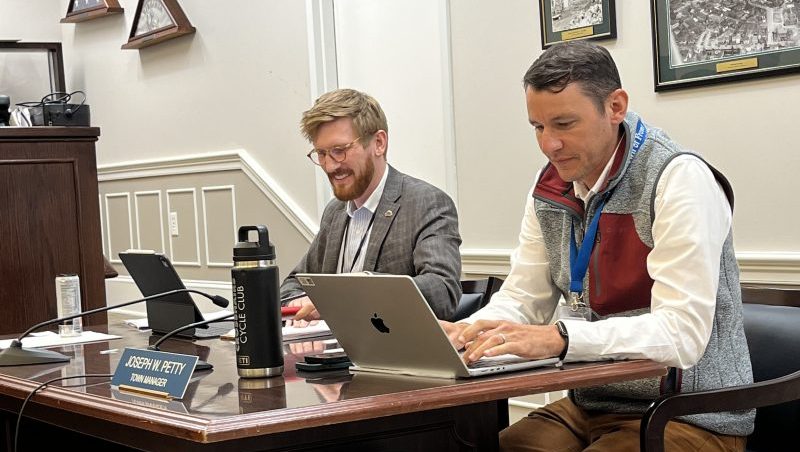
(L) County Administrator Bradley Gotshall and (R) Town Manager Joe Petty.
Apparently, newly appointed Supervisor Hugh Henry is prepared to see a difference. At the BOS work session, he cautioned against a sweeping inclusion of all industrial users in this prohibition. He expressed his willingness to concur with a restriction that targets high-volume water consumers like data centers, while leaving freedom to users with a much smaller consumption rate to draw groundwater. Whatever one thinks of data centers and wherever one falls within the ongoing debate about whether Town and County should develop performance standards for such a time in which a data center comes to this locality, it may benefit the conversation to become much more specific about who is being indicated and who is not being indicated.

James Christopher “Chris” Sain (1948 – 2026)
Alice “Maybelle” Henson (1938 – 2026)

How Sleep and Stress Affect Cancer Risk

Spanberger Signs Sweeping Public Safety and Gun Violence Bills

Horses, Fans Return as Shenandoah Downs Season Begins

Skill Games Halted Again as Spanberger Issues Veto

VDOT: Warren County Traffic Alert for April 13 – 17, 2026

The Cat Who Outlasted Six Prime Ministers

Front Royal, Virginia. Vacation Destination?

Virginia State Police Report Major Drug Seizures in Weekly Crime Suppression Effort

Virginia Secures Birth Control Access as Other Southern States Eye Abortion Pill Manufacturers

SCC Approves Loudoun Transmission Line, Nixes Undergrounding; Final Route to be Determined

Slate of New Virginia Laws Address Health Care and Housing Affordability
James J. Coverston Sr. (1942 – 2026)

Business Growth Series: Your Biggest Problem Isn’t Competition — It’s Being Overlooked

Why Many Experts Say a Concussion Should Be Called a Brain Injury

Missouri Man Arrested in Undercover Operation Targeting Online Crimes Against Children

Trump Tax Plan Credited With Higher Refunds, Lower Taxes

Spanberger Vetoes Fairfax Casino Bill, Citing Local Opposition

Blue Ridge Point-to-Point Races Return Saturday at Woodley Farm

Legislative Effort to Buy Monroe’s Loudoun Estate on Pause, Budget Effort Underway

US House Democrats Call for Congress to Come Back Into Session for Iran War Debate

Virginia to Raise Minimum Wage to $15 by 2028 Under New Law

Spanberger Signs Bills to Aid Low-Income Utility Customers, Manage Power Demand
