
Chamber News
Library, Learning, and Local Revenue: Key Issues Dominate Warren County Candidate Forum
A packed crowd filled the ballroom at the DoubleTree by Hilton on Sept. 3 as the Front Royal–Warren County Chamber of Commerce hosted a night of candidate forums. Moderator Bret Bement thanked the hotel for donating the space, the public for submitting questions, and the Royal Examiner for recording the event. He reminded the audience that the forum was nonpartisan, questions were issue-based, and candidates had no advance notice. Timed lights kept answers on track, and outbursts were not allowed.

Moderator Bret Bement
The evening began with brief remarks from candidates without opponents present. George E. Cline Jr., running unopposed for the Fork District School Board seat, introduced himself as a 1987 Warren County graduate, father of eight WCPS graduates, and a civic volunteer. He serves as president of the Warren County Builders Association, chair of the County Appeals Board, and vice chair of the Town Property Maintenance Code Board. He’s also served on the Area Agency on Aging and Habitat for Humanity boards. Cline said he will be accessible, support teachers, listen to ideas, work closely with the Board of Supervisors at budget time, and push to expand programs at the Blue Ridge Technical Center.
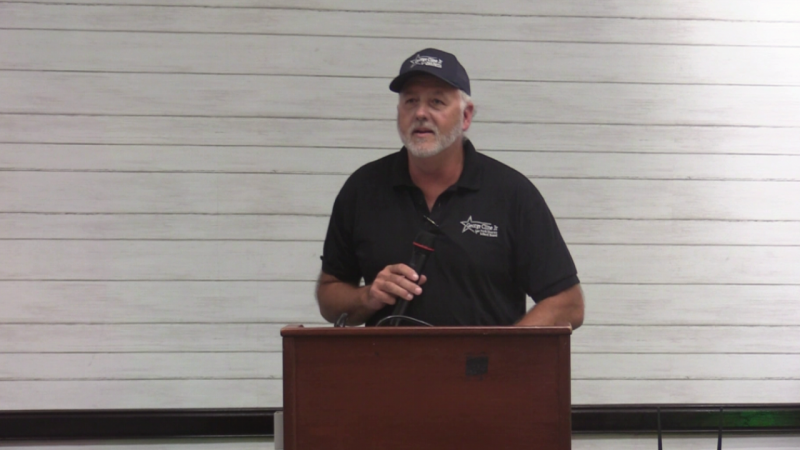
George Cline

Shane Boswell
State House candidate Shane Boswell (District 31) also addressed the crowd. A veteran who enlisted after 9/11, Boswell said he’s focused on service and problem-solving over “culture wars.” He criticized the incumbent’s voting record and said his priorities include empowering neighborhoods to control dangerous pass-through traffic on U.S. 522 and I-81, streamlining trade licensing for skilled workers, and protecting personal data. His message: “Live here, work here, and grow here.”
Happy Creek School Board: Jones vs. Stahl
The first contested forum featured Sarah Jones and Joseph “Joe” Stahl, candidates for the Happy Creek District School Board seat.
Jones, a lifelong county resident and WCPS graduate, said she’s running to strengthen classrooms by supporting teachers. “Education is the foundation of opportunity,” she said. Her top goals: teacher retention, fair and competitive pay, and meaningful professional development. She promised a collaborative, student-focused approach and more trust between the board, parents, teachers, and the community.

Joe Stahl

Sara Jones
Stahl, a retired U.S. Air Force colonel and longtime instructor, emphasized team-building and listening. Married for 30 years and a father of 12, he highlighted his 14 years of teaching pilots, coaching youth sports, and teaching high school science. “You’ve got to work with the superintendent, the parents, and the teachers,” he said. “Your door has to be open.”
Both pledged to complete the state-recommended board training within 12–18 months. Jones called herself a “lifelong learner” who would seek extra coursework on policy and law. Stahl said training is a “no-brainer.”
On teacher recruitment and retention, Stahl called teachers “the front line,” urged better pay, strong administrative backing on discipline, and resources that match different learning styles. Jones said teachers shouldn’t have to choose which bill to pay. She wants a deeper look at health insurance options, stronger exit surveys and in-person exit interviews, and safe spaces for honest feedback.
On board conduct, Jones said effective members listen, communicate respectfully, and set shared goals to guide decisions. Stahl agreed that disagreements can improve outcomes when handled like adults: “It’s our disagreements that make us better.”
Curriculum drew focus. Stahl backed the science of reading and phonics-based instruction, urging steady implementation across grades, as seen in the “Sold a Story” podcast. Jones tied stable staffing to better results in literacy and other subjects.
On student achievement, Stahl said kids learn in different ways—books, visuals, demonstrations—and need engaging instruction to stay challenged. Jones linked achievement to keeping trained teachers: frequent retraining hurts consistency and slows progress.
Both addressed absenteeism. Stahl said some students don’t come because they’re bored and not challenged; he wants instruction that pulls them back. Jones noted that missing 10% of school—about two days a month—counts as chronic absence and hurts growth. She called for healthy school climates and outreach to families to identify needs.
On safety, bullying, and discipline, Stahl called physical security “number one” and said bullying damages learning and mental health. He argued that students who disrupt should be supported in different settings. Jones agreed that safety is a major concern, but pointed to Virginia law: schools must provide an equal education to every student, and moving a student to an alternate setting requires proper process and parental permission. Stahl replied that students who pose a threat can be removed to protect others.
Asked for two opportunities and two challenges, Stahl listed safety and teacher support among the top challenges and pushed for apprenticeships with local businesses and a clearer online dashboard for communication. Jones highlighted strong career pathways—like CNA-to-nursing and law enforcement—and praised “grow your own” teacher programs and tuition support. Her chief challenge is understanding why trained educators leave.
In closing, Jones promised transparent budgeting, better pay and respect for teachers, and stronger parent communication, noting her PTO work, service on the modified calendar committee, and completion of WCPS 101. Stahl pointed to his service, recent WCPS 101 graduation, and community involvement. “The biggest way to support the community is by serving on the school board,” he said.
Board of Supervisors, Happy Creek: Carter vs. Turnmeyer
The final forum featured Tony Carter, a former five-term supervisor, and Bryan Scott Turnmeyer, a small business owner and IT professional.
Carter, a lifelong resident and insurance industry retiree, leaned on experience. He cited major projects completed during his earlier service: new schools, a public safety building, renovated parks and stadiums, a community gym, expanded fire and rescue staffing, and upgrades to elementary schools. He said the board’s role is to set policy and tax rates—not micromanage staff—and called for a return to stability after “a lot of acrimony” in recent years.

Scott Turnmeyer

Tony Carter
Turnmeyer, who runs a Main Street business with his wife, said Warren County needs new revenue to meet growing needs. He branded himself “Mr. Tourism,” arguing the county captures only a small slice of Virginia’s visitor spending. With three wealthy, nearby suburban counties an hour away, he sees a chance to draw more visitors through modern digital marketing, stronger branding with the Town of Front Royal, and destination projects. “We’ve got to bring money in first,” he said.
On homelessness, Carter favored continued partnerships with nonprofits and Social Services. Turnmeyer agreed but stressed funding: prevention, workforce housing, addiction services, and jobs all require a stronger tax base. Economic development, he said, is the path to sustaining those efforts.
On growing revenue, both discussed tourism. Carter suggested revisiting past studies and focusing on cost-effective investments. Turnmeyer said nearby communities outspend Warren County “20 to 1” on tourism marketing and urged a joint town-county push using the established Discover Front Royal brand, targeted online campaigns, and county investment in destination assets like sports complexes or an amphitheater.
Agritourism drew support from both. Turnmeyer said county rules are too tight and even hinder pick-your-own farms; he wants simpler, clearer policies for farm events and experiences that match what visitors seek. Carter said small pockets—vineyards, markets, the fairgrounds—show promise and can expand.
On public safety, both agreed that funding must keep up with rising calls. Carter noted the county has steadily added paid stations and personnel and must keep compensation competitive, even if Northern Virginia pays more. Turnmeyer, from a fire/EMS family, again tied sustained funding to economic growth, saying tourism is the quickest revenue lever while industrial projects take years to land and build.
On the Samuels Public Library, there was rare unity. Carter called the attempt to cut funding “a tremendous waste of time, money, and energy,” and said he’s running again in part to restore normal funding. Turnmeyer called the library “a phenomenal institution,” said it should be funded, and urged scrapping the newly created library board. Both warned that without new revenue, valued services—from the library to animal care—could face cuts in the future.
Asked about board conduct, Carter said disagreements should be handled respectfully and decisions made for the good of the whole county. Turnmeyer said compromise and “engaged conversation” are essential: “Five heads are better than two.” Both said the town and county must work together; Turnmeyer criticized the recent cancellation of a liaison meeting and urged voters to demand cooperation.
On accessibility, Turnmeyer pointed to his regular live social-media Q&As and pledged to reflect his district’s consensus even if he personally disagrees. Carter cited surveys, public hearings, a better county website, and traditional outreach, noting many residents commute long hours and need easy ways to be heard.
In closing, Carter said his institutional knowledge would help steady county government and restore transparency and common sense. Turnmeyer called this a “crucial time,” urging voters to back new ideas and revenue strategies: “We’ve got to stop kicking the can down the road.”
Early voting begins Sept. 19. Election Day is Nov. 4.
Watch the Front Royal-Warren County Chamber of Commerce Local Candidate Forum from September 3, 2025, in this exclusive Royal Examiner video by Mark Williams.

Man Arrested After Domestic Assault, Barricade and Fire at Shenandoah Avenue Residence

“Pink Cocaine” Emerging in U.S. Drug Market, Authorities Warn

Hike Kidz Foundation Builds Momentum with Community-First Mission and New Board of Directors

Some of History’s Biggest Discoveries Were the Result of Dumb Luck

Senators Propose Phasing Out Data Center Tax Credit, House Budget Keeps It

Lawmakers Propose Major Investments to Expand Student Aid, Limit Tuition Increases

Funeral Prearrangements: 3 Good Reasons to Plan Ahead

STEAM Night Launches Students Into Space at A.S. Rhodes Elementary School

Virginia Housing Market Sees Surge in Pending Sales to Start 2026

Is Front Royal Destined to Become Another Fairfax?

Here’s What to Know About the DHS Funding Shutdown

Lord Fairfax Health District Updates WIC Services and Expands Schedule

Poll: Virginians Back Tighter Gun Laws, Favor Current Redistricting System

What is ‘Performance-Based Regulation’, and How Can It Lower Utility Bills?

Lawmakers Reshape Youngkin’s Final Budget With Focus on Affordability, No New Taxes

El Salvador Turns to AI to Personalize Learning Nationwide

New Version of Keytruda Speeds Up Cancer Treatment, With Help From Space

Shenandoah Rail Trail Supporters Applaud CTB Move to Purchase Corridor, Launch Public Engagement

Virginia Delegate Eric Phillips Warns of Growing Strain on Power Grid, Calls for In-State Energy Expansion

Welcoming Spring Into Your Home: A Fresh Start for the Season
Government Business Shouldn’t Require a Public Display of Patriotism

March at Shenandoah River State Park: Salamanders, Wildflowers, and Nights in Nature

Blue Ridge Care Marks 45 Years, Highlights PACE Program That Helps Seniors Stay at Home
Why Trump’s Election Rhetoric Is So Dangerous
