
State News
Lynchburg GOP Sues to Overturn Virginia’s ‘Convention Ban Law’
The Lynchburg Republican City Committee (LRCC) on Tuesday filed a federal civil rights lawsuit against the Virginia Department of Elections, the State Board of Elections and Elections Commissioner Susan Beals, arguing that a 2021 law known as the “Convention Ban Law” unconstitutionally strips political parties of their First Amendment rights to freedom of speech and association.
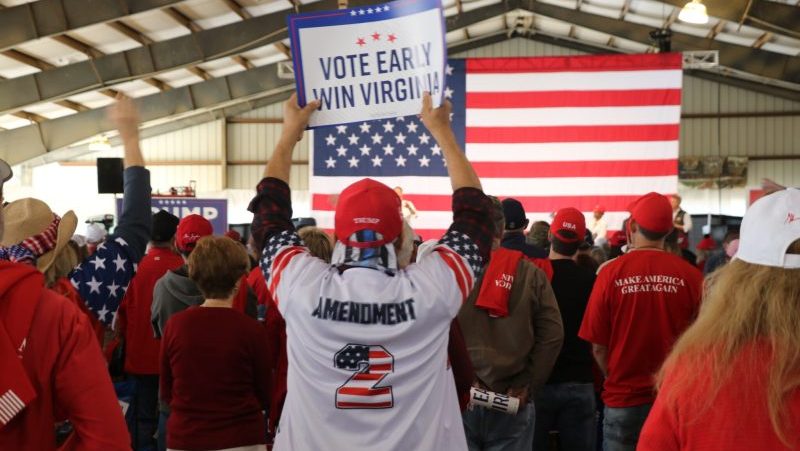
Lynchburg Republicans on Tuesday filed a federal suit seeking to overturn a new law that effectively bans party-run conventions in Virginia. (Photo by Charlotte Rene Woods/Virginia Mercury)
The lawsuit, filed in the U.S. District Court for the Western District of Virginia, comes on the heels of another pending legal challenge from within Virginia’s Republican Party. On March 1, the Republican Committee of Virginia’s 6th Congressional District voted 22-1 to pursue its own litigation against the same statute, claiming it deprives political parties of their ability to control how they nominate candidates.
At the heart of both challenges is a new section in the state code, which prohibits parties from using nomination methods that exclude voters “who are otherwise eligible to participate … but are unable to attend meetings” due to certain circumstances including having a disability, temporarily living outside the state, or experiencing a contagious disease.
The provision effectively bans long-standing party-run processes such as conventions, mass meetings, and firehouse primaries — instead mandating open, state-run primaries that do not require voter registration by political party.
“The Convention Ban Law is a direct affront to our freedom of association as a party,” said LRCC Chair Veronica Bratton.
“Until 2024, the LRCC could choose a party-run process such as a party canvass or a convention to choose its nominee. This allowed us to keep opponents of our party from participating in helping choose our candidate, or even being that candidate.”
With the new law taking effect, the commonwealth of Virginia requires Lynchburg Republicans “to allow Democrats, or even people who ran against our nominees, to choose our nominees, or even be our nominees,” Bratton said.
Bratton cited the example of Peter Alexander, who signed a statement of intent pledging to support all Republican nominees in 2024, but then ran as a write-in candidate against GOP nominee Chris Faraldi in the general election. Alexander has since formed an exploratory committee to challenge Republican City Councilwoman Stephanie Reed in 2026.
Under the Republican Party of Virginia’s Party Plan, Alexander’s support of an opponent disqualifies him from participating in Republican nomination contests for four years.
“The Party Plan makes our membership rules clear,” Bratton said. “The Convention Ban Law undermines those rules and puts our party’s integrity at risk.”
The legislation at issue — officially passed in 2021 and taking effect in January 2024 — was spearheaded by Del. Dan Helmer, D-Fairfax, and received bipartisan support. It was designed to ensure that absentee voters, including military personnel, students, and individuals with disabilities or medical vulnerabilities, are not excluded from participating in nominating processes.
Helmer defended the legislation Tuesday, arguing that the law was carefully crafted to protect the voting rights of Virginians who have historically faced barriers to participating in the electoral process.
“We crafted a law that is constitutional and that is all about the ability of service members, students and people with disabilities to be able to choose a representative,” Helmer said in a phone interview. He described the law as one that “promotes democracy,” adding, “I am confident that it will prevail in court.”
Helmer also pushed back on the political motivations he sees behind the lawsuit, linking the Lynchburg GOP’s challenge to a broader trend within the Republican Party, accusing them of undermining civil rights.
“It’s no surprise with (President Donald) Trump and (Elon) Musk attacking veterans and service members that Republicans in Lynchburg are trying to undermine their civil rights as well,” he said.
However, critics say the law goes far beyond accessibility and amounts to a state takeover of party operations.
Rick Boyer, an elections attorney with Lynchburg’s Integrity Law Firm, who is representing the LRCC, said the law “forces Republicans to allow Democrats to help choose their nominees, and vice versa,” due to Virginia’s lack of party registration and the open primary system.
“Both the U.S. and Virginia Constitutions prohibit the government from shutting down the party’s preferred speech, and from forcing it to allow its political opponents to help choose its candidates, watering down its message and weakening its chances for victory at the polls,” Boyer said.
He added that Lynchburg Republicans are confident that the Convention Ban Law is unconstitutional, and “look forward to seeing it overturned, taking power away from Richmond and returning it to local Republican activists at the grassroots level.”
The suit requests both temporary and permanent injunctive relief, asking the court to declare the law unconstitutional and to allow the LRCC to return to traditional nomination methods in time for the 2026 election cycle. With the statute already in force, all Republican nominations for 2025 have been locked in as state-run primaries, which are set for June 17.
In 2023, Virginia Attorney General Jason Miyares weighed in on the law, casting doubt on the legality of firehouse primaries.
“A political party may not select a nomination method that de facto requires covered voters to be physically present to participate or that otherwise has the practical effect of excluding their participation,” Miyares wrote in a legal opinion requested at the time by House Minority Leader Todd Gilbert, R-Shenandoah.
That opinion came amid an attempt by Lynchburg Republicans to conduct a firehouse primary for a city council race — a process that was ultimately curtailed under the looming threat of noncompliance with state law.
Still, Republican critics argue that the statute effectively nationalizes local nomination processes and disempowers grassroots organizers.
“The LRCC voted overwhelmingly to challenge the Convention Ban Law,” Bratton said. “We’re standing up for the constitutional rights of all political parties, and fighting for the grassroots of our party against the big-money Richmond interests that try to ram open primaries down the throats of the people.”
The LRCC has launched a legal defense fund to raise money for the ongoing litigation.
by Markus Schmidt, Virginia Mercury
Virginia Mercury is part of States Newsroom, a nonprofit news network supported by grants and a coalition of donors as a 501c(3) public charity. Virginia Mercury maintains editorial independence. Contact Editor Samantha Willis for questions: info@virginiamercury.com.

Stephen Paul Sill (1955 – 2026)

Virginia Seeks Public Input for 2026 Statewide Rail Plan

Front Royal Craftsmen Revive Centuries-Old Timber Framing Tradition

Local NewsVDOT: Warren County Traffic Alert for March 16 – 20, 2026

Virginia Lawmakers End Session Without Final Budget

Your Personal Mission Statement: A Guide to Getting What You Want Out of Life

Disappointed In Our Olympic Spirit

How St. Patrick’s Day Became America’s Biggest Irish Party

Virginia State Police Urge Sober Plans for Saint Patrick’s Day Celebrations

In a One-Party County, Internal Party Decisions Affect Us All

Virginia State Police Seize Nearly 100 Pounds of Narcotics, Recover Firearms in Weekly Crime Suppression Effort

Barton Charles “Bart” Haller (1940 – 2026)

Dawn Lee Dodson (1970 – 2026)

Mary Helen “Nanny” Spires Johnt (1954 – 2026)

Another Round of ‘Momnibus’ Bills Are Headed Towards the Governor This Year

Virginia Joins States Challenging Trump Admin Regulations That Limit Free Birth Control Access

Update: Charlotte Swanson Smith (1951 – 2025)
Why We are Challenging the Republican Mass Meeting

Bruce Norman Showman (1954 – 2026)

EDA Relaunches Small Business Loan Program to Help Warren County Entrepreneurs Access Capital

Targeted Exercises to Improve Your Putting

The Hidden Risks of House Hunting Solely Online

Choosing the Right Cleaner for Every Surface in Your Home

New Church Among Consent Items at County Planning Commission Meeting
